. 1998 Nov;18(11):6408-15.
doi: 10.1128/MCB.18.11.6408.

The RAG-HMG1 complex enforces the 12/23 rule of V(D)J recombination specifically at the double-hairpin formation step

Affiliations

The RAG-HMG1 complex enforces the 12/23 rule of V(D)J recombination specifically at the double-hairpin formation step

R B West et al. Mol Cell Biol. 1998 Nov.

Abstract

A central unanswered question concerning the initial phases of V(D)J recombination has been at which step the 12/23 rule applies. This rule, which governs which variable (V), diversity (D), and joining (J) segments are able to pair during recombination, could operate at the level of signal sequence synapsis after RAG-HMG1 complex binding, signal nicking, or signal hairpin formation. It has also been unclear whether additional proteins are required to achieve adherence to the 12/23 rule. We developed a novel system for the detailed biochemical analysis of the 12/23 rule by using an oligonucleotide-based substrate that can include two signals. Under physiologic conditions, we found that the complex of RAG1, RAG2, and HMG1 can successfully recapitulate the 12/23 rule with the same specificity as that seen intracellularly and in crude extracts. The cleavage complex can bind and nick 12x12 and 23x23 substrates as well as 12x23 substrates. However, hairpin formation occurs at both of the signals only on 12x23 substrates. Moreover, under physiologic conditions, the presence of a partner 23-bp spacer suppresses single-site hairpin formation at a 12-bp spacer and vice versa. Hence, this study illustrates that synapsis suppresses single-site reactions, thereby explaining the high physiologic ratio of paired versus unpaired V(D)J recombination events in lymphoid cells.


Figures
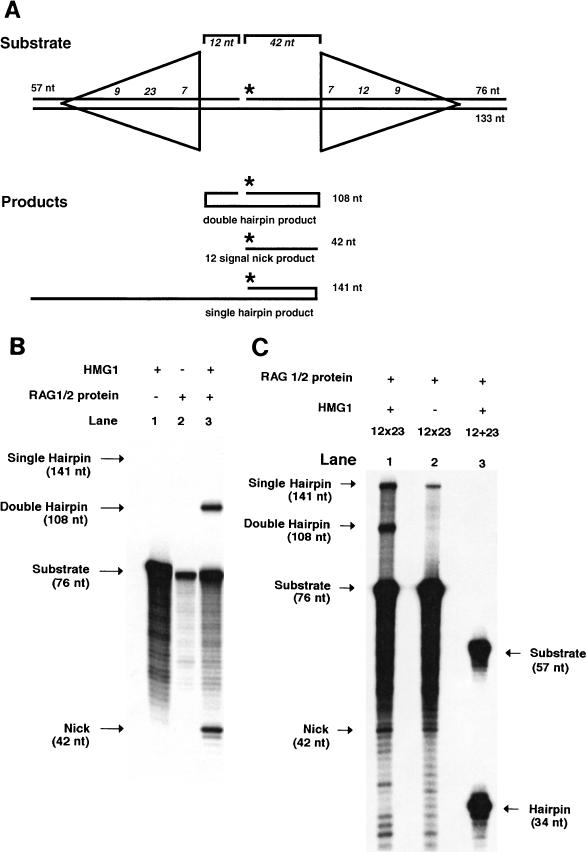
FIG. 1
FIG. 1
Concerted RAG cutting on an oligonucleotide 12×23 substrate. (A) Structure of the oligonucleotide substrate. The substrate is composed of three oligonucleotides (lines) that form the 12- and 23-signals (shown with triangles). Numbers at the ends of the oligonucleotides indicate the length of the entire adjacent oligonucleotide. Italicized numbers along the DNA strands represent the conserved signal sequences (heptamer, nonamer, and spacer) within the larger oligonucleotides. The structure of this substrate is such that there are 54 bp between the 12- and 23-signals. The brackets above and below the structure give the distances (in italics) between various landmarks, such as the edge of the signal sequence. The location of the radiolabel is denoted with a star. The structures of the nicked and double-hairpinned labeled products are shown, and the lengths of the products are given. (B) RAG1, RAG2, and HMG1 were incubated with the 12×23 substrate, and the products were separated on a 15% denaturing polyacrylamide gel. Lane 1, 12×23 substrate with HMG1 but without RAG1 and RAG2 in Mg2+ conditions; lane 2, 12×23 substrate with RAG1 and RAG2 in Mg2+ conditions; lane 3, 12×23 substrate with HMG1, RAG1, and RAG2 in Mg2+ conditions. (C) RAG1 and RAG2 were incubated with substrates in Mn2+ conditions, and the products were separated on a 15% denaturing polyacrylamide gel. Lane 1, 12×23 substrate with RAG1 and RAG2 with HMG; lane 2, 12×23 substrate with RAG1 and RAG2 alone; lane 3, single site 12 substrate with equimolar cold single site 23 substrate with RAG1 and RAG2 with HMG1.
FIG. 2
FIG. 2
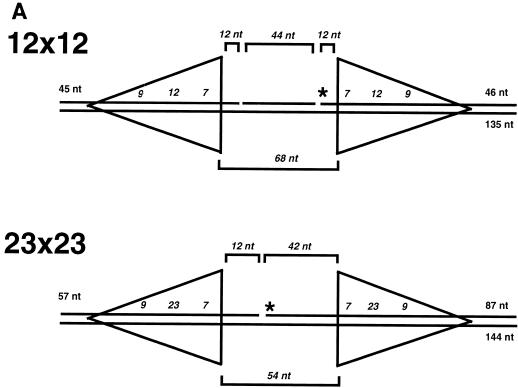
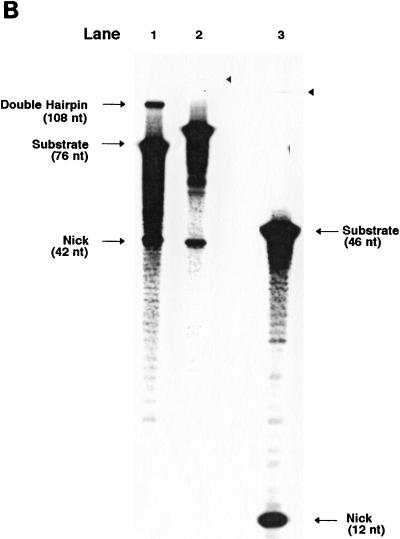
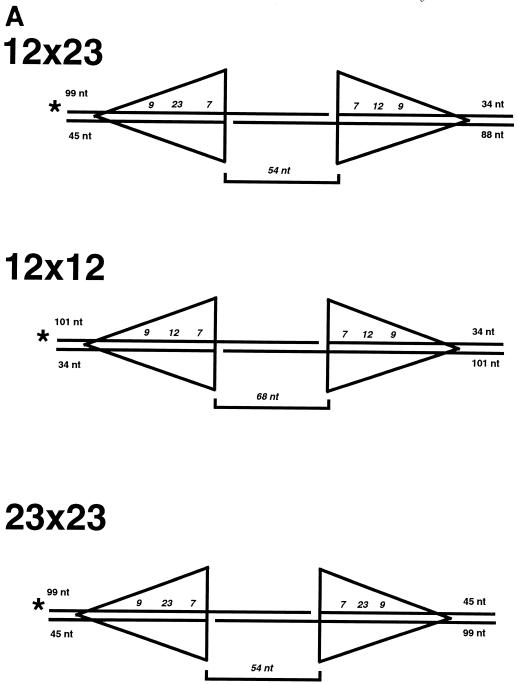
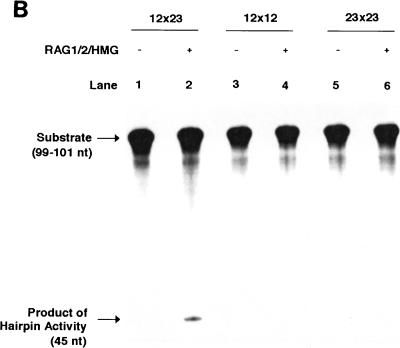
RAG nuclease activity on non-12×23 substrates: double hairpinning is efficient only on 12×23 substrates but nicking can occur on non-12×23 substrates. (A) The 12×12 and 23×23 substrate structures are shown in the same format as in Fig. 1A. (B) RAG1, RAG2, and HMG1 were incubated with the different substrates, and the products were separated on a 15% denaturing polyacrylamide gel. Lane 1, 12×23 substrate with RAG1, RAG2, and HMG1 with a Mg2+ divalent cation; lane 2, same as in lane 1 but with the 23×23 substrate; lane 3, same as in lane 1 but with the 12×12 substrate. The arrowheads mark the positions of the barely detectable single hairpin products, which are more apparent upon darker exposure (data not shown).
FIG. 2
FIG. 2
RAG nuclease activity on non-12×23 substrates: double hairpinning is efficient only on 12×23 substrates but nicking can occur on non-12×23 substrates. (A) The 12×12 and 23×23 substrate structures are shown in the same format as in Fig. 1A. (B) RAG1, RAG2, and HMG1 were incubated with the different substrates, and the products were separated on a 15% denaturing polyacrylamide gel. Lane 1, 12×23 substrate with RAG1, RAG2, and HMG1 with a Mg2+ divalent cation; lane 2, same as in lane 1 but with the 23×23 substrate; lane 3, same as in lane 1 but with the 12×12 substrate. The arrowheads mark the positions of the barely detectable single hairpin products, which are more apparent upon darker exposure (data not shown).
FIG. 3
FIG. 3
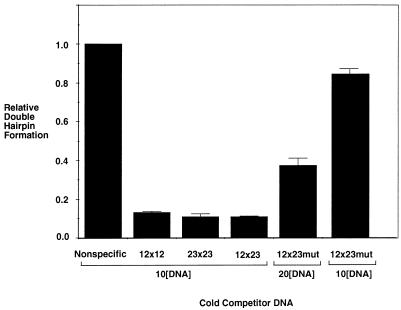
Competition assay with non-12×23 substrates: equivalent competition by 12×23, 12×12, and 23×23 substrates. HMG1 was preincubated at equimolar concentrations with a mixture of radiolabeled 12×23 substrate and a 10-fold concentration of cold competitor substrate. RAG1 and RAG2 were then added under Mg2+ conditions. The products were separated on a 15% denaturing polyacrylamide gel. The intensities of the double hairpin product and the remaining substrate were then quantified with the PhosphorImager system. The double hairpin product value was normalized to the nonspecific DNA sample, which was assigned a relative value of 1. The molar concentration of unlabeled (cold) competitor relative to labeled 12×23 substrate is shown as 10[DNA] or 20[DNA], indicating 10 or 20 times more unlabeled (cold) competitor DNA. 12×23mut designates the substrate that has an ablated nonamer at the 23-signal.
FIG. 4
FIG. 4
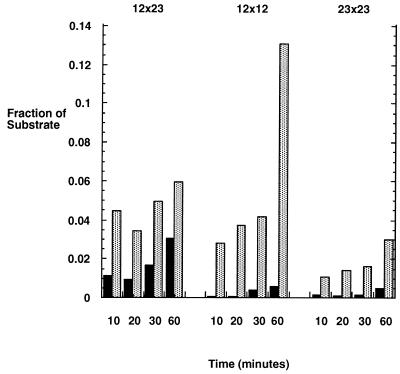
Time course of the RAG nuclease activity on non-12×23 substrates. RAG1, RAG2, and HMG1 were incubated with the 12×23, 12×12, or 23×23 substrates for 10, 20, 30, and 60 min in Mg2+ conditions. The products were separated on a 15% denaturing polyacrylamide gel. The intensities of the double hairpin and nicked products and the remaining substrate were then quantified with the PhosphorImager system. The ratio of the double hairpin product to the substrate is indicated by the black bars, and the ratio of the nicked product to the substrate is indicated by the stippled bars.
FIG. 5
FIG. 5
RAG activity on prenicked substrates. (A) The prenicked 12×23, 12×12, and 23×23 substrate structures are shown in the same format as in Fig. 1A. (B) RAG1, RAG2, and HMG1 were incubated in Mg2+ conditions with 12×23, 12×12, and 23×23 substrates which had a nick at each signal site. The products were separated on a 15% denaturing polyacrylamide gel. Lanes 1 and 2, 12×23 nicked substrate without and with RAG proteins and HMG1, respectively; lanes 3 and 4, 12×12 nicked substrate without and with RAG proteins and HMG1, respectively; lane 5 and 6, 23×23 nicked substrate without and with RAG proteins and HMG1, respectively.
FIG. 5
FIG. 5
RAG activity on prenicked substrates. (A) The prenicked 12×23, 12×12, and 23×23 substrate structures are shown in the same format as in Fig. 1A. (B) RAG1, RAG2, and HMG1 were incubated in Mg2+ conditions with 12×23, 12×12, and 23×23 substrates which had a nick at each signal site. The products were separated on a 15% denaturing polyacrylamide gel. Lanes 1 and 2, 12×23 nicked substrate without and with RAG proteins and HMG1, respectively; lanes 3 and 4, 12×12 nicked substrate without and with RAG proteins and HMG1, respectively; lane 5 and 6, 23×23 nicked substrate without and with RAG proteins and HMG1, respectively.

References

    1. Bianchi M E, Falciola L, Ferrari S, Lilley D M. The DNA binding site of HMG1 protein is composed of two similar segments (HMG boxes), both of which have counterparts in other eukaryotic regulatory proteins. EMBO J. 1992;11:1055–1063. - PMC - PubMed
    1. Eastman Q M, Leu T M J, Schatz D G. Initiation of V(D)J recombination in vitro obeying the 12/23 rule. Nature. 1996;380:85–88. - PubMed
    1. Eastman Q M, Schatz D G. Nicking is asynchronous and stimulated by synapsis in 12/23 rule-regulated V(D)J cleavage. Nucleic Acids Res. 1997;25:4370–4378. - PMC - PubMed
    1. Grawunder U, Lieber M R. A complex of RAG-1 and RAG-2 persists on the DNA after single-strand cleavage at V(D)J recombination signal sequences. Nucleic Acids Res. 1997;25:1375–1382. - PMC - PubMed
    1. Grawunder U, West R B, Lieber M R. Antigen receptor gene rearrangement. Curr Opin Immunol. 1998;10:172–180. - PubMed

Publication types

MeSH terms

LinkOut - more resources