. 1998 Nov;18(11):6423-9.
doi: 10.1128/MCB.18.11.6423.

Targeted inactivation of mouse RAD52 reduces homologous recombination but not resistance to ionizing radiation

Affiliations

Targeted inactivation of mouse RAD52 reduces homologous recombination but not resistance to ionizing radiation

T Rijkers et al. Mol Cell Biol. 1998 Nov.

Abstract

The RAD52 epistasis group is required for recombinational repair of double-strand breaks (DSBs) and shows strong evolutionary conservation. In Saccharomyces cerevisiae, RAD52 is one of the key members in this pathway. Strains with mutations in this gene show strong hypersensitivity to DNA-damaging agents and defects in recombination. Inactivation of the mouse homologue of RAD52 in embryonic stem (ES) cells resulted in a reduced frequency of homologous recombination. Unlike the yeast Scrad52 mutant, MmRAD52(-/-) ES cells were not hypersensitive to agents that induce DSBs. MmRAD52 null mutant mice showed no abnormalities in viability, fertility, and the immune system. These results show that, as in S. cerevisiae, MmRAD52 is involved in recombination, although the repair of DNA damage is not affected upon inactivation, indicating that MmRAD52 may be involved in certain types of DSB repair processes and not in others. The effect of inactivating MmRAD52 suggests the presence of genes functionally related to MmRAD52, which can partly compensate for the absence of MmRad52 protein.


Figures
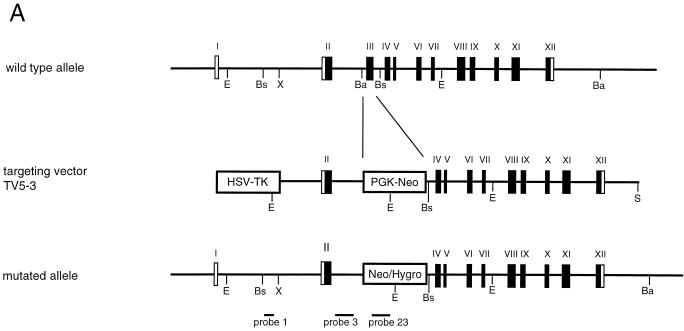
FIG. 1
FIG. 1
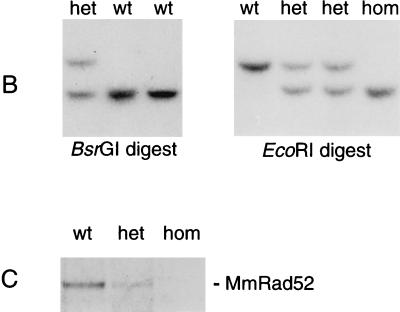
Disruption of the MmRAD52 gene. (A) Schematic representation of the MmRAD52 locus, the targeting vector, and the targeted locus. All coding exons are indicated by numbered solid boxes, and noncoding (parts of) exons are shown as open boxes. Relevant EcoRI (E), BsrGI (Bs), XbaI (X), BamHI (Ba), and SacII (S) restriction sites and the positions of the probes used for Southern blot analysis are indicated. (B) Southern blots of DNA from targeted ES cell clones after electroporation of the cells with targeting vector TV5-3 and digestion of the genomic DNA with BsrGI (left) and subsequently with targeting vector TV7-11 and digestion with EcoRI (right). Both blots were hybridized with probe 1. (C) Western blot of whole-cell extracts from MmRAD52+/+, MmRAD52+/−, and MmRAD52−/− ES cells, incubated with a 1:10,000 dilution of crude anti-MmRad52 antiserum.
FIG. 1
FIG. 1
Disruption of the MmRAD52 gene. (A) Schematic representation of the MmRAD52 locus, the targeting vector, and the targeted locus. All coding exons are indicated by numbered solid boxes, and noncoding (parts of) exons are shown as open boxes. Relevant EcoRI (E), BsrGI (Bs), XbaI (X), BamHI (Ba), and SacII (S) restriction sites and the positions of the probes used for Southern blot analysis are indicated. (B) Southern blots of DNA from targeted ES cell clones after electroporation of the cells with targeting vector TV5-3 and digestion of the genomic DNA with BsrGI (left) and subsequently with targeting vector TV7-11 and digestion with EcoRI (right). Both blots were hybridized with probe 1. (C) Western blot of whole-cell extracts from MmRAD52+/+, MmRAD52+/−, and MmRAD52−/− ES cells, incubated with a 1:10,000 dilution of crude anti-MmRad52 antiserum.
FIG. 2
FIG. 2
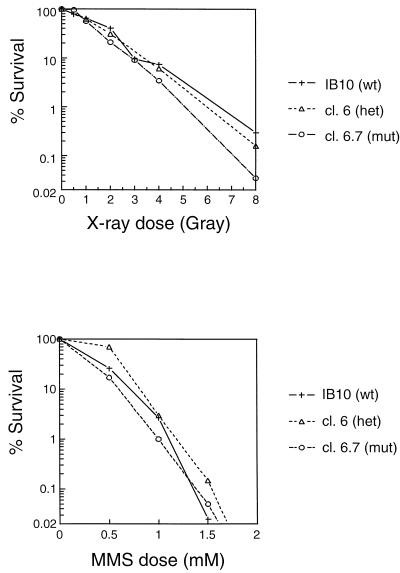
X-ray and MMS survivals of wild-type and targeted ES cells. The survival curves of the MmRAD52+/+ (IB10), MmRAD52+/− (clone 6), and MmRAD52−/− (clone 6.7) ES cell lines are shown. The percentage of surviving, colony-forming cells is plotted as a function of X-ray (top) or MMS (bottom) dose. Cloning efficiencies varied from 9 to 30%, and the survival of the untreated cells was set to 100%. The data in the upper graph represent the average of seven independent X-ray exposure experiments; the lower graph depicts a typical MMS survival experiment (performed twice). Experiments with an independently derived MmRAD52−/− ES cell line gave similar results.
FIG. 3
FIG. 3
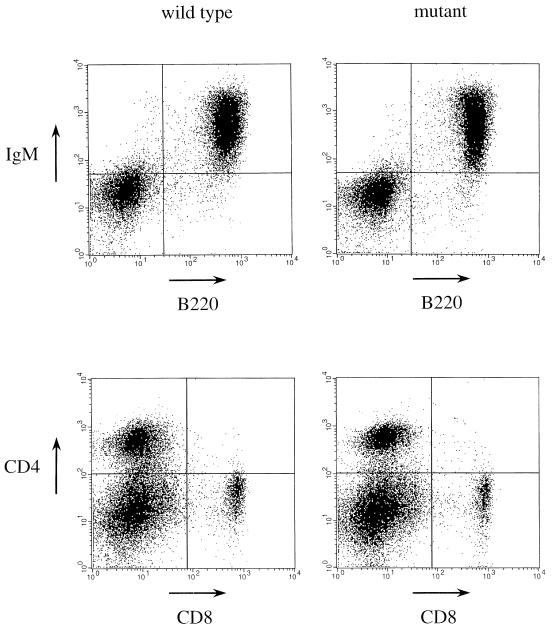
Flow cytometric analysis of splenic lymphocytes. Flow cytometry results for splenic lymphocytes isolated from a wild-type mouse (left) and an MmRAD52−/− null mutant mouse (right) are shown. The cells were stained with the B-cell markers anti-B220 and anti-IgM antibodies (top) or with the T-cell markers anti-CD4 and anti-CD8 antibodies (bottom).

References

    1. Akaboshi E, Inoue Y, Ryo H. Cloning of the cDNA and genomic DNA that correspond to the recA-like gene of Drosophila melanogaster. Jpn J Genet. 1994;69:663–670. - PubMed
    1. Bai Y, Symington L S. A Rad52 homolog is required for RAD51-independent mitotic recombination in Saccharomyces cerevisiae. Genes Dev. 1996;10:2025–2037. - PubMed
    1. Baumann P, Benson F E, West S C. Human Rad51 protein promotes ATP-dependent homologous pairing and strand transfer reactions in vitro. Cell. 1996;87:757–766. - PubMed
    1. Bendixen C, Sunjevaric I, Bauchwitz R, Rothstein R. Identification of a mouse homologue of the Saccharomyces cerevisiae recombination and repair gene, RAD52. Genomics. 1994;23:300–303. - PubMed
    1. Bennett C B, Lewis A L, Baldwin K K, Resnick M A. Lethality induced by a single site-specific double-strand break in a dispensable yeast plasmid. Proc Natl Acad Sci USA. 1993;90:5613–5617. - PMC - PubMed

Publication types

Substances