Implications of applying widely accepted cholesterol screening and management guidelines to a British adult population: cross sectional study of cardiovascular disease and risk factors
- PMID: 9784450
- PMCID: PMC28695
- DOI: 10.1136/bmj.317.7166.1125
Implications of applying widely accepted cholesterol screening and management guidelines to a British adult population: cross sectional study of cardiovascular disease and risk factors
Abstract
Objective: To compare the implications of four widely used cholesterol screening and treatment guidelines by applying them to a population in the United Kingdom.
Design: Guidelines were applied to population based data from a cross sectional study of cardiovascular disease and risk factors.
Setting: Newcastle upon Tyne, United Kingdom.
Subjects: General population sample (predominantly of European origin) of 322 men and 319 women aged 25-64 years.
Main outcome measures: Proportions recommended for screening and treatment.
Methods: Criteria from the British Hyperlipidaemia Association, the British Drugs and Therapeutics Bulletin (which used the Sheffield table), the European Atherosclerosis Society, and the American national cholesterol education programme were applied to the population.
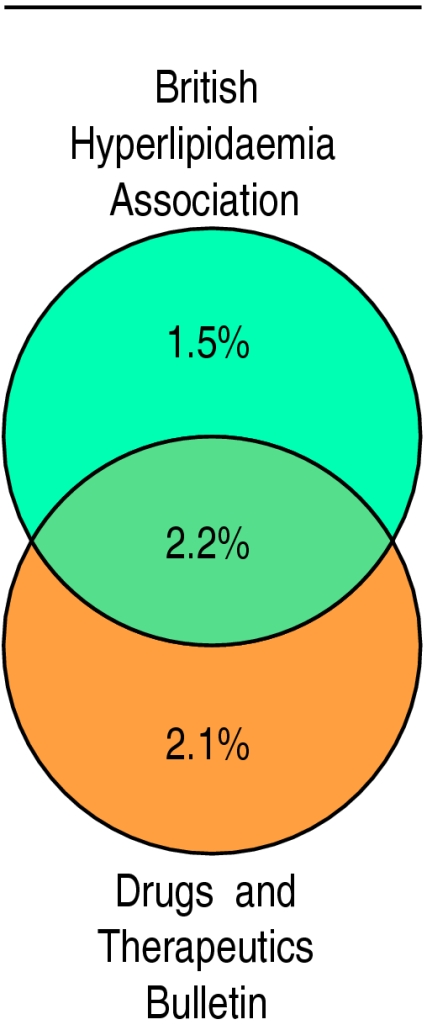
Results: Proportions recommended for treatment varied appreciably. Based on the British Drugs and Therapeutics Bulletin guidelines, treatment was recommended for 5.3% (95% confidence interval 2.9% to 7.7%) of men and 3.3% (1.5% to 5.3%) of women, while equivalent respective values were 4.6 (2.3 to 6.9) and 2.8 (1.0 to 4.6) for the British Hyperlipidaemia Association, 23% (18.4% to 27.6%) and 10.6% (7.3% to 14.0%) for the European Atherosclerosis Society, and 37.2% (31.9% to 42.5%) and 22.2% (17.6% to 26.8%) for the national cholesterol education programme. Only the British Hyperlipidaemia Association and Drugs and Therapeutics Bulletin guidelines recommend selective screening. Applying British Hyperlipidaemia Association guidelines, from 7.1% (4.3% to 9.9%) of men in level one to 56.7% (51.3% to 62.1%) of men in level three, and from 4.4% (2.1% to 6.7%) of women in level one to 54.4% (48.9% to 59.9%) of women in level three would have been recommended for cholesterol screening. Had the Drugs and Therapeutics Bulletin guidelines been applied, 22.2% (16.5% to 27.9%) of men and 12.2% (8. 6% to 15.8%) of women would have been screened.
Conclusions: Without evidence based guidelines, there are problems of variation. A consistent approach needs to be developed and agreed across the United Kingdom.
Figures
Comment in
-
Cholesterol screening and management guidelines. Having several guidelines is confusing.BMJ. 1999 Apr 24;318(7191):1140. doi: 10.1136/bmj.318.7191.1140a. BMJ. 1999. PMID: 10213742 Free PMC article. No abstract available.
-
Cholesterol screening and management guidelines. Policy based on Sheffield table fully satisfies authors' criteria.BMJ. 1999 Apr 24;318(7191):1140-1. BMJ. 1999. PMID: 10366266 No abstract available.
References
-
- NHS Centre for Reviews and Dissemination. Implementing clinical practice guidelines. Effective Health Care 1994;4(1).
-
- Grimshaw J, Russell I. Effect of clinical guidelines on medical practice: A systematic review of rigorous evaluations. Lancet. 1993;342:1317–1322. - PubMed
-
- Ramsay L, Haq I, Jackson P, Yeo W. The Sheffield table for primary prevention of coronary heart disease: corrected. Lancet. 1996;348:1251–1252. - PubMed
-
- Standing Medical Advisory Committee. The use of statins. London: Standing Medical Advisory Committee; 1997.
Publication types
MeSH terms
Substances
LinkOut - more resources
Full Text Sources
Medical