. 1998 Nov 1;18(21):9112-29.
doi: 10.1523/JNEUROSCI.18-21-09112.1998.

Neural learning rules for the vestibulo-ocular reflex

Collaborators, Affiliations

Neural learning rules for the vestibulo-ocular reflex

J L Raymond et al. J Neurosci. .

Abstract

Mechanisms for the induction of motor learning in the vestibulo-ocular reflex (VOR) were evaluated by recording the patterns of neural activity elicited in the cerebellum by a range of stimuli that induce learning. Patterns of climbing-fiber, vestibular, and Purkinje cell simple-spike signals were examined during sinusoidal head movement paired with visual image movement at stimulus frequencies from 0.5 to 10 Hz. A comparison of simple-spike and vestibular signals contained the information required to guide learning only at low stimulus frequencies, and a comparison of climbing-fiber and simple-spike signals contained the information required to guide learning only at high stimulus frequencies. Learning could be guided by comparison of climbing-fiber and vestibular signals at all stimulus frequencies tested, but only if climbing fiber responses were compared with the vestibular signals present 100 msec earlier. Computational analysis demonstrated that this conclusion is valid even if there is a broad range of vestibular signals at the site of plasticity. Simulations also indicated that the comparison of vestibular and climbing-fiber signals across the 100 msec delay must be implemented by a subcellular "eligibility" trace rather than by neural circuits that delay the vestibular inputs to the site of plasticity. The results suggest two alternative accounts of learning in the VOR. Either there are multiple mechanisms of learning that use different combinations of neural signals to drive plasticity, or there is a single mechanism tuned to climbing-fiber activity that follows activity in vestibular pathways by approximately 100 msec.


Figures
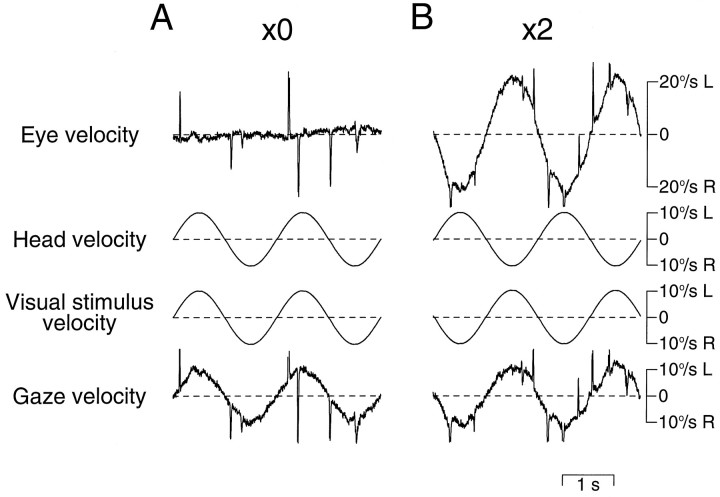
Fig. 1.
Fig. 1.
Stimuli that induce learned decreases (×0, A) and increases (×2, B) in the gain of the VOR. Fromtop to bottom, the tracesare eye velocity with respect to the orbit, angular head velocity in space, visual stimulus velocity in space, and gaze velocity in space. Gaze velocity was computed as the sum of head velocity in space plus eye velocity in the orbit. In all traces, upward deflections represent leftward position or velocity (L); downward deflectionsrepresent rightward position or velocity (R). The brief deflections in the eye and gaze velocity tracesare caused by saccadic eye movements; their amplitudes have been cropped. The frequency of the stimuli is 0.5 Hz.
Fig. 2.
Fig. 2.
Histograms showing the simple-spike activity recorded in a representative Purkinje cell during stimuli that induce learned decreases (×0, A,B) and increases (×2, C,D) in the gain of the VOR. Head velocity, Angular head velocity in the horizontal plane. Vertical dashed lines mark peak contraversive and ipsiversive head velocity. Note the different time scales in the left(A, C) and right(B, D) panels, which show data for sinusoidal stimuli at 0.5 and 5 Hz, respectively. Twenty to 500 stimulus cycles were averaged to obtain each histogram. The simplified circuit diagram on the left highlights the loci of vestibular and Purkinje cell (PC) simple-spike signals in the circuit for the VOR.
Fig. 3.
Fig. 3.
Summary of Purkinje cell simple-spike responses, plotted relative to the vestibular stimulus. Each plot compares responses during ×0 stimuli and ×2 stimuli at the single frequency indicated in the bottom right quadrant. Each point represents the simple-spike activity recorded in a single Purkinje cell, plotted in polar coordinates with distance from the origin corresponding to the amplitude of response modulation and an angle corresponding to the phase shift between peak simple-spike activity and head velocity. Responses in phase with peak ipsiversive head velocity are plotted to the right of the origin, responses in phase with peak contraversive head velocity are plotted to theleft of the origin, and clockwise rotation around the graph represents increased phase lead. An individual Purkinje cell contributed two symbols for each stimulus frequency: a + (monkey D) or X (monkey E)symbol for the ×0 stimulus, and a filled square (monkey D) or filled triangle (monkey E) for the ×2 stimulus. The plots in A–D are on the same scale, with inner and outer circles representing 10 simple spikes/sec (SS/s) and 50 simple spikes/sec, respectively.
Fig. 4.
Fig. 4.
Histograms showing climbing-fiber activity during stimuli that induce learned decreases (×0,A, B) and increases (×2,C, D) in the gain of the VOR. Climbing-fiber activity was recorded as complex spikes in the representative Purkinje cell whose simple-spike responses are shown in Figure 2. Climbing-fiber responses from 20–500 stimulus cycles were averaged to obtain each histogram. Note the different time scales in the left (A, C) andright (B, D)panels, which show data for sinusoidal stimuli at 0.5 and 5 Hz, respectively. Vertical dashed lines mark peak contraversive and ipsiversive head velocity. The simplified circuit diagram on the left highlights the loci of vestibular signals and climbing-fiber (CF) signals in the circuit for the VOR. IO, Inferior olive.
Fig. 5.
Fig. 5.
Summary of climbing-fiber responses, plotted relative to the vestibular stimulus. A–D, Climbing-fiber responses to stimulus frequencies of 0.5, 2, 5, and 10 Hz. Responses are plotted in polar coordinates, with distance from the origin corresponding to the amplitude of response modulation and an angle corresponding to the phase shift between peak climbing-fiber activity and head velocity. Responses in phase with peak ipsiversive head velocity are plotted to the right of the origin, responses in phase with peak contraversive head velocity are plotted to the left of the origin, and clockwise rotation around the graph represents increased phase lead. An individual climbing fiber contributed two symbols for each stimulus frequency: a + (monkey D) or X (monkey E)symbol for the ×0 stimulus, and a filled square (monkey D) or a filled triangle (monkey E) for the ×2 stimulus. R×0 marks the point in the vestibular stimulus leading peak contraversive head velocity by 46°, and R×2 marks the point in the vestibular stimulus leading peak ipsiversive head velocity by 46°. Open arrows show the predicted phase at each frequency for a fixed delay in the climbing-fiber response of 122 msec from R×0. Filled arrowsshow the predicted phase at each frequency for a fixed delay in the climbing-fiber response of 122 msec fromR×2. In all panels, inner and outer circles represent 1 climbing-fiber spike per second (CFR/s) and 2 climbing-fiber spikes/sec, respectively. Note the difference in scale from Figure 3.
Fig. 6.
Fig. 6.
Schematic showing several simulated vestibular parallel-fiber (PF) inputs to a single Purkinje cell (PC). The trace above each parallel fiber shows its activity during sinusoidal head rotation about a vertical axis. The dashed vertical line marks the time of peak ipsiversive head velocity. Activity inPFϕ lags peak ipsiversive head velocity by ϕ degrees. Each PFϕ synapses onto the Purkinje cell with a weight wϕ.
Fig. 7.
Fig. 7.
Predicted learned changes in the VOR for a reduction in the weight of parallel fibers that fire at different phases of the vestibular stimulus. Traces representing the variables in Equations 3-7 are shown for a reduction in the weight of a parallel fiber whose activity peaks during ipsiversive head velocity (A, Δw0 = −0.5), for a reduction in the weight of a parallel fiber whose activity lags ipsiversive head velocity by 90° (B, Δw90 = −0.5), and for a reduction in the weight of a parallel fiber whose activity peaks during contraversive head velocity (C, Δw180 = −0.5). H, Head velocity;PF0 , PF90 , PF180, activity in parallel fibers lagging ipsiversive head velocity by 0° (A), 90° (B), and 180° (C); ΔPC, learned change in activity of the Purkinje cell evoked by the vestibular stimulus; ΔVOR, learned change in the VOR-driven eye velocity;VORpre, eye velocity driven by vestibular stimulus before learning (dashed traces);VORpost, eye velocity driven by vestibular stimulus after learning (solid traces). For H, ΔVOR,VORpre, and VORposttraces, upward deflection represents ipsiversive (I) head or eye velocity, anddownward deflection represents contraversive (C) head or eye velocity. For PFand ΔPC traces, upward anddownward deflections represent increases and decreases in neural activity. Vertical dashed lines inA, B, and C mark the time of peak activity in PF0,PF90, PF180, respectively.
Fig. 8.
Fig. 8.
Predicted learned changes in the gain (A) and phase (B) of the VOR, plotted as a function of the phase of the vestibular parallel fiber (PF) undergoing synaptic depression (LTD) (Eq. 7, Δwϕ = −0.1). Peak activity in a parallel fiber of phase 0° coincides with peak ipsiversive head velocity. Larger phase values correspond to parallel fibers with progressively more lag relative to head velocity.A, Change in the gain of the VOR, plotted as the gain after synaptic depression divided by the gain before synaptic depression. Values greater than one represent increases in gain; values less than one represent decreases in gain. B, Change in the phase of the VOR, plotted as the difference between the phase before synaptic depression and the phase after depression. Positive values represent increased phase lag (in degrees), negative values represent increased phase lead.
Fig. 9.
Fig. 9.
Predicted synaptic and behavioral changes produced by a plasticity mechanism driven by simultaneous activity in climbing fibers and vestibular parallel fibers. Spike trains from the typical climbing fiber, whose responses are shown in Figure 4, were used as the input to the simultaneous plasticity mechanism (Eq. 8). Open symbols, Predicted changes for the climbing fiber spike trains present during ×0 stimuli; filled symbols, predicted changes for the climbing fiber spike trains present during ×2 stimuli.A, Predicted changes in the synaptic weights of parallel fibers that fire at different phases of the vestibular stimulus.A1, Changes predicted for 0.5 Hz stimuli.A2, Changes predicted for 5 Hz stimuli.B, Phase of the parallel fiber undergoing largest weight reduction (LTD) as a function of the stimulus frequency. Thethin vertical lines to the right of the graph mark the range of phases for ×0 stimuli at frequencies of 0.5, 2, 5, and 10 Hz, and the thick vertical lines represent the range of phases for ×2 stimuli. C, Predicted change in the gain of the VOR as a function of stimulus frequency.Arrows of the same style mark results corresponding to the same simulation.
Fig. 10.
Fig. 10.
Predicted synaptic and behavioral changes for a plasticity mechanism driven by nonsimultaneous activity in climbing fibers and vestibular parallel fibers. Spike trains from the typical climbing fiber in Figure 4 were used as the input to the nonsimultaneous plasticity mechanism (Eq. 9). Reduction in the parallel-fiber weights was proportional to the activity in the parallel fiber at some interval (TPF-CF) before a spike in the climbing fiber. Results are shown for three different values of TPF-CF: 50, 100, and 200 msec. A–C, Phase of the parallel fiber undergoing largest synaptic weight reduction as a function of the stimulus frequency. The thin vertical lines to theright of each graph mark the range of phases for ×0 stimuli at frequencies of 0.5, 2, 5, and 10 Hz, and the thick vertical lines represent the range of phases for the ×2 stimuli. D–F, Predicted change in the gain of the VOR as a function of stimulus frequency. Open symbols, Predicted changes for the climbing-fiber spike trains present during ×0 stimuli; filled symbols, predicted changes for the climbing-fiber spike trains present during ×2 stimuli.
Fig. 11.
Fig. 11.
Range of PF-CF intervals (range of values forTPF-CF) yielding appropriate changes in the VOR. Spike trains from the typical climbing fiber in Figure 4 were used as the input to the nonsimultaneous plasticity mechanism (Eq. 9). Predicted changes in the gain of the VOR for ×0 stimuli (A–D) and ×2 stimuli (E–H) are plotted as a function of the value ofTPF-CF. A, E, Predictions for 0.5 Hz stimuli. B, F, Predictions for 2 Hz stimuli (bold traces) and 0.5 Hz stimuli (thin traces). C,G and D, H, Predictions for 5 and 10 Hz stimuli (bold traces), with predictions for lower frequencies replotted (thin traces).Shaded regions in each graph mark the range of values for TPF-CF that yielded appropriate predicted changes in the gain of the VOR for all stimuli at or below the indicated frequency.
Fig. 12.
Fig. 12.
Range of PF-CF intervals (range of values forTPF-CF) that yielded appropriate predicted changes in the gain of the VOR for all four stimulus frequencies tested (0.5, 2, 5, and 10 Hz). Each linerepresents the range of effective values ofTPF-CF for one individual climbing fiber.A, Range of values of TPF-CFthat yielded decreases in gain in response to ×0 stimuli.B, Range of values of TPF-CFthat yielded increases in gain in response to ×2 stimuli.
Fig. 13.
Fig. 13.
Predicted synaptic and behavioral changes for a simultaneous plasticity mechanism when a 100 msec delay was introduced in the vestibular parallel-fiber signals. Predictions were calculated for ×2 stimuli at 0.5 and 5 Hz, using two parallel fibers whose vestibular signals lagged ipsiversive or contraversive head velocity by 100 msec. H, Head velocity;AFFi, AFFc, activity in vestibular afferents that fire in phase with ipsiversive and contraversive head velocity, respectively;PFi, PFc, activity in parallel fibers whose responses are delayed 100 msec relative to those in AFFi,AFFc (note that the different time scales in the left and right panels affect the apparent size of the 100 msec shift); CFR, average responses in the climbing fiber shown in Figure 4;PFi × wi,PFc × wc, input to the Purkinje cell from each of the vestibular parallel fibers before (dashed trace) and after (solid trace) learning, computed as activity in the parallel fiber multiplied by its synaptic weight; ΔPC, learned change in the response of the Purkinje cell to the head velocity stimulus; ΔVOR, learned change in the VOR-driven eye velocity;VORpre (dashed trace), eye velocity elicited by the head velocity stimulus before learning;VORpost (solid trace), eye velocity elicited by the head velocity stimulus after learning. ForH, ΔVOR,VORpre, andVORposttraces, upward deflection represents ipsiversive (I) head or eye velocity, anddownward deflection represents contraversive (C) head or eye velocity. For AFF,PF, and ΔPC traces,upward and downward deflections represent increases and decreases in neural activity. Vertical dashed lines mark the time of peak activity inPFi to highlight its phase relationship toH and to CFR at stimulus frequencies of 0.5 and 5 Hz.
Fig. 14.
Fig. 14.
Predicted change in the gain of the VOR as a function of the width of tuning of the plasticity mechanism. Predictions for stimulus frequencies of 0.5, 2, 5, and 10 Hz are shown in separate plots. Responses of nine individual climbing fibers were used as the input to the nonsimultaneous plasticity mechanism (Eq. 10), with a fixed value for TPF-CF of 100 msec. Reduction in the weight of a parallel fiber was proportional to activity in that parallel fiber in an eligibility window centered 100 msec before a spike in the climbing fiber. Changes in the VOR predicted from the changes in parallel fiber weights are shown for eligibility windows of various widths, defined by values for ς of 0.001–1 sec (width of tuning). Open symbols, Predicted changes for the ×0 stimuli; filled symbols, predicted changes for the ×2 stimuli.

References

    1. Albus JS. A theory of cerebellar function. Math Biosci. 1971;10:25–61.
    1. Baker R, Precht W, Llinas R. Cerebellar modulatory action on the vestibulo-trochlear pathway in the cat. Exp Brain Res. 1972;15:364–385. - PubMed
    1. Balaban CD, Kawaguchi Y, Watanabe E. Evidence of a collateralized projection from the inferior olive to the flocculus and vestibular nuclei in rabbits. Neuroscience Lett. 1981;22:23–29. - PubMed
    1. Bienenstock EL, Cooper LN, Munro PW. Theory for the development of neuron selectivity: orientation specificity and binocular interaction in visual cortex. J Neurosci. 1982;2:32–48. - PMC - PubMed
    1. Bock O. Non-linear interaction of the vestibular and the eye tracking system in man. Exp Brain Res. 1982;47:461–464. - PubMed

Publication types

LinkOut - more resources
