


Design and characterization of alpha-melanotropin peptide analogs cyclized through rhenium and technetium metal coordination
- PMID: 9788997
- PMCID: PMC23606
- DOI: 10.1073/pnas.95.22.12814
Design and characterization of alpha-melanotropin peptide analogs cyclized through rhenium and technetium metal coordination
Abstract
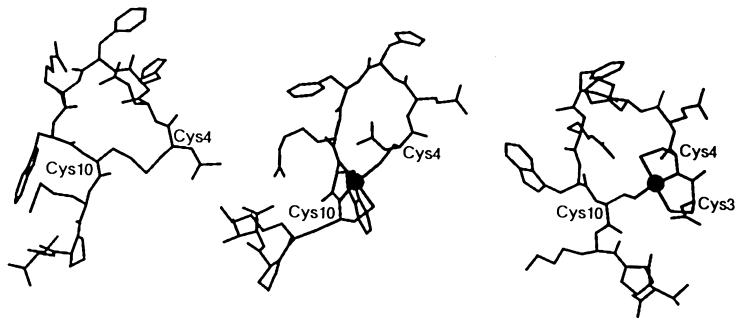
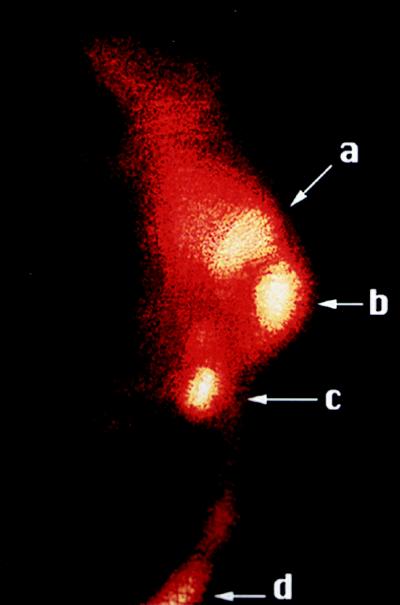
alpha-Melanocyte stimulating hormone (alpha-MSH) analogs, cyclized through site-specific rhenium (Re) and technetium (Tc) metal coordination, were structurally characterized and analyzed for their abilities to bind alpha-MSH receptors present on melanoma cells and in tumor-bearing mice. Results from receptor-binding assays conducted with B16 F1 murine melanoma cells indicated that receptor-binding affinity was reduced to approximately 1% of its original levels after Re incorporation into the cyclic Cys4,10, D-Phe7-alpha-MSH4-13 analog. Structural analysis of the Re-peptide complex showed that the disulfide bond of the original peptide was replaced by thiolate-metal-thiolate cyclization. A comparison of the metal-bound and metal-free structures indicated that metal complexation dramatically altered the structure of the receptor-binding core sequence. Redesign of the metal binding site resulted in a second-generation Re-peptide complex (ReCCMSH) that displayed a receptor-binding affinity of 2.9 nM, 25-fold higher than the initial Re-alpha-MSH analog. Characterization of the second-generation Re-peptide complex indicated that the peptide was still cyclized through Re coordination, but the structure of the receptor-binding sequence was no longer constrained. The corresponding 99mTc- and 188ReCCMSH complexes were synthesized and shown to be stable in phosphate-buffered saline and to challenges from diethylenetriaminepentaacetic acid (DTPA) and free cysteine. In vivo, the 99mTcCCMSH complex exhibited significant tumor uptake and retention and was effective in imaging melanoma in a murine-tumor model system. Cyclization of alpha-MSH analogs via 99mTc and 188Re yields chemically stable and biologically active molecules with potential melanoma-imaging and therapeutic properties.
Figures
References
-
- Iverson B L, Iverson S A, Roberts V A, Getzoff E D, Tainer J A, Benkovic S J, Lerner R A. Science. 1990;249:659–662. - PubMed
-
- Regan L. Annu Rev Biophys Biomol Struct. 1993;22:257–281. - PubMed
-
- Kellis J T, Jr, Todd R J, Arnold F H. Bio/Technology. 1991;9:994–995. - PubMed
-
- Klemba M, Gardner K H, Marino S, Clarke N D, Regan L. Nat Struct Biol. 1995;2:368–373. - PubMed
-
- Kruck T P A, Lau S, Sarkar B. Can J Chem. 1976;54:1300–1308.
Publication types
MeSH terms
Substances
Associated data
- Actions
LinkOut - more resources
Full Text Sources
Other Literature Sources
