


HIV-1 Tat protein mimicry of chemokines
- PMID: 9789057
- PMCID: PMC23742
- DOI: 10.1073/pnas.95.22.13153
HIV-1 Tat protein mimicry of chemokines
Abstract
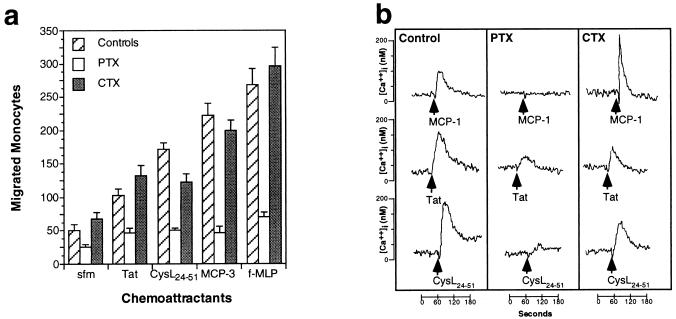
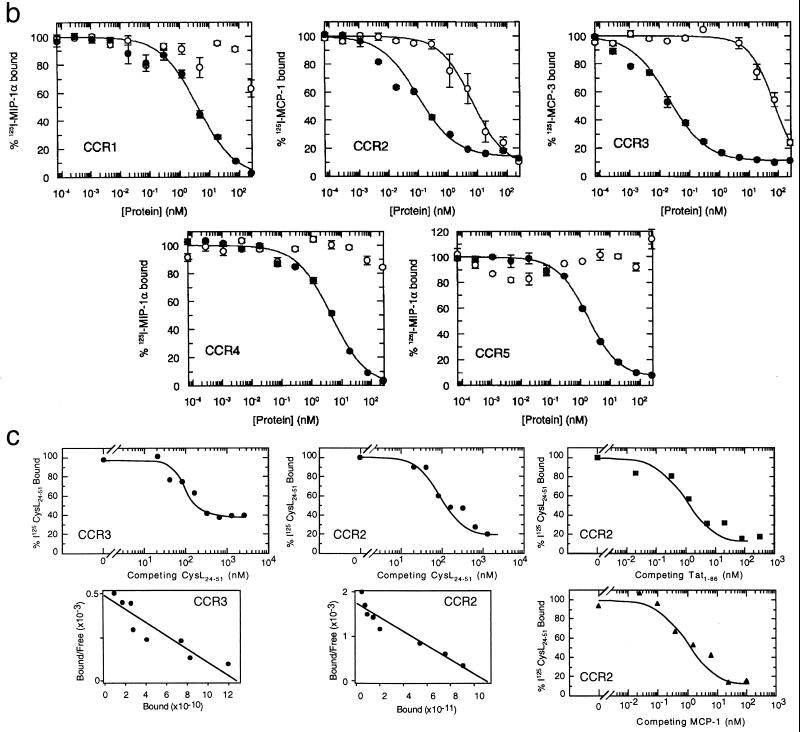
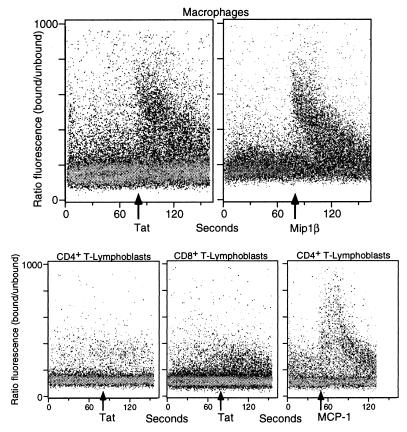
The HIV-1 Tat protein is a potent chemoattractant for monocytes. We observed that Tat shows conserved amino acids corresponding to critical sequences of the chemokines, a family of molecules known for their potent ability to attract monocytes. Synthetic Tat and a peptide (CysL24-51) encompassing the "chemokine-like" region of Tat induced a rapid and transient Ca2+ influx in monocytes and macrophages, analogous to beta-chemokines. Both monocyte migration and Ca2+ mobilization were pertussis toxin sensitive and cholera toxin insensitive. Cross-desensitization studies indicated that Tat shares receptors with MCP-1, MCP-3, and eotaxin. Tat was able to displace binding of beta-chemokines from the beta-chemokine receptors CCR2 and CCR3, but not CCR1, CCR4, and CCR5. Direct receptor binding experiments with the CysL24-51 peptide confirmed binding to cells transfected with CCR2 and CCR3. HIV-1 Tat appears to mimic beta-chemokine features, which may serve to locally recruit chemokine receptor-expressing monocytes/macrophages toward HIV producing cells and facilitate activation and infection.
Figures



References
-
- Albini A, Benelli R, Presta M, Rusnati M, Ziche M, Rubartelli A, Paglialunga G, Bussolino F, Noonan D. Oncogene. 1996;12:289–297. - PubMed
-
- Lafrenie R M, Wahl L M, Epstein J S, Hewlett I K, Yamada K M, Dhawan S. J Immunol. 1996;157:974–977. - PubMed
-
- Mitola S, Sozzani S, Luini W, Primo L, Bosatti A, Weich H, Bussolino F. Blood. 1997;90:1365–1372. - PubMed
-
- Benelli R, Mortarini R, Anichini A, Giunciuglio D, Noonan D M, Montalti S, Tacchetti C, Albini A. AIDS. 1998;12:261–268. - PubMed
Publication types
MeSH terms
Substances
Grants and funding
LinkOut - more resources
Full Text Sources
Other Literature Sources
Molecular Biology Databases
Miscellaneous
