


Phenotype-genotype studies in kuru: implications for new variant Creutzfeldt-Jakob disease
- PMID: 9789072
- PMCID: PMC23768
- DOI: 10.1073/pnas.95.22.13239
Phenotype-genotype studies in kuru: implications for new variant Creutzfeldt-Jakob disease
Abstract
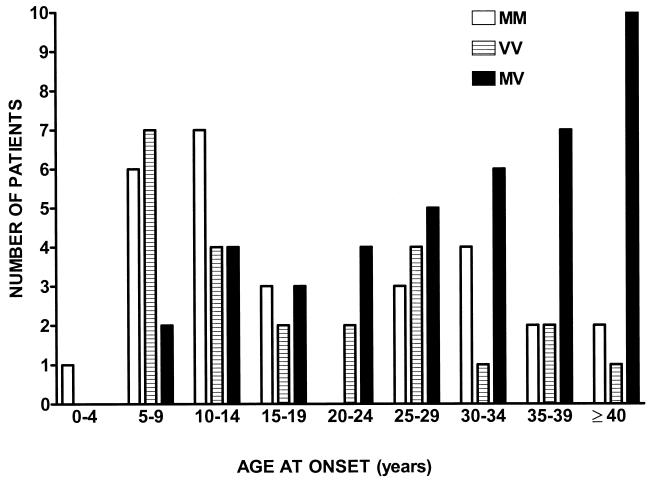
The PRNP polymorphic (methionine/valine) codon 129 genotype influences the phenotypic features of transmissible spongiform encephalopathy. All tested cases of new variant Creutzfeldt-Jakob disease (nvCJD) have been homozygous for methionine, and it is conjectural whether different genotypes, if they appear, might have distinctive phenotypes and implications for the future "epidemic curve" of nvCJD. Genotype-phenotype studies of kuru, the only other orally transmitted transmissible spongiform encephalopathy, might be instructive in predicting the answers to these questions. We therefore extracted DNA from blood clots or sera from 92 kuru patients, and analyzed their codon 129 PRNP genotypes with respect to the age at onset and duration of illness and, in nine cases, to detailed clinical and neuropathology data. Homozygosity at codon 129 (particularly for methionine) was associated with an earlier age at onset and a shorter duration of illness than was heterozygosity, but other clinical characteristics were similar for all genotypes. In the nine neuropathologically examined cases, the presence of histologically recognizable plaques was limited to cases carrying at least one methionine allele (three homozygotes and one heterozygote). If nvCJD behaves like kuru, future cases (with longer incubation periods) may begin to occur in older individuals with heterozygous codon 129 genotypes and signal a maturing evolution of the nvCJD "epidemic." The clinical phenotype of such cases should be similar to that of homozygous cases, but may have less (or at least less readily identified) amyloid plaque formation.
Figures
References
-
- Will R G, Ironside J W, Zeidler M, Cousens S N, Estibeiro K, Alperovitch A, Poser S, Pocchiari M, Hofman A, Smith P G. Lancet. 1996;347:921–925. - PubMed
-
- Zeidler M, Stewart G E, Barraclough C R, Bateman D E, Bates D, Burn D J, Colchester A C, Durward W, Fletcher N A, Hawkins S A, Mackenzie J M, Will R G. Lancet. 1997;350:903–907. - PubMed
-
- Zeidler M, Stewart G, Cousens S N, Estibeiro K, Will R G. Lancet. 1997;350:668. - PubMed
-
- Klatzo I, Gajdusek D C, Zigas V. Lab Invest. 1959;8:799–847. - PubMed
-
- Goldfarb L G, Petersen R B, Tabaton M, Brown P, LeBlanc A C, Montagna P, Cortelli P, Julien J, Vital C, Perdelbury W W, et al. Science. 1992;258:806–808. - PubMed
MeSH terms
Substances
LinkOut - more resources
Full Text Sources
Medical
