


Glial reduction in the subgenual prefrontal cortex in mood disorders
- PMID: 9789081
- PMCID: PMC23786
- DOI: 10.1073/pnas.95.22.13290
Glial reduction in the subgenual prefrontal cortex in mood disorders
Abstract
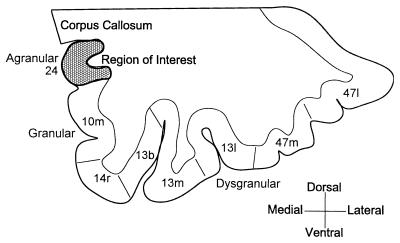
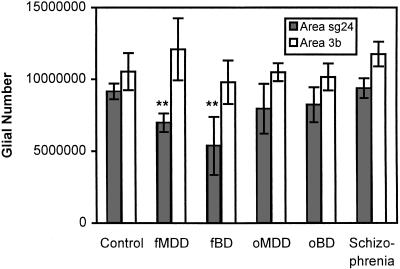
Mood disorders are among the most common neuropsychiatric illnesses, yet little is known about their neurobiology. Recent neuroimaging studies have found that the volume of the subgenual part of Brodmann's area 24 (sg24) is reduced in familial forms of major depressive disorder (MDD) and bipolar disorder (BD). In this histological study, we used unbiased stereological techniques to examine the cellular composition of area sg24 in two different sets of brains. There was no change in the number or size of neurons in area sg24 in mood disorders. In contrast, the numbers of glia were reduced markedly in both MDD and BD. The reduction in glial number was most prominent in subgroups of subjects with familial MDD (24%, P = 0.01) or BD (41%, P = 0.01). The glial reduction in subjects without a clear family history was lower in magnitude and not statistically significant. Consistent with neuroimaging findings, cortical volume was reduced in area sg24 in subjects with familial mood disorders. Schizophrenic brains studied as psychiatric controls had normal neuronal and glial numbers and cortical volume. Glial and neuronal numbers also were counted in area 3b of the somatosensory cortex in the same group of brains and were normal in all psychiatric groups. Glia affect several processes, including regulation of extracellular potassium, glucose storage and metabolism, and glutamate uptake, all of which are crucial for normal neuronal activity. We thus have identified a biological marker associated with familial mood disorders that may provide important clues regarding the pathogenesis of these common psychiatric conditions.
Figures
References
-
- Price J L, Carmichael S T, Drevets W C. In: Progress in Brain Research: The Emotional Motor System. Holstege G, Bandler R, Saper C B, editors. Vol. 107. Amsterdam: Elsevier Science; 1996. pp. 523–536. - PubMed
-
- Drevets W C, Price J L, Simpson J R, Todd R D, Vannier M, Raichle M E. Nature (London) 1997;386:824–827. - PubMed
-
- Hirayasu, Y., Shenton, M. E., Salisbury, D. F., Wible, C. G., Fischer, I. A., Kisler, T., Kwon, J. S., Dickey, C. C., Yurgelun-Todd, D. A., Tohen, M., et al. (1998) Biol. Psychiatry 43, Suppl. 97S. - PubMed
-
- An X, Bandler R, Öngür D, Price J L. J Comp Neurol. 1998;401:455–479. - PubMed
Publication types
MeSH terms
Grants and funding
LinkOut - more resources
Full Text Sources
Other Literature Sources
Medical
