. 1998 Oct 27;95(22):13313-8.
doi: 10.1073/pnas.95.22.13313.

Pharmacological analysis of cyclooxygenase-1 in inflammation

Affiliations

Pharmacological analysis of cyclooxygenase-1 in inflammation

C J Smith et al. Proc Natl Acad Sci U S A. .

Abstract

The enzymes cyclooxygenase-1 and cyclooxygenase-2 (COX-1 and COX-2) catalyze the conversion of arachidonic acid to prostaglandin (PG) H2, the precursor of PGs and thromboxane. These lipid mediators play important roles in inflammation and pain and in normal physiological functions. While there are abundant data indicating that the inducible isoform, COX-2, is important in inflammation and pain, the constitutively expressed isoform, COX-1, has also been suggested to play a role in inflammatory processes. To address the latter question pharmacologically, we used a highly selective COX-1 inhibitor, SC-560 (COX-1 IC50 = 0.009 microM; COX-2 IC50 = 6.3 microM). SC-560 inhibited COX-1-derived platelet thromboxane B2, gastric PGE2, and dermal PGE2 production, indicating that it was orally active, but did not inhibit COX-2-derived PGs in the lipopolysaccharide-induced rat air pouch. Therapeutic or prophylactic administration of SC-560 in the rat carrageenan footpad model did not affect acute inflammation or hyperalgesia at doses that markedly inhibited in vivo COX-1 activity. By contrast, celecoxib, a selective COX-2 inhibitor, was anti-inflammatory and analgesic in this model. Paradoxically, both SC-560 and celecoxib reduced paw PGs to equivalent levels. Increased levels of PGs were found in the cerebrospinal fluid after carrageenan injection and were markedly reduced by celecoxib, but were not affected by SC-560. These results suggest that, in addition to the role of peripherally produced PGs, there is a critical, centrally mediated neurological component to inflammatory pain that is mediated at least in part by COX-2.


Figures
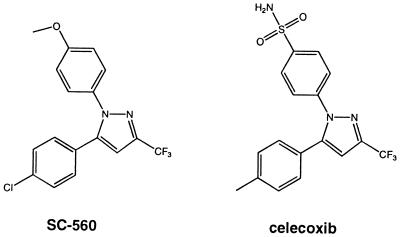
Figure 1
Figure 1
Structures of SC-560 and celecoxib. SC-560: COX-1 IC50 = 0.009 μM, COX-2 IC50 = 6.3 μM; celecoxib: COX-1 IC50 = 15 μM, COX-2 IC50 = 0.04 μM.
Figure 2
Figure 2
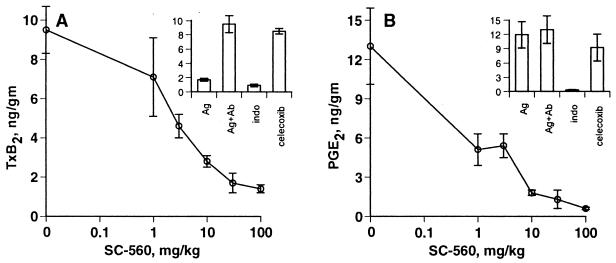
Inhibition of PG production in the reversed passive dermal Arthus reaction. Compounds were administered by oral gavage 1 hr before initiation of the Arthus reaction. The Arthus reaction was initiated by intradermal injection of rabbit anti-chicken egg albumin (Ab) followed immediately by i.v. injection of 10 mg of chicken egg albumin (Ag). Dermal injection sites were removed and extracted for PGs, which were quantified by ELISA. (A) Sensitivity of Arthus reaction-stimulated TxB2 to SC-560. (Inset) TxB2 levels in negative control (Ag only) and Arthus reaction skin (Ag + Ab) compared with Arthus reaction skin from animals dosed with 10 mg/kg indomethacin or 30 mg/kg celecoxib. (B) Sensitivity of rat skin PGE2 to SC-560. (Inset) PGE2 levels in control skin and Arthus reaction skin compared with Arthus reaction skin from animals dosed with 10 mg/kg indomethacin or 30 mg/kg celecoxib. Data are expressed as mean ± SEM, n = 4 per treatment group.
Figure 3
Figure 3
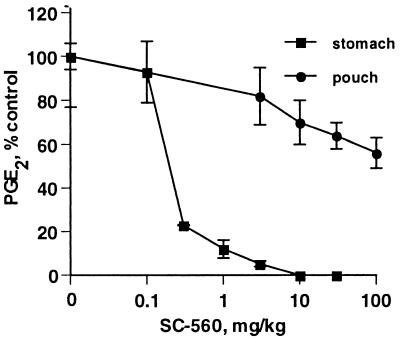
Inhibition of PG production in the inflamed rat air pouch and stomach mucosa by SC-560. SC-560 was administered by oral gavage 1 hr before initiating an inflammatory response in the air pouch with LPS. PGE2 present in the pouch exudate (•) and extracted from the stomach mucosa (■) was quantified by ELISA. Each point represents percent of control PGE2 ± SEM, n = 6 per treatment group.
Figure 4
Figure 4
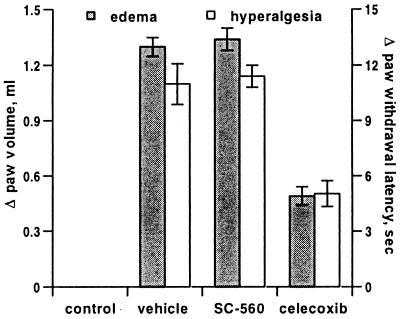
Effect of COX inhibitors on carrageenan-induced edema and hyperalgesia in the rat footpad. A single dose of 30 mg/kg SC-560, celecoxib, or vehicle was administered by oral gavage 2 hr before initiation of inflammation with carrageenan. Edema (■, left axis) and hyperalgesia (□, right axis) were measured 6 hr after carrageenan injection. Data shown are the mean (n = 5) ± SEM and are from one of three experiments with similar results.
Figure 5
Figure 5
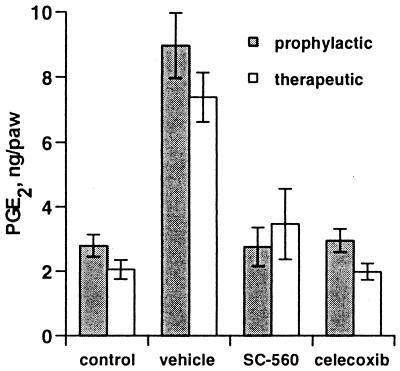
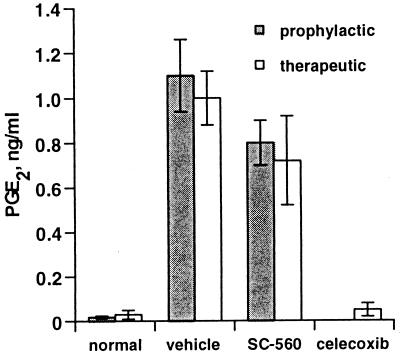
Effect of COX inhibitors on carrageenan-induced PGE2 in the rat footpad. A single dose of 30 mg/kg SC-560, celecoxib, or vehicle was administered by oral gavage either 2 hr before (■) or 3 hr after (□) carrageenan injection. Paw inflammatory fluid was collected and PGE2 was quantified by ELISA. Data represent mean (n = 5) ± SEM and are from one of three experiments with similar results.
Figure 6
Figure 6
Effect of COX inhibitors on PGE2 in rat CSF. A single dose of 30 mg/kg SC-560, celecoxib, or vehicle was administered by oral gavage either 2 hr before (■) or 3 hr after (□) carrageenan injection. CSF was collected and PGE2 was quantified by ELISA. Data represent several experiments reported as the mean (n = 5–15) ± SEM.
Figure 7
Figure 7
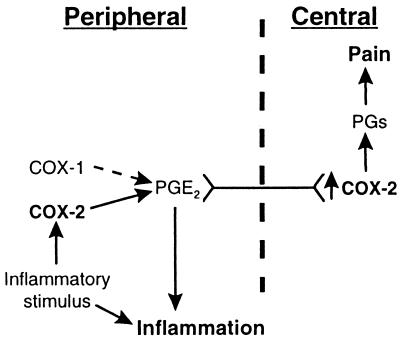
Model for COX-1- and COX-2-derived PGs in inflammation and pain. The initial peripheral inflammatory signal causes local upregulation of COX-2 and PGs that mediate plasma extravasation and neurological signals to the CNS. Inflammatory mediators including PGs increase nerve traffic, resulting in increased COX-2 expression in the spinal cord, which in turn produces PGs that influence central pain signals.

References

    1. Insel P A. In: The Pharmacological Basis of Therapeutics. Gilman A, Rall T W, Nies A S, Taylor P, editors. Oxford: Pergamon; 1990. pp. 638–681.
    1. Garrison J C. In: The Pharmacological Basis of Therapeutics. Gilman A, Rall T W, Nies A S, Taylor P, editors. Oxford: Pergamon Press; 1990. pp. 574–599.
    1. Moncada S, Palmer R M, Higgs E A. Pharmacol Rev. 1991;43:109–142. - PubMed
    1. Davies P, MacIntyre D E. In: Inflammation: Basic Principles and Clinical Correlates. Gallin J I, Goldstein I M, Snyderman R, editors. New York: Raven; 1992. pp. 123–137.
    1. Williams T J, Morley J. Nature (London) 1973;246:215–217. - PubMed

MeSH terms

LinkOut - more resources