


Gene discovery in the wood-forming tissues of poplar: analysis of 5, 692 expressed sequence tags
- PMID: 9789088
- PMCID: PMC23802
- DOI: 10.1073/pnas.95.22.13330
Gene discovery in the wood-forming tissues of poplar: analysis of 5, 692 expressed sequence tags
Abstract
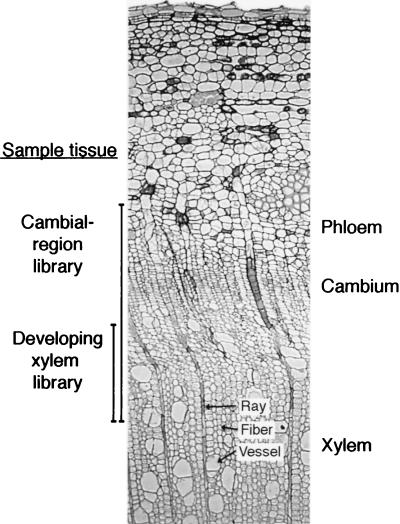
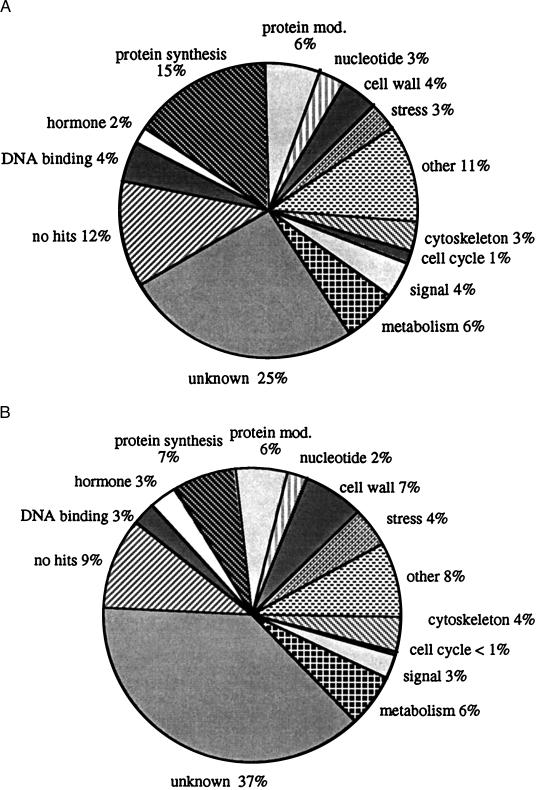
A rapidly growing area of genome research is the generation of expressed sequence tags (ESTs) in which large numbers of randomly selected cDNA clones are partially sequenced. The collection of ESTs reflects the level and complexity of gene expression in the sampled tissue. To date, the majority of plant ESTs are from nonwoody plants such as Arabidopsis, Brassica, maize, and rice. Here, we present a large-scale production of ESTs from the wood-forming tissues of two poplars, Populus tremula L. x tremuloides Michx. and Populus trichocarpa 'Trichobel.' The 5,692 ESTs analyzed represented a total of 3,719 unique transcripts for the two cDNA libraries. Putative functions could be assigned to 2,245 of these transcripts that corresponded to 820 protein functions. Of specific interest to forest biotechnology are the 4% of ESTs involved in various processes of cell wall formation, such as lignin and cellulose synthesis, 5% similar to developmental regulators and members of known signal transduction pathways, and 2% involved in hormone biosynthesis. An additional 12% of the ESTs showed no significant similarity to any other DNA or protein sequences in existing databases. The absence of these sequences from public databases may indicate a specific role for these proteins in wood formation. The cDNA libraries and the accompanying database are valuable resources for forest research directed toward understanding the genetic control of wood formation and future endeavors to modify wood and fiber properties for industrial use.
Figures
References
-
- Larson P R. The Vascular Cambium: Development and Structure, Springer Series in Wood Science. Berlin: Springer; 1994.
-
- Telewski F W, Aloni R, Sauter J J. In: Biology of Populus and Its Implications for Management and Conservation. Stettler R F, Bradshaw H D Jr, Heilman P E, Hinckley T M, editors. Ottawa, ON, Canada: NRC Research; 1996. pp. 301–330.
-
- Baucher M, Monties B, Van Montagu M, Boerjan W. Crit Rev Plant Sci. 1998;17:125–197.
-
- Arioli T, Peng L, Betzner A S, Burn J, Wittke W, Herth W, Camilleri C, Höfte H, Plazinski J, Birch R, et al. Science. 1998;279:717–720. - PubMed
Publication types
MeSH terms
Substances
Associated data
- Actions
- Actions
- Actions
- Actions
- Actions
- Actions
- Actions
- Actions
- Actions
- Actions
- Actions
- Actions
- Actions
- Actions
- Actions
- Actions
- Actions
- Actions
- Actions
- Actions
- Actions
- Actions
- Actions
- Actions
- Actions
- Actions
- Actions
- Actions
- Actions
- Actions
Grants and funding
LinkOut - more resources
Full Text Sources
Other Literature Sources
