. 1998 Nov;275(5):R1654-60.
doi: 10.1152/ajpregu.1998.275.5.R1654.

M2 muscarinic receptor contributes to contraction of the denervated rat urinary bladder

Affiliations

M2 muscarinic receptor contributes to contraction of the denervated rat urinary bladder

A S Braverman et al. Am J Physiol. 1998 Nov.

Abstract

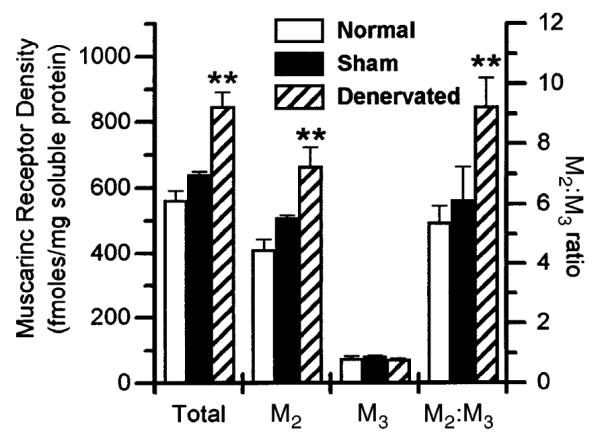
In vitro bladder contractions in response to cumulative carbachol doses were measured in the presence of selective muscarinic antagonists from rats that had their major pelvic ganglion bilaterally removed. Denervation induced both hypertrophy and a supersensitivity of the bladders to agonist. The affinities in control bladders for antagonism of carbachol-induced contractions were consistent with M3-mediated contractions. Affinities in denervated bladders for 4-diphenlacetoxy-N-methylpiperidine methiodide (8.5) and p-fluoro hexahydrosilodifenidol (6.6) were consistent with M2-mediated contractions, although the methoctramine affinity (6.5) was consistent with M3-mediated contractions. Subtype-selective immunoprecipitation of muscarinic receptors revealed a 50% increase in total and a 60% increase in M2 receptor density with no change in M3 receptor density in denervated bladders compared with normal or sham-operated controls. This increase in M2 receptor density is consistent with the change in affinity of the antagonists for inhibition of carbachol-induced contractions and may indicate that M2 receptors or a combination of M2 and M3 receptors directly mediates smooth muscle contraction in the denervated bladder.


Figures
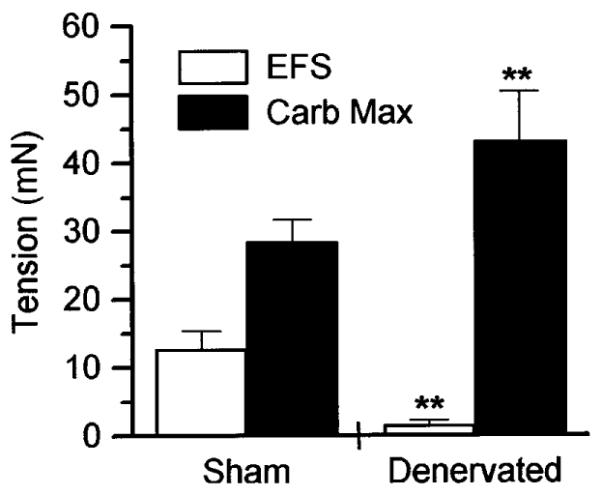
Fig. 1
Fig. 1
Tension developed by sham-operated control and denervated rat bladder muscle strips in vitro in response to electrical field stimulation (EFS) or carbachol-evoked maximum (Carb Max). Data shown are averages ± SE. In response to electric field stimulation (8 V, 1-ms duration at 30 Hz), actual tension developed was 12.7 ± 2.6 mN for sham-operated (n = 14 muscle strips) and 1.6 ± 0.7 mN for denervated rats (n = 60 muscle strips). Maximal carbachol responses were 28.4 ± 3.2 mN for sham-operated (n = 14 muscle strips) and 43.1 ± 7.3 mN for denervated rat bladder strips (n = 60 muscle strips). **Significantly different (ANOVA, P < 0.01) from sham-operated control.
Fig. 2
Fig. 2
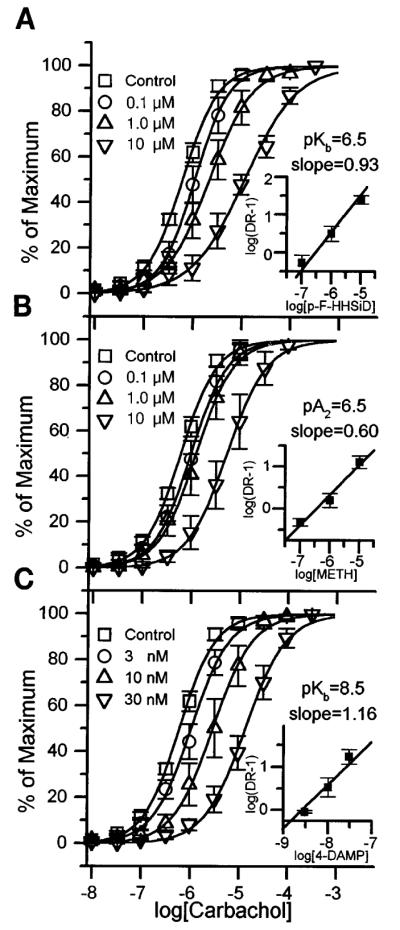
Carbachol dose-response (DR) displacement curves and Schild plot (insets) for p-fluoro hexahydrosilodifenidol (p-F-HHSiD; A), methoctramine (B), and 4-diphenlacetoxy-N-methylpiperidine methiodide (4-DAMP; C) effect on denervated rat bladder strips in vitro. Each antagonist curve represents average responses of 5 muscle strip preparations (1 strip from each of 5 denervated rats), whereas control curve represents the average of 14 muscle strips expressed as percent of each individual strip’s maximal carbachol response. These maximal responses (averages ± SE) were 32.3 ± 2.8 mN for control; 26.6 ± 2.2, 34.0 ± 5.4, and 27.2 ± 4.7 mN for 0.1, 1, and 10 μM p-F-HHSiD respectively; 26.2 ± 3.2, 34.2 ± 5.7, and 37.6 ± 5.9 mN for 1, 3, and 10 μM methoctramine respectively; and 37.8 ± 7.5, 36.7 ± 7.2, and 32.0 ± 3.7 mN for 3, 10, and 30 nM 4-DAMP, respectively. There was no significant difference in maximum between these groups.
Fig. 3
Fig. 3
Precipitation of M2 and M3 muscarinic receptor subtypes from bladder of normal control, sham-operated control, and denervated rats. Receptors were labeled with [3H]quinuclidnylbenzilate and solubilized as described in Luthin et al. (17). Data shown are average femptomoles of receptor per milligram solubilized protein ± SE from individual denervated bladders (n = 4) or pooled normal (n = 3) or sham-operated controls (n = 1 performed in quintuplet) or ratio of M2 to M3 receptors. Protein concentration in solubilized receptor preparation was ~8% of protein concentration in crude homogenate. Compared with filtration binding, ~50% of muscarinic receptors were solubilized (data not shown). **Significant difference (P < 0.01) from control.

References

    1. Anderson KE, Holmquist F, Fovaeus M, Hedlund H, Sundler R. Muscarinic receptor stimulation of phosphoinositide hydrolysis in the human isolated urinary bladder. J. Urol. 1991;146:1156–1159. - PubMed
    1. Bonner TI, Buckley NJ, Young AC, Brann MR. Identification of a family of muscarinic acetylcholine receptor genes. Science. 1987;237:527–532. - PubMed
    1. Brandes SB, Ruggieri MR. Muscarinic receptor subtypes in normal, fetal and gravid rabbit bladder, heart and uterus. Adv. Exp. Med. Biol. 1995;385:241–249. - PMC - PubMed
    1. Braverman AS, Luthin GR, Ruggieri MR. Prejunctional M1 facilitory and M2 inhibitory muscarinic receptors mediate rat bladder contractility. Am. J. Physiol. 1998;274:R517–R523. Regulatory Integrative Comp. Physiol. 43. - PMC - PubMed
    1. Braverman AS, Luthin GR, Ruggieri MR. The M2 muscarinic acetylcholine receptor contributes to rat urinary bladder contraction. Part 2. Soc. Neurosci. Abstr. 1997;23:2022.

Publication types

LinkOut - more resources