


Functional consequences of changing proline residues in the phenylalanine-specific permease of Escherichia coli
- PMID: 9791098
- PMCID: PMC107607
- DOI: 10.1128/JB.180.21.5515-5519.1998
Functional consequences of changing proline residues in the phenylalanine-specific permease of Escherichia coli
Abstract
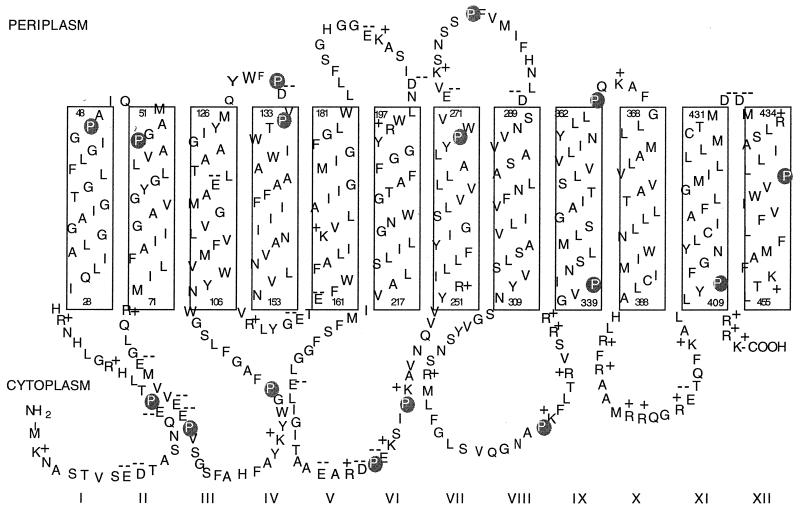
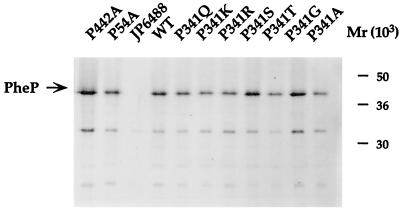
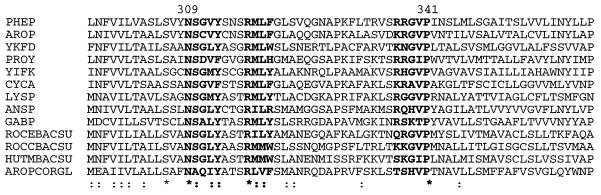
The PheP protein is a high-affinity phenylalanine-specific permease of the bacterium Escherichia coli. A topological model based on genetic analysis involving the construction of protein fusions with alkaline phosphatase has previously been proposed in which PheP has 12 transmembrane segments with both N and C termini located in the cytoplasm (J. Pi and A. J. Pittard, J. Bacteriol. 178:2650-2655, 1996). Site-directed mutagenesis has been used to investigate the functional importance of each of the 16 proline residues of the PheP protein. Replacement of alanine at only three positions, P54, P341, and P442, resulted in the loss of 50% or more activity. Substitutions at P341 had the most dramatic effects. None of these changes in transport activity were, however, associated with any defect of the mutant protein in inserting into the membrane, as indicated by [35S]methionine labelling and immunoprecipitation using anti-PheP serum. A possible role for each of these three prolines is discussed. Inserting a single alanine residue at different sites within span IX and the loop immediately preceding it also had major effects on transport activity, suggesting an important role for a highly organized structure in this region of the protein.
Figures
References
-
- Gibson, F. Personal communication.
-
- Ito K, Akiyama Y. In vivo analysis of integration of membrane proteins in Escherichia coli. Mol Microbiol. 1991;5:2243–2253. - PubMed
Publication types
MeSH terms
Substances
LinkOut - more resources
Full Text Sources
Other Literature Sources
Molecular Biology Databases
Research Materials
Miscellaneous
