. 1998 Nov;180(21):5520-8.
doi: 10.1128/JB.180.21.5520-5528.1998.

Identification of chlorobenzene dioxygenase sequence elements involved in dechlorination of 1,2,4,5-tetrachlorobenzene

Affiliations

Identification of chlorobenzene dioxygenase sequence elements involved in dechlorination of 1,2,4,5-tetrachlorobenzene

S Beil et al. J Bacteriol. 1998 Nov.

Abstract

The TecA chlorobenzene dioxygenase and the TodCBA toluene dioxygenase exhibit substantial sequence similarity yet have different substrate specificities. Escherichia coli cells producing recombinant TecA enzyme dioxygenate and simultaneously eliminate a halogen substituent from 1,2,4,5-tetrachlorobenzene but show no activity toward benzene, whereas those producing TodCBA dioxygenate benzene but not tetrachlorobenzene. A hybrid TecA dioxygenase variant containing the large alpha-subunit of the TodCBA dioxygenase exhibited a TodCBA dioxygenase specificity. Acquisition of dehalogenase activity was achieved by replacement of specific todC1 alpha-subunit subsequences by equivalent sequences of the tecA1 alpha-subunit. Substrate transformation specificities and rates by E. coli resting cells expressing hybrid systems were analyzed by high-performance liquid chromatography. This allowed the identification of both a single amino acid and potentially interacting regions required for dechlorination of tetrachlorobenzene. Hybrids with extended substrate ranges were generated that exhibited activity toward both benzene and tetrachlorobenzene. The regions determining substrate specificity in (chloro)benzene dioxygenases appear to be different from those previously identified in biphenyl dioxygenases.


Figures
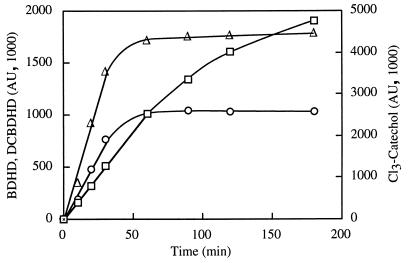
FIG. 1
FIG. 1
HPLC analysis of product formation. E. coli cells carrying dioxygenase genes were incubated with 0.5 mM substrate. At regular time intervals, samples were taken, and the supernatant fluids were analyzed by HPLC (Table 1) for product accumulation. The formation of 3,4-dichloro-cis-1,2-dihydroxy-1,2-dihydrocyclohexa-3,5-diene (DCBDHD [▵]) from 1,2-dichlorobenzene and cis-1,2-dihydroxy-1,2-dihydrocyclohexa-3,5-diene (BDHD [○]) from benzene by E. coli (pSTO4) and the formation of 3,4,6-trichlorocatechol (Cl3-catechol) from tetrachlorobenzene (□) by E. coli (pSTE7) are shown as a function of time.
FIG. 2
FIG. 2
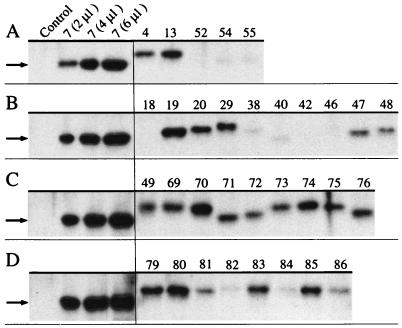
Western blot analysis of soluble α-subunit proteins. After electrophoretic separation of 4 μl of crude extracts of E. coli cells carrying different plasmids encoding dioxygenase systems, soluble α-subunits were detected with anti-BedC1 rabbit antibody (38), and bands corresponding to chimeric α-subunit proteins (50 to 51 kDa) were visualized on film. Eight microliters of E. coli (pBluescript II KS[+]) was used as a negative control, and 2, 4, and 6 μl of E. coli (pSTE7) crude cell extract served as internal standards on the first four lanes of each gel. Numbers at the top of each lane correspond to the number of the plasmid carried in E. coli according to Tables 2 and 3 and Fig. 3. The sizes of the wild-type proteins produced in E. coli (pSTE7) and E. coli (pSTO4) were 50.1 ± 0.3 (indicated by an arrow) and 51.3 ± 0.3 kDa, respectively, which is in close agreement with the deduced molecular masses of wild-type TecA (50.5 kDa) (4) and TodCBA (50.9 kDa) (39) dioxygenases. Small differences in the relative mobility of α-subunit proteins are assumed to be due to differences in size and amino acid composition of individual chimeras. The panel was composed from four different gels with Photoshop software (version 3.0; Adobe).
FIG. 3
FIG. 3
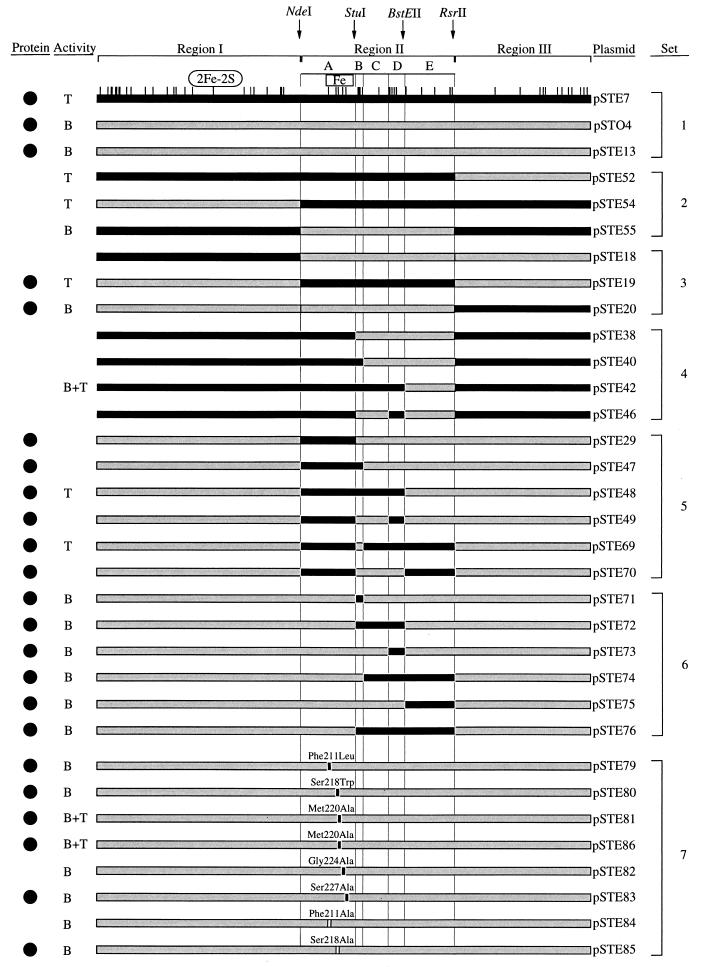
Constructs of dioxygenase α-subunit proteins. Plasmids pSTE7 (tecA1A2A3A4) and pSTO4 (todC1C2BA) carry wild-type dioxygenase systems. Hybrid systems were constructed with the chimeric α-subunits in the tecA2A3A4 background, except for plasmid pSTE86, which contains the todC1C2BA background (Table 2). The regions I of the two enzymes differ by 24 amino acid residues, subregions IIA differ by 5, IIB differ by 4, IIC differ by 1, IID differ by 5, IIE differ by 5, and III differ by 12. The positions at which the amino acids differ between TecA1 and TodC1 are shown on top of pSTE7 α-subunit. Black bars indicate fragments of TecA1 origin, grey bars indicate fragments of TodC1 origin, and white boxed amino acids in pSTE84 and pSTE85 were present in neither TecA1 nor in TodC1. Regions I, II, and III and subregions IIA, IIB, IIC, IID, and IID are delineated by black vertical lines. Relevant restriction sites are indicated. The position of the putative Rieske-type [2Fe-2S] iron-sulfur cluster (11, 28) in region I is indicated as an oval. The putative mononuclear iron-coordination motif Glu214-Xaa3–4-Asp219-Xaa2-His222-Xaa4–5-His228 (17) is shown as a boxed area. Solid circles (•) indicate E. coli cells expressing soluble α-subunit protein of TecA1 at a significant level compared to the TecA1 wild-type level. With the exception of E. coli (pSTE18), all constructs transformed 1,2-dichlorobenzene. In addition to 1,2-dichlorobenzene, E. coli resting cells carrying the corresponding plasmid transformed benzene (B), tetrachlorobenzene (T), or all three substrates (B+T) with activities above the detection limit (see Table 3).
FIG. 4
FIG. 4
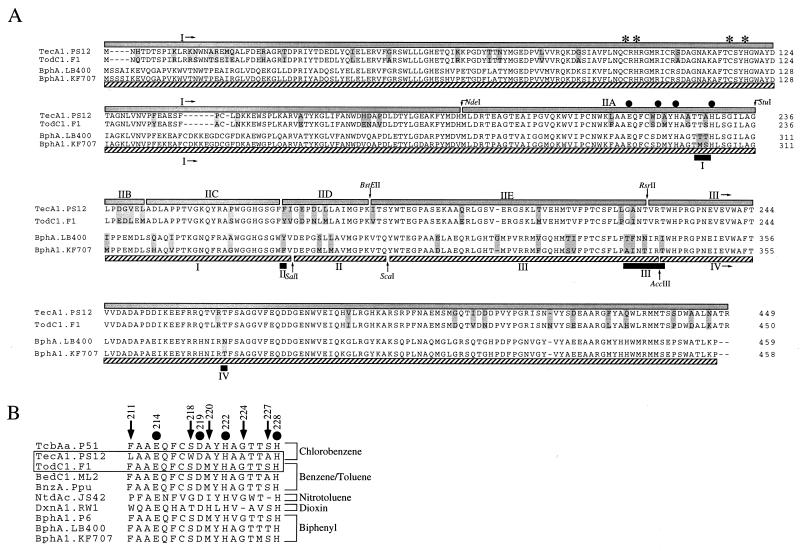
Protein sequence alignment of α-subunits of selected class IIB dioxygenases. Amino acid alignment of α-subunits of chlorobenzene, toluene, and biphenyl class IIB dioxygenases is shown as follows: TecA1.PS12, chlorobenzene dioxygenase of Burkholderia sp. strain PS12 (4); TodC1.F1, toluene dioxygenase of P. putida F1 (39); BphA.LB400, biphenyl dioxygenase of Pseudomonas sp. LB400 (7); BphA1.KF707, biphenyl dioxygenase of P. pseudoalcaligenes KF707 (33). The assignments of regions, subregions, and restriction sites used in this study are indicated by grey boxes above the alignment, and those used in the study of Kimura et al. (19) are indicated below the alignment by dashed boxes, whereas regions specified by Mondello et al. (23) are shown as black boxes (A). Additional sequences used in the alignment of the putative iron ligand region were as follows: TcbAa.P51, chlorobenzene dioxygenase of Pseudomonas sp. strain P51 (37); BedC1.ML2, benzene dioxygenase of P. putida ML2 (35); BnzA.Ppu, benzene dioxygenase of P. putida (15); BphA1.P6, biphenyl dioxygenase of Rhodococcus globerulus P6 (2); NtdAc.JS42, 2-nitrotoluene dioxygenase of Pseudomonas sp. strain JS42 (25); DxnA1.RW1, dioxin dioxygenase of Sphingomonas sp. strain RW1 (1) (B). Differences between TecA1 and TodC1 and BphA and BphA1, respectively, are indicated by shaded amino acids. The numbering of the position of amino acid residues in the putative active-site iron liganding region IIA refers to the TecA1 sequence. Arrows indicate amino acids and their positions, which are different between TecA1 and TodC1 in subregion IIA. Solid circles show putative active-site mononuclear iron ligands (17). Asterisks indicate the conserved cysteines and histidines, putative ligands of the Rieske-type [2Fe-2S] iron-sulfur cluster (11, 28), with the consensus sequence Cys-Xaa-His16–17-Xaa-Cys-Xaa2-Xaa-His (22).

References

    1. Armengaud, J., B. Happe, and K. N. Timmis. Genetic analysis of dioxin dioxygenase of Sphingomonas sp. strain RW1: catabolic genes dispersed on the genome. J. Bacteriol. 180:3954–3966. - PMC - PubMed
    1. Asturias J A, Diaz E, Timmis K N. The evolutionary relationship of biphenyl dioxygenase from gram-positive Rhodococcus globerulus P6 to multicomponent dioxygenases from gram-negative bacteria. Gene. 1995;156:11–18. - PubMed
    1. Batie C J, Ballou D P, Correll C J. Phthalate dioxygenase reductase and related flavin-iron-sulphur containing electron transferases. In: Müller F, editor. Chemistry and biochemistry of flavoenzymes. Boca Raton, Fla: CRC Press; 1992. pp. 544–554.
    1. Beil S, Happe B, Timmis K N, Pieper D H. Genetic and biochemical characterization of the broad spectrum chlorobenzene dioxygenase from Burkholderia sp. strain PS12: dechlorination of 1,2,4,5-tetrachlorobenzene. Eur J Biochem. 1997;247:190–199. - PubMed
    1. Bradford M M. A rapid and sensitive method for the quantitation of microgram quantities of protein utilizing the principle of protein-dye binding. Anal Biochem. 1976;72:248–254. - PubMed

Publication types

LinkOut - more resources