. 1998 Nov;180(21):5540-6.
doi: 10.1128/JB.180.21.5540-5546.1998.

Mechanism of osmotic activation of the quaternary ammonium compound transporter (QacT) of Lactobacillus plantarum

Affiliations

Mechanism of osmotic activation of the quaternary ammonium compound transporter (QacT) of Lactobacillus plantarum

E Glaasker et al. J Bacteriol. 1998 Nov.

Abstract

The accumulation of quaternary ammonium compounds in Lactobacillus plantarum is mediated via a single transport system with a high affinity for glycine betaine (apparent Km of 18 microM) and carnitine and a low affinity for proline (apparent Km of 950 microM) and other analogues. Mutants defective in the uptake of glycine betaine were generated by UV irradiation and selected on the basis of resistance to dehydroproline (DHP), a toxic proline analogue. Three independent DHP-resistant mutants showed reduced glycine betaine uptake rates and accumulation levels but behaved similarly to the wild type in terms of direct activation of uptake by high-osmolality conditions. Kinetic analysis of glycine betaine uptake and efflux in the wild-type and mutant cells is consistent with one uptake system for quaternary ammonium compounds in L. plantarum and a separate system(s) for their excretion. The mechanism of osmotic activation of the quaternary ammonium compound transport system (QacT) was studied. It was observed that the uptake rates were inhibited by the presence of internal substrate. Upon raising of the medium osmolality, the QacT system was rapidly activated (increase in maximal velocity) through a diminished inhibition by trans substrate as well as an effect that is independent of intracellular substrate. We also studied the effects of the cationic amphipath chlorpromazine, which inserts into the cytoplasmic membrane and thereby influences the uptake and efflux of glycine betaine. The results provide further evidence for the notion that the rapid efflux of glycine betaine upon osmotic downshock is mediated by a channel protein that is responding to membrane stretch or tension. The activation of QacT upon osmotic upshock seems to be brought about by a turgor-related parameter other than membrane stretch or tension.


Figures
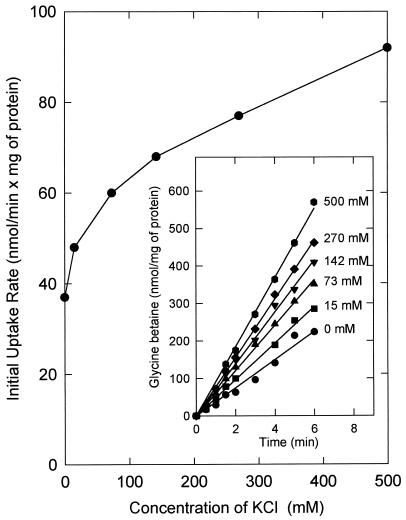
FIG. 1
FIG. 1
Dependence of the initial rate of glycine betaine uptake on increases in medium osmolality imposed by KCl. Cells of L. plantarum ATCC 14917 were grown on CDM containing 0.8 M KCl, washed, and resuspended in 50 mM potassium phosphate (pH 6.5). The concentrated cell suspensions were diluted in 50 mM potassium phosphate (pH 6.5) to a final protein concentration of 0.13 mg/ml. After 8 min of preenergization with 10 mM glucose, uptake was initiated at time zero by the addition [14C]glycine betaine (final concentration of 1.3 mM) plus KCl as indicated. The initial uptake rates were determined and plotted against the concentration of KCl that was added to the 50 mM potassium phosphate.
FIG. 2
FIG. 2
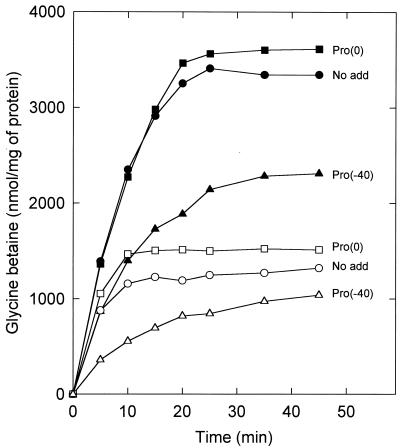
Dependence of glycine betaine uptake on the internal proline concentration. Cells of L. plantarum ATCC 14917 were grown on CDM without proline containing 0.8 M KCl. The cells were washed and resuspended in 50 mM potassium phosphate (pH 6.5) plus 50 μg of chloramphenicol per ml to a final protein concentration of 0.18 mg/ml. After 40 min of preenergization with 10 mM glucose, uptake was initiated at time zero by the addition of 1.3 mM [14C]glycine betaine (no add) or 1.3 mM [14C]glycine betaine plus 1.3 mM unlabeled proline [Pro(0)]. Alternatively, the cells were preenergized for 40 min with 10 mM glucose plus 1.3 mM unlabeled proline, and uptake was initiated at time zero by the addition of 1.3 mM [14C]glycine betaine [Pro(−40)]. The uptake was assayed without (open symbols) or with (closed symbols) 0.8 M KCl (final concentration) added together with the glucose.
FIG. 3
FIG. 3
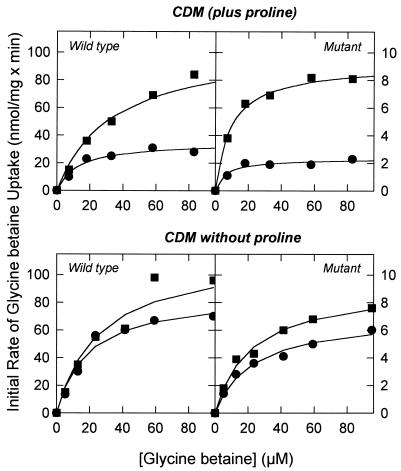
Kinetics of glycine betaine uptake in wild-type and DHPR-38.1 L. plantarum ATCC 14917. The cells were grown on CDM or CDM without proline, washed, and resuspended in 50 mM potassium phosphate (pH 6.5). After 7 min of preenergization with 10 mM glucose, uptake was initiated by the addition of [14C]glycine betaine with (squares) or without (circles) 0.8 M KCl. Further details are described in the footnote to Table 2.
FIG. 4
FIG. 4
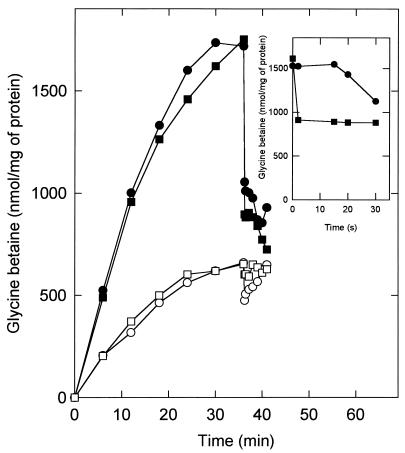
Hypo-osmotic shock and chlorpromazine trigger efflux of [14C]glycine betaine. Cells of L. plantarum ATCC 14917 were grown on CDM containing 0.8 M KCl, washed, and resuspended in 50 mM potassium phosphate (pH 6.5). The concentrated cell suspensions were diluted in 50 mM potassium phosphate (pH 6.5) to a final protein concentration of 0.39 mg/ml. After 6 min of preenergization with 10 mM glucose, uptake was initiated at time zero by the addition of [14C]glycine betaine (final concentration of 1.3 mM) without (open symbols) or with (closed symbols) 0.8 M KCl (final concentration). After 36.5 min, 0.1 mM chlorpromazine (final concentration) was added (circles), or the samples were diluted fivefold with 50 mM potassium phosphate (pH 6.5) containing 10 mM glucose plus 1.3 mM [14C]glycine betaine (squares). The inset shows the lag time of the efflux triggered by the addition of 0.1 mM chlorpromazine (circles); the efflux after hypo-osmotic shock (squares) is instantaneous, since 2 s is the time resolution of the experiment.
FIG. 5
FIG. 5
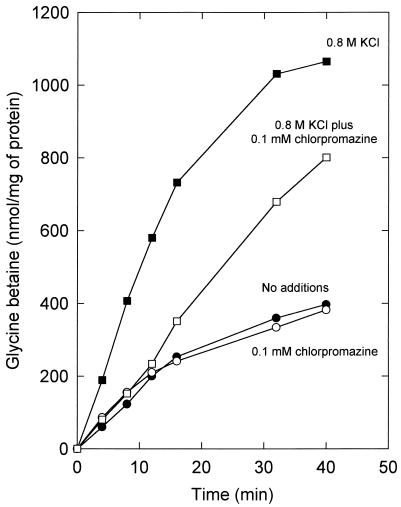
Effect of chlorpromazine on the uptake of [14C]glycine betaine. Cells of L. plantarum ATCC 14917 were grown on CDM containing 0.8 M KCl, washed, and resuspended in 50 mM potassium phosphate (pH 6.5). The concentrated cell suspensions were diluted in 50 mM potassium phosphate (pH 6.5) to a final protein concentration of 0.17 mg/ml. After 6 min of preenergization with 10 mM glucose, uptake was initiated at time zero by the addition of [14C]glycine betaine (final concentration of 1.3 mM) without (closed symbols) or with (open symbols) 0.1 mM chlorpromazine (final concentration). The uptake was assayed without (circles) or with (squares) 0.8 M KCl (final concentration) added together with the [14C]glycine betaine.

References

    1. Csonka L N. Physiological and genetic responses of bacteria to osmotic stress. Microbiol Rev. 1989;53:121–147. - PMC - PubMed
    1. Faatz E, Middendorf A, Bremer E. Cloned structural genes for the osmotically regulated binding-protein-dependent glycine betaine transport system (ProU) of Escherichia coli K-12. Mol Microbiol. 1988;2:265–279. - PubMed
    1. Glaasker E, Konings W N, Poolman B. Osmotic regulation of intracellular solute pools in Lactobacillus plantarum. J Bacteriol. 1996;178:575–582. - PMC - PubMed
    1. Glaasker E, Konings W N, Poolman B. Glycine-betaine fluxes in Lactobacillus plantarum during osmostasis and hyper- and hypoosmotic shock. J Biol Chem. 1996;271:10060–10065. - PubMed
    1. Gouesbet G, Trautwetter A, Bonassie S, Wu L F, Blanco C. Characterization of the Erwinia chrysanthemi osmoprotectant transporter gene ousA. J Bacteriol. 1996;178:447–455. - PMC - PubMed

Publication types

LinkOut - more resources