. 1998 Nov;180(21):5769-75.
doi: 10.1128/JB.180.21.5769-5775.1998.

Transcriptional regulation of the Streptococcus salivarius 57.I urease operon

Affiliations

Transcriptional regulation of the Streptococcus salivarius 57.I urease operon

Y Y Chen et al. J Bacteriol. 1998 Nov.

Abstract

The Streptococcus salivarius 57.I ure cluster was organized as an operon, beginning with ureI, followed by ureABC (structural genes) and ureEFGD (accessory genes). Northern analyses revealed transcripts encompassing structural genes and transcripts containing the entire operon. A sigma70-like promoter could be mapped 5' to ureI (PureI) by primer extension analysis. The intensity of the signal increased when cells were grown at an acidic pH and was further enhanced by excess carbohydrate. To determine the function(s) of two inverted repeats located 5' to PureI, transcriptional fusions of the full-length promoter region (PureI), or a deletion derivative (PureIDelta100), and a promoterless chloramphenicol acetyltransferase (CAT) gene were constructed and integrated into the chromosome to generate strains PureICAT and PureIDelta100CAT, respectively. CAT specific activities of PureICAT were repressed at pH 7.0 and induced at pH 5.5 and by excess carbohydrate. In PureIDelta100CAT, CAT activity was 60-fold higher than in PureICAT at pH 7.0 and pH induction was nearly eliminated, indicating that expression was negatively regulated. Thus, it was concluded that PureI was the predominant, regulated promoter and that regulation was governed by a mechanism differing markedly from other known mechanisms for bacterial urease expression.


Figures
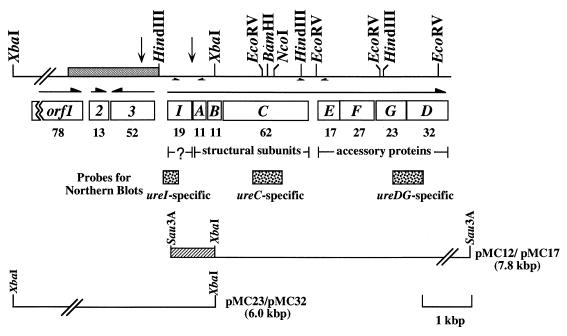
FIG. 1
FIG. 1
ure cluster and the 5′ flanking region on the S. salivarius 57.I chromosome. A restriction endonuclease map of the chromosome containing the ure cluster and the 5′ flanking region is shown on the top line. The limits of the DNA sequence shown in Fig. 2 are indicated by vertical arrows. The relative location and the direction of transcription of each ORF are indicated by horizontal arrows. The molecular mass in kilodaltons of each gene product is shown below each gene. The locations and orientations of primer pairs used in RT-PCR are indicated by arrows immediately under the restriction map. The Sau3A-XbaI region from pMC12, used as a probe for identifying pMC32, is indicated in a hatched box. The region used for the construction of pCW45 and pMC77 (see below) for integration is indicated in a shaded box within the restriction map.
FIG. 2
FIG. 2
Nucleotide and deduced amino acid sequences of the 5′ flanking region of the ure cluster. ORF3 and ureI are transcribed from the opposite DNA strands; thus, the sequence of ureI presented here is the coding strand, and the sequence of ORF3 is the noncoding strand. The locations and orientations of primers (PureIas-100 and PMC32-1) used to identify the transcriptional start site of ureI and of primers used to amplify PureI and PureIΔ100 (PureIs, PureIde12, and PureIas) are indicated by horizontal arrows. The transcriptional start site of ureI, determined by primer extension analysis, is indicated by a vertical arrow, and the corresponding −10 and −35 regions are overlined. The sequences of the inverted repeats 5′ to PureI are shaded.
FIG. 3
FIG. 3
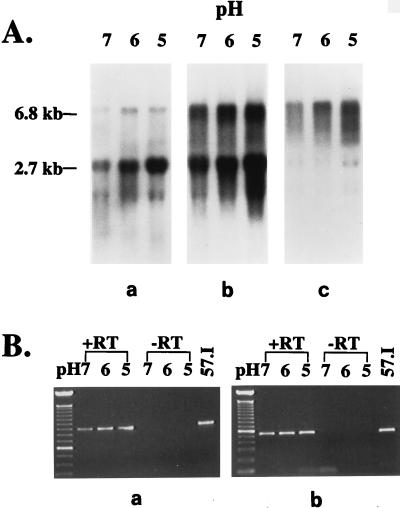
(A) Northern blot analysis of ure-specific messages. Ten micrograms of total cellular RNA from cultures at each pH level was probed with a ureI-specific probe (a), a ureC-specific probe (b), and a ureDG-specific probe (c). (B) PCR products generated from RT-PCR. 1% of total cDNA generated by RT-PCR from each RNA sample was amplified with specific primers (Fig. 1), and 10% of the PCR products were run on a 0.8% Tris-borate-EDTA gel. Some PCR products were generated with a primer pair specific for the ureIA intergenic region (a), and others were generated with a primer pair specific for the ureCE intergenic region (b). RT was included in some reactions (+RT), but not in control reactions which were carried out identically to the experimental samples (−RT). In other control reactions PCRs were used to amplify the target region from S. salivarius 57.I chromosomal DNA under the same conditions (57.I). The 100-bp DNA ladder was used as the molecular weight marker.
FIG. 4
FIG. 4
Primer extension analysis of PureI. Total cellular RNA of S. salivarius 57.I from steady-state cultures grown in a chemostat were used. Radiolabeled primer PMC32-1 was incubated with the RNA, and the corresponding DNA was synthesized. The same primer was used to prime dideoxy sequencing reactions with plasmid pMC32 as a template. Lanes 1 and 2 show total RNA isolated from pH 7.0 and pH 5.5 cultures, respectively, with 10 mM fructose. Lane 3 shows total RNA isolated from a pH 5.5 culture with 200 mM fructose.
FIG. 5
FIG. 5
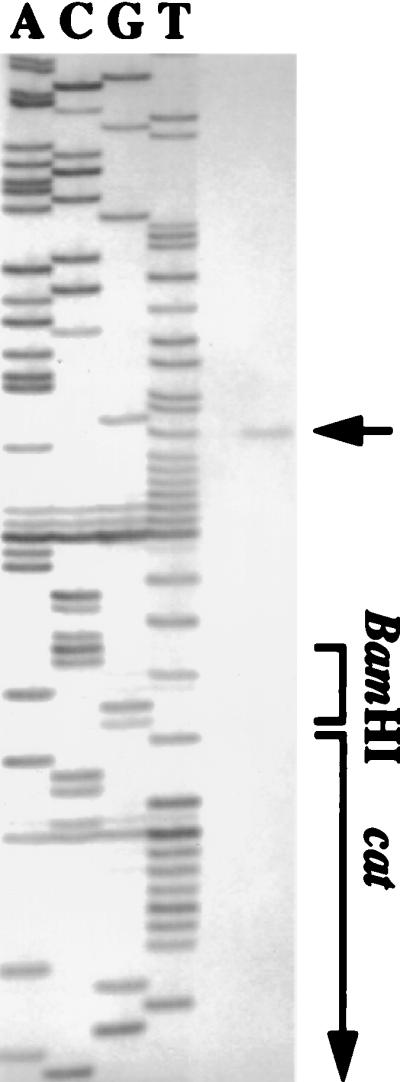
Primer extension analysis of PureIΔ100CAT. Total cellular RNA of S. salivarius PureIΔ100CAT from a steady-state culture grown at pH 5.5 with 20 mM glucose was isolated, and the radiolabeled primer cat (5′-AATGCCTCAAAATGT-3′) was used. The DNA sequences were derived from pMC71 with the same primer.

References

    1. Ausubel F M, Brent R, Kingston R E, Moore D D, Seidman J G, Smith J A, Struhl K. Current protocols in molecular biology. New York, N.Y: John Wiley and Sons; 1989.
    1. Bartolomé B, Jubete Y, Martinez E, dela Cruz F. Construction and properties of a family of pACYC184-derived cloning vectors compatible with pBR322. Gene. 1991;102:75–78. - PubMed
    1. Caparon M G, Scott J R. Genetic manipulation of pathogenic streptococci. Methods Enzymol. 1991;204:580–581. - PubMed
    1. Chen Y M, Burne R A. Analysis of Streptococcus salivarius urease expression using continuous chemostat culture. FEMS Microbiol Lett. 1996;135:223–229. - PubMed
    1. Chen Y M, Clancy K A, Burne R A. Streptococcus salivarius urease: genetic and biochemical characterization and expression in a dental plaque streptococcus. Infect Immun. 1996;64:585–592. - PMC - PubMed

Publication types

Associated data

LinkOut - more resources