. 1998 Nov;64(11):4333-9.
doi: 10.1128/AEM.64.11.4333-4339.1998.

Phylogenetic analysis of nonthermophilic members of the kingdom crenarchaeota and their diversity and abundance in soils

Affiliations

Phylogenetic analysis of nonthermophilic members of the kingdom crenarchaeota and their diversity and abundance in soils

DH Buckley et al. Appl Environ Microbiol. 1998 Nov.

Abstract

Within the last several years, molecular techniques have uncovered numerous 16S rRNA gene (rDNA) sequences which represent a unique and globally distributed lineage of the kingdom Crenarchaeota that is phylogenetically distinct from currently characterized crenarchaeotal species. rDNA sequences of members of this novel crenarchaeotal group have been recovered from low- to moderate-temperature environments (-1.5 to 32 degreesC), in contrast to the high-temperature environments (temperature, >80 degreesC) required for growth of the currently recognized crenarchaeotal species. We determined the diversity and abundance of the nonthermophilic members of the Crenarchaeota in soil samples taken from cultivated and uncultivated fields located at the Kellogg Biological Station's Long-Term Ecological Research site (Hickory Corners, Mich.). Clones were generated from 16S rDNA that was amplified by using broad-specificity archaeal PCR primers. Twelve crenarchaeotal sequences were identified, and the phylogenetic relationships between these sequences and previously described crenarchaeotal 16S rDNA sequences were determined. Phylogenetic analyses included nonthermophilic crenarchaeotal sequences found in public databases and revealed that the nonthermophilic Crenarchaeota group is composed of at least four distinct phylogenetic clusters. A 16S rRNA-targeted oligonucleotide probe specific for all known nonthermophilic crenarchaeotal sequences was designed and used to determine their abundance in soil samples. The nonthermophilic Crenarchaeota accounted for as much as 1.42% +/- 0.42% of the 16S rRNA in the soils analyzed.


Figures

FIG. 1
FIG. 1
Phylogenetic tree showing the relationships of nonthermophilic Crenarchaeota 16S rDNA sequences. The environments from which clones were recovered and the studies in which the clones were examined are listed in Table 2. The symbols indicate the specificities of crenarchaeotal probe Cren499R (8) (⧫), probes Cren667 (11) and GI-554 (22) (■), and probe Cren745 (this study) (•). The sequences determined in this study are indicated by boldface type. C. symbiosum, Cenarchaeum symbiosum.
FIG. 2
FIG. 2
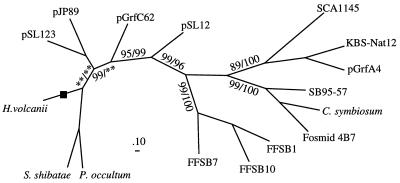
Phylogenetic tree generated by using maximum-likelihood analysis for 740 nucleotide positions between E. coli 16S rDNA positions 1 and 915. The bootstrap value to the left of each backslash was generated by using maximum-likelihood analysis, and the value to the right was generated by using parsimony analysis. Bootstrap values that were less than 50% are indicated by two asterisks. Scale bar = 10% difference between nucleotide sequences. S. shibatae, Sulfolobus shibatae; P. occultum, Pyrodictum occultum.
FIG. 3
FIG. 3
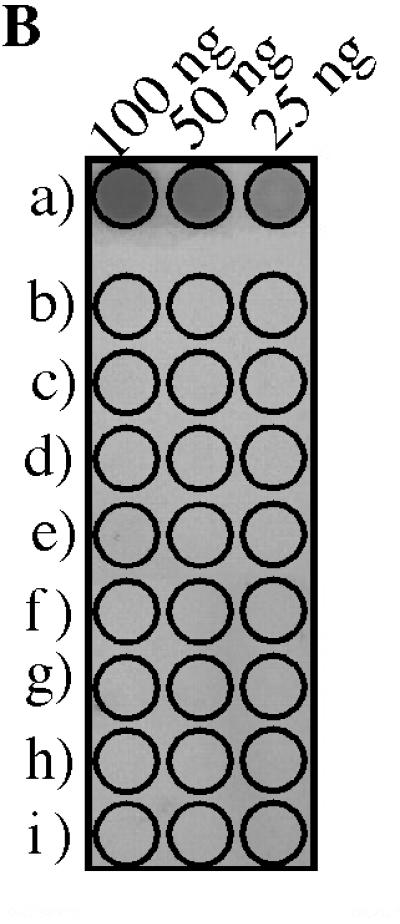
Cren745 oligonucleotide probe sequence aligned with its target sequence from nonthermophilic crenarchaeotal 16S rRNA and nontarget sequences used as negative controls. Bases not shared with the target sequence are indicated, while bases shared with the target sequence are indicated by dots. To demonstrate specificity, Cren745 was hybridized to 100, 50, and 25 ng of total RNA from each of the controls. M. RFM-3, Methanobrevibacter sp. strain RFM-3.
FIG. 3
FIG. 3
Cren745 oligonucleotide probe sequence aligned with its target sequence from nonthermophilic crenarchaeotal 16S rRNA and nontarget sequences used as negative controls. Bases not shared with the target sequence are indicated, while bases shared with the target sequence are indicated by dots. To demonstrate specificity, Cren745 was hybridized to 100, 50, and 25 ng of total RNA from each of the controls. M. RFM-3, Methanobrevibacter sp. strain RFM-3.
FIG. 4
FIG. 4
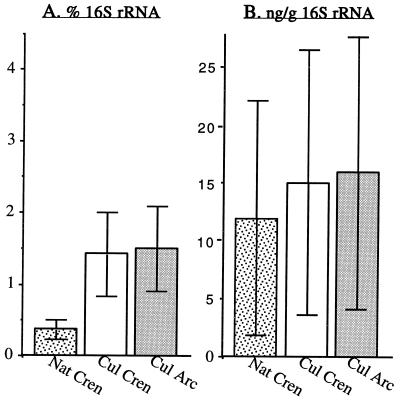
(A) Relative abundance of nonthermophilic crenarchaeotal 16S rRNA in soil samples from native (Nat Cren) or cultivated (Cul Cren) fields, as well as relative abundance of archaeal 16S rRNA in the cultivated field samples (Cul Arc). (B) Amounts of crenarchaeotal 16S rRNA per gram (dry weight) of soil, as estimated by normalizing the abundance of 16S rRNA to the total amount of community 16S rRNA recovered from the soils. The error bars indicate sample standard errors; the sample sizes were 9 for native field samples and 8 for cultivated field samples.

References

    1. Alm E W, Oerther D B, Larsen N, Stahl D A, Raskin L. The oligonucleotide probe database. Appl Environ Microbiol. 1996;62:3557–3559. - PMC - PubMed
    1. Amann R I, Ludwig W, Schleifer K-H. Phylogenetic identification and in situ detection of individual microbial cells without cultivation. Microbiol Rev. 1995;59:143–169. - PMC - PubMed
    1. Barns S M, Delwiche C F, Palmer J D, Pace N R. Perspectives on archaeal diversity, thermophily and monophyly from environmental rRNA sequences. Proc Natl Acad Sci USA. 1996;93:9188–9193. - PMC - PubMed
    1. Barns S M, Fundyga R E, Jeffries M W, Pace N R. Remarkable archaeal diversity detected in a Yellowstone National Park hot spring environment. Proc Natl Acad Sci USA. 1994;91:1609–1613. - PMC - PubMed
    1. Bintrim S B, Donohue T J, Handelsman J, Roberts G P, Goodman R M. Molecular phylogeny of archaea from soil. Proc Natl Acad Sci USA. 1997;94:277–282. - PMC - PubMed

LinkOut - more resources