


Identification of a marine agarolytic pseudoalteromonas isolate and characterization of its extracellular agarase
- PMID: 9797294
- PMCID: PMC106656
- DOI: 10.1128/AEM.64.11.4378-4383.1998
Identification of a marine agarolytic pseudoalteromonas isolate and characterization of its extracellular agarase
Abstract
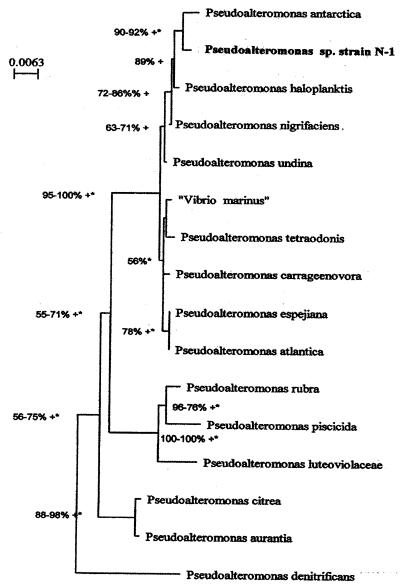
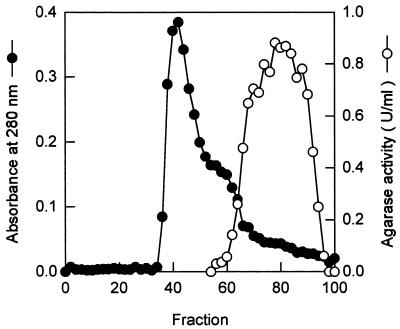
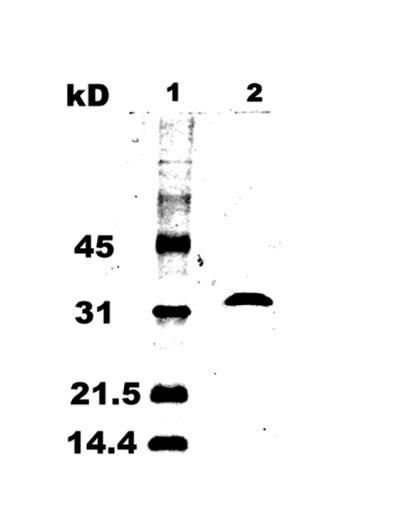
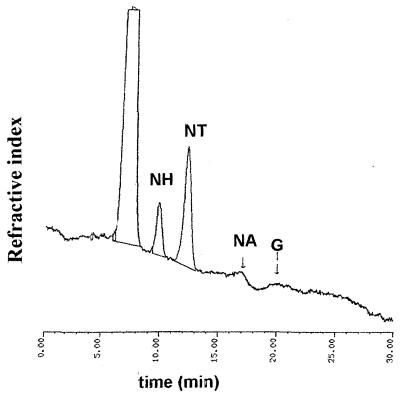
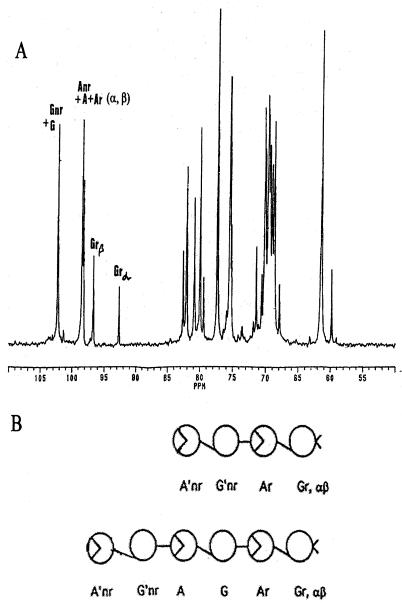
The phenotypic and agarolytic features of an unidentified marine bacteria that was isolated from the southern Pacific coast was investigated. The strain was gram negative, obligately aerobic, and polarly flagellated. On the basis of several phenotypic characters and a phylogenetic analysis of the genes coding for the 16S rRNA, this strain was identified as Pseudoalteromonas antarctica strain N-1. In solid agar, this isolate produced a diffusible agarase that caused agar softening around the colonies. An extracellular agarase was purified by ammonium sulfate precipitation, gel filtration, and ion-exchange chromatography on DEAE-cellulose. The purified protein was determined to be homogeneous on the basis of sodium dodecyl sulfate-polyacrylamide gel electrophoresis, and it had a molecular mass of 33 kDa. The enzyme hydrolyzed the beta-1,4-glycosydic linkages of agar, yielding neoagarotetraose and neoagarohexaose as the main products, and exhibited maximal activity at pH 7. The enzyme was stable at temperatures up to 30 degreesC, and its activity was not affected by salt concentrations up to 0.5 M NaCl.
Figures

References
-
- Agbo J A C, Moss M O. The isolation and characterization of agarolytic bacteria from a lowland river. J Gen Microbiol. 1979;115:355–368.
-
- Akagawa-Matsushita M, Matsuo M, Koga Y, Yamasato K. Alteromonas atlantica sp. nov. and Alteromonas carrageenovora sp. nov., bacteria that decompose algal polysaccharides. Int J Syst Bacteriol. 1992;42:621–627.
-
- Aoki T, Araki T, Kitamikado M. Purification and characterization of a novel β-agarase from Vibrio sp. AP-2. Eur J Biochem. 1990;187:461–465. - PubMed
-
- Ausubel F, Brent R, Kingston R, Moore D, Seidman J, Smith J, Struhl K. Current protocols in molecular biology. New York, N.Y: John Wiley & Sons, Inc.; 1987. pp. 2.4.1–2.4.2.
-
- Barbeyron H, Kloareg B. The gene encoding the kappa-carragenase of Alteromonas carrageenovora is related to β-1,3-1,4-glucanases. Gene. 1994;139:105–109. - PubMed
LinkOut - more resources
Full Text Sources
Other Literature Sources
Molecular Biology Databases
