. 1998 Nov;180(22):5896-905.
doi: 10.1128/JB.180.22.5896-5905.1998.

Targeted mutagenesis of sigma54 activator proteins in Myxococcus xanthus

Affiliations

Targeted mutagenesis of sigma54 activator proteins in Myxococcus xanthus

L Gorski et al. J Bacteriol. 1998 Nov.

Abstract

Myxococcus xanthus DNA segments related to the highly conserved central sequence of sigma54 activator proteins have been investigated. A genetic technique designed to inactivate a gene that encodes such an activator by inserting a plasmid-borne internal fragment of the putative gene has been tested. When the internal fragment inserted by homologous recombination into the corresponding chromosomal locus, the expected duplication of the gene was observed by Southern hybridization. The single restriction fragment characteristic of each segment was replaced in the insertion strains by two hybridizing fragments, and one of these fragments hybridized with the kanamycin resistance gene of the plasmid vector. The combined molecular weights of the two fragments from the insertion strains were equal to the molecular weight of the original fragment plus the expected molecular weight contributed by the vector. In the duplication, one copy is expected to have an N-terminal deletion and the other copy is expected to have a C-terminal deletion. In most cases, the net result should be loss of activator function. If an activator is essential for vegetative growth, then it should not be possible to obtain the insertion strain by plasmid integration. Indeed, integrants for three of the segments were not obtained in repeated trials; however, a plausible explanation for these results other than lethality can be offered. Of the seven insertions validated by Southern hybridization, four strains exhibited defects in the development of fruiting bodies. One of these failed to develop in submerged culture, though it developed normally on agar. The other three showed arrested development of fruiting bodies, each at a morphologically different stage of aggregation. One of the mutants may be defective in the reception pathway of A-signal.


Figures

FIG. 1
FIG. 1
Common structure of ς54 activator proteins. The N-terminal domain is the least conserved among genera and has a length which ranges from 12 to 400 amino acids. Some activators are phosphorylated on an aspartate residue in this domain (P). The C-terminal domain of 65 to 130 amino acids has a helix-turn-helix (HTH) motif characteristic of DNA binding proteins. The central domain of about 240 amino acids is the most highly conserved and has an ATP binding motif. Approximate locations of the PCR primers used to amplify the central domain are indicated by the converging arrows. Consensus data are from reference .
FIG. 2
FIG. 2
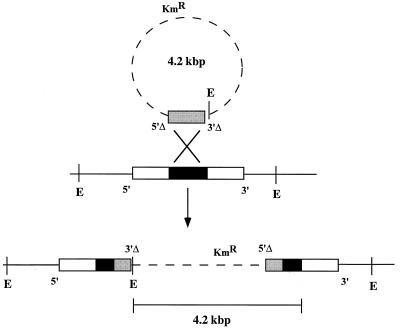
Gene disruption in M. xanthus by homologous recombination. A plasmid that carries an internal fragment of the ς54 activator target gene (shaded box) recognizes its homolog within the genome (black box). Because the PCR-amplified fragment is completely internal to the central domain (Fig. 1), that fragment can be considered to have the 5′ end of the activator gene (5′Δ) and the 3′ end of the gene (3′Δ) deleted. A single homologous crossover event should lead to a tandem duplication of the internal gene fragment and incorporation of the vector into the chromosomal gene, resulting in a knockout (or null) mutation in that gene. The vector bears the gene that encodes kanamycin resistance. E indicates sites of restriction enzyme cleavage used for Southern blot analysis.
FIG. 3
FIG. 3
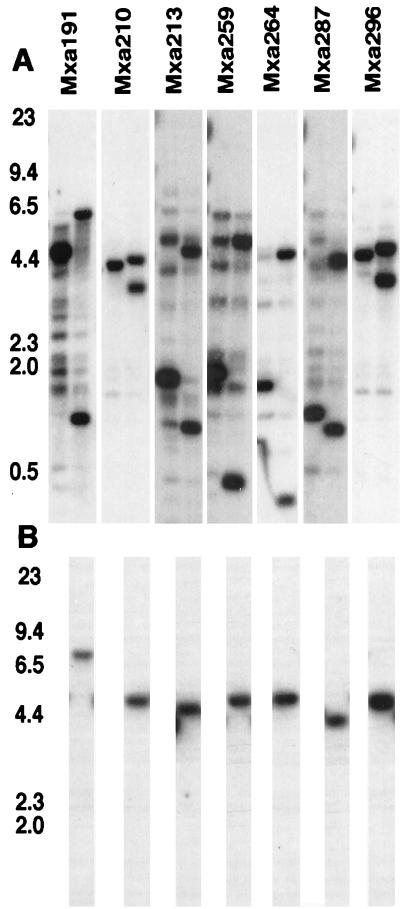
Southern blots of the insertion strains. Approximately 1 μg of DNA was loaded in each lane. DNA preparations were restricted with SmaI. SmaI sites are indicated with an E in the diagram of Fig. 2. Probes are listed across the top. The first lane of each blot contains wild-type DNA, and the second lane contains DNA from the insertion mutant. The locations of standard size markers (with sizes in kilobases) are indicated. Each blot has been probed with the PCR fragment used to create that mutant. (B) DNAs from the wild type and each of the mutants were also probed with a portion of the kanamycin resistance gene from pBGS18. Standard size markers of 23, 9.4, 6.5, 4.4, 2.3, and 2.0 kb are shown.
FIG. 4
FIG. 4
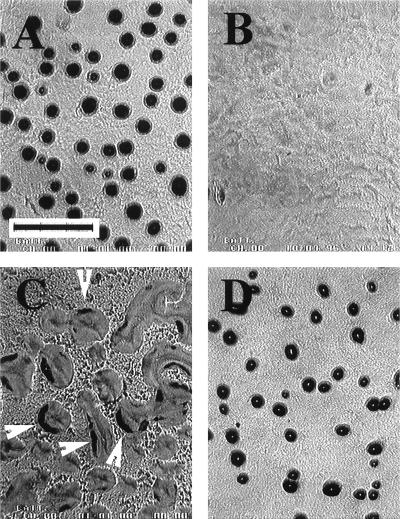
Development of strains on TPM agar at 24 h. (A) Wild type; (B) Mxa287; (C) Mxa213; (D) Mxa259. Arrowheads indicate incompletely closed structures. The scale bar in panel A measures 0.15 cm, and the scale is the same for all frames.
FIG. 5
FIG. 5
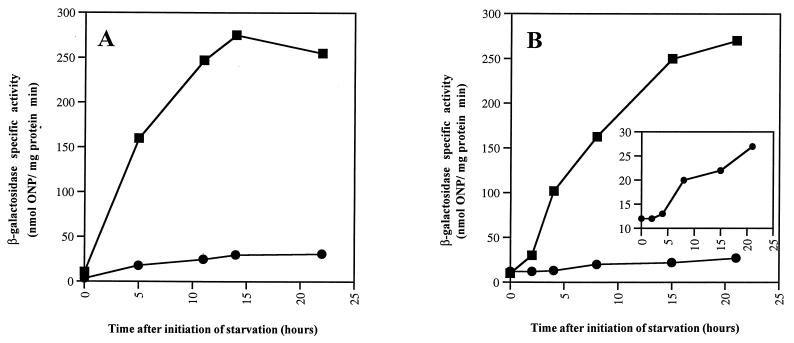
Expression of β-galactosidase from the Tn5lac Ω4521 reporter. (A) Strain Mxa296. The squares indicate β-galactosidase specific activity from cells developed on TPM agar, and the circles indicate β-galactosidase specific activity from cells in submerged culture. (B) Strain Mxa287. The squares reflect β-galactosidase expression in a wild-type background, and the circles show expression in a Mxa287 mutant background. The inset shows Ω4521 expression in the Mxa287 mutant background plotted on a more sensitive scale. ONP, o-nitrophenyl.
FIG. 6
FIG. 6
Expression of developmentally regulated Tn5lac reporter fusions in Mxa287. The squares represent β-galactosidase specific activity in a wild-type background, and the circles represent β-galactosidase specific activity of the fusions in a Mxa287 mutant background. ONP, o-nitrophenyl.

References

    1. Avery L, Kaiser D. In situ transposon replacement and isolation of a spontaneous tandem genetic duplication. Mol Gen Genet. 1983;191:99–109. - PubMed
    1. Bowden M G, Kaplan H B. The Myxococcus xanthus developmentally expressed asgB-dependent genes can be targets of the A signal-generating or A signal-responding pathway. J Bacteriol. 1996;178:6628–6631. - PMC - PubMed
    1. Bretscher A P, Kaiser D. Nutrition of Myxococcus xanthus, a fruiting myxobacterium. J Bacteriol. 1978;133:763–768. - PMC - PubMed
    1. Brun Y V, Shapiro L. A temporally controlled ς-factor is required for polar morphogenesis and normal cell division in Caulobacter. Genes Dev. 1992;6:2395–2408. - PubMed
    1. Campos J M, Geisselsoder J, Zusman D R. Isolation of bacteriophage Mx4, a generalized transducing phage for Myxococcus xanthus. J Mol Biol. 1978;119:167–178. - PubMed

Publication types

MeSH terms

LinkOut - more resources