. 1998 Nov;180(22):5978-83.
doi: 10.1128/JB.180.22.5978-5983.1998.

Fitness landscapes for effects of shape on chemotaxis and other behaviors of bacteria

Affiliations

Fitness landscapes for effects of shape on chemotaxis and other behaviors of bacteria

D B Dusenbery. J Bacteriol. 1998 Nov.

Abstract

Data on the shapes of 218 genera of free-floating or free-swimming bacteria reveal groupings around spherical shapes and around rod-like shapes of axial ratio about 3. Motile genera are less likely to be spherical and have larger axial ratios than nonmotile genera. The effects of shape on seven possible components of biological fitness were determined, and actual fitness landscapes in phenotype space are presented. Ellipsoidal shapes were used as models, since their hydrodynamic drag coefficients can be rigorously calculated in the world of low Reynolds number, where bacteria live. Comparing various shapes of the same volume, and assuming that departures from spherical have a cost that varies with the minimum radius of curvature, led to the following conclusions. Spherical shapes have the largest random dispersal by Brownian motion. Increased surface area occurs in oblate ellipsoids (disk-like), which rarely occur. Elongation into prolate ellipsoids (rod-like) reduces sinking speed, and this may explain why some nonmotile genera are rod-like. Elongation also favors swimming efficiency (to a limited extent) and the ability to detect stimulus gradients by any of three mechanisms. By far the largest effect (several hundred-fold) is on temporal detection of stimulus gradients, and this explains why rod-like shapes and this mechanism of chemotaxis are common.


Figures
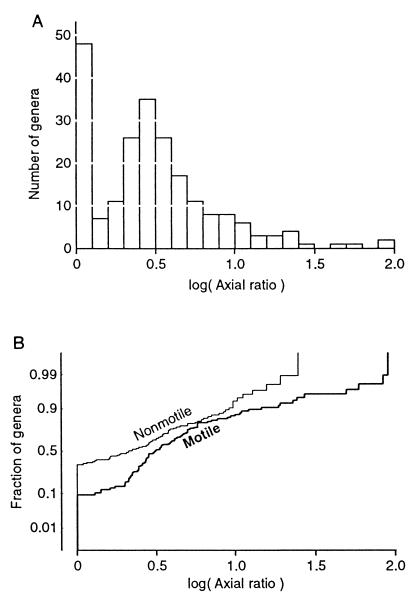
FIG. 1
FIG. 1
Distribution of axial ratios. (A) Distribution of axial ratios for 218 genera of unconstrained bacteria. The median axial ratio is 2.82. (B) Cumulative distributions for the 97 motile and 94 nonmotile genera. On the cumulative probability scale ( [p. 118]), a normal distribution falls on a straight line.
FIG. 2
FIG. 2
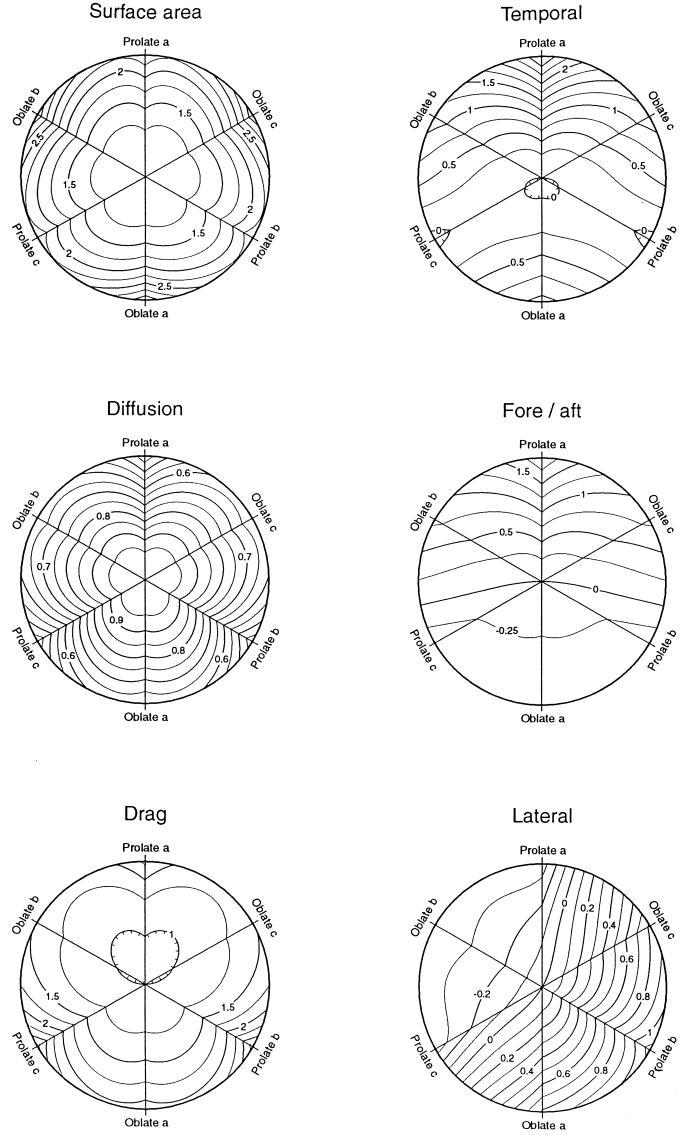
Contour plots of possible fitness components for equal-volume ellipsoids of all shapes. The values of the contours are relative to an equal-volume sphere. The sphere (a = b = c) is at the center, and the distance from the center is proportional to the negative log of the minimum radius of curvature occurring in each ellipsoid compared to the radius of the equal-volume sphere. At the outer edge of the plots, ellipsoids have a minimum radius of curvature of 1% that of the sphere. The three axes of the plots encompass the shapes in which two axes of the ellipsoid are identical (ellipsoids of revolution). At one end of each axis, prolate ellipsoids, with semiaxes equal to some permutation of (10, 10−1/2, 10−1/2), resemble rods, with axial ratios of 32; at the opposite end, oblate ellipsoids with semiaxes (10−4/5, 102/5, 102/5) resemble disks with axial ratios of 0.063. (Left) in Surface area, the contour values are the surface area of equal-volume ellipsoids; in Diffusion, the contours are the diffusion coefficients of equal-volume ellipsoids (equation 6); in Drag, the contour values are the frictional drag coefficient (fa′) for translation along axis a (equation 4). For the latter, the values within the innermost contour are less than 1, indicating that these shapes have a lower drag than an equal-volume sphere. (Right) Contour values are measures of the sensitivity a free-swimming organism can have in detecting the direction of a stimulus gradient by one of three mechanisms. In all three plots, the contour value is the log of a parameter proportional to the signal-to-noise ratio and sensitive to the shape of the organism. In Temporal, the parameter is (τa3/2 fa−1/2), which is proportional to the maximum signal-to-noise ratio for organisms employing temporal mechanisms and swimming in the direction of axis a. In Fore/aft, the parameter is (a τa1/2), which is proportional to the maximum signal-to-noise ratio for organisms employing fore-and-aft comparisons. In Lateral, the parameter is (bτ′1/2), which is proportional to the signal-to-noise ratio for organisms employing lateral comparisons, and τ′ is the smaller of τa′ or τb′.

References

    1. Berg H C. Random walks in biology. Princeton, N.J: Princeton University Press; 1993.
    1. Berg H C, Purcell E M. Physics of chemoreception. Biophys J. 1977;20:193–219. - PMC - PubMed
    1. Cooper S. Bacterial growth and division. San Diego, Calif: Academic Press; 1991.
    1. Cooper S, Denny M W. A conjecture on the relationship of bacterial shape to motility in rod-shaped bacteria. FEMS Microbiol Lett. 1997;148:227–231.
    1. Cox R G. The motion of long slender bodies in a viscous fluid. Part 1. General theory. J Fluid Mech. 1970;44:791–810.

MeSH terms

LinkOut - more resources