. 1998 Dec;72(12):9835-43.
doi: 10.1128/JVI.72.12.9835-9843.1998.

Adeno-associated virus type 2-mediated gene transfer: role of epidermal growth factor receptor protein tyrosine kinase in transgene expression

Affiliations

Adeno-associated virus type 2-mediated gene transfer: role of epidermal growth factor receptor protein tyrosine kinase in transgene expression

C Mah et al. J Virol. 1998 Dec.

Abstract

Adeno-associated virus type 2 (AAV), a single-stranded, DNA-containing, nonpathogenic human parvovirus, has gained attention as a potentially useful vector for human gene therapy. However, the transduction efficiency of AAV vectors varies greatly in different cells and tissues in vitro and in vivo. We have recently documented that a cellular tyrosine phosphoprotein, designated the single-stranded D-sequence-binding protein (ssD-BP), plays an important role in AAV-mediated transgene expression (K. Y. Qing et al., Proc. Natl. Acad. Sci. USA 94:10879-10884, 1997) and that a strong correlation exists between the phosphorylation state of the ssD-BP and AAV transduction efficiency in vitro as well as in vivo (K. Y. Qing et al., J. Virol. 72:1593-1599, 1998). In this report, we document that treatment of cells with specific inhibitors of the epidermal growth factor receptor protein tyrosine kinase (EGF-R PTK) activity, such as tyrphostin, leads to significant augmentation of AAV transduction efficiency, and phosphorylation of the ssD-BP is mediated by the EGF-R PTK. Treatment of cells with EGF results in phosphorylation of the ssD-BP, whereas treatment with tyrphostin causes dephosphorylation of the ssD-BP and consequently leads to increased expression of the transgene. Furthermore, AAV transduction efficiency inversely correlates with expression of the EGF-R in different cell types, and stable transfection of the EGF-R cDNA causes phosphorylation of the ssD-BP, leading to significant inhibition in AAV-mediated transgene expression which can be overcome by the tyrphostin treatment. These data suggest that the PTK activity of the EGF-R is a crucial determinant in the life cycle of AAV and that further studies on the interaction between the EGF-R and the ssD-BP may yield new insights not only into its role in the host cell but also in the successful use of AAV vectors in human gene therapy.


Figures
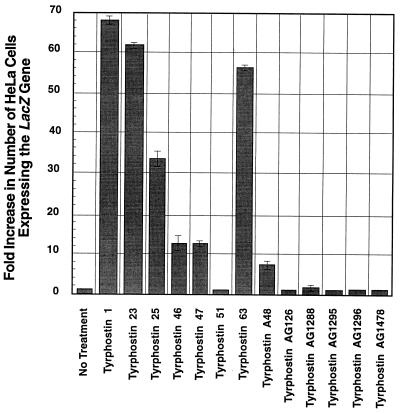
FIG. 1
FIG. 1
Comparative analyses of transduction efficiencies of vCMVp-lacZ in HeLa cells treated with 500 μM concentrations of various tyrphostins. Approximately equivalent numbers of HeLa cells were treated with each of the indicated compounds separately for 2 h and then infected with vCMVp-lacZ at an MOI of 2 under identical conditions. Forty-eight hours p.i., cells were fixed and stained with X-Gal, and the numbers of blue cells were determined as described in Materials and Methods.
FIG. 2
FIG. 2
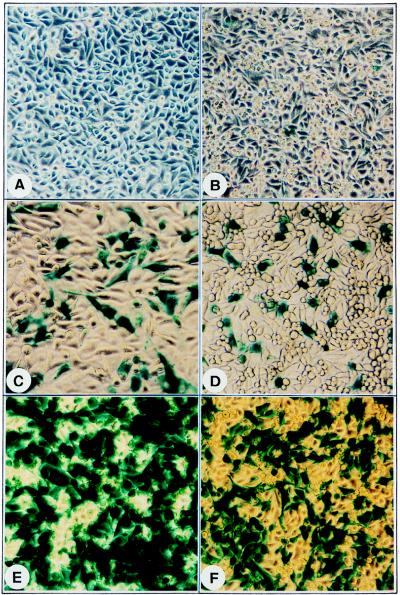
Comparative analyses of transduction efficiency of vCMVp-lacZ in HeLa cells (A) following either mock treatment (B) or treatment with HU (C), genistein (D), tyrphostin 1 (E), or tyrphostin 23 (F). Approximately equivalent numbers of HeLa cells were either mock treated or treated with the indicated compounds for 2 h and infected with the vCMVp-lacZ vector at an MOI of 2 under identical conditions. Forty-eight hours p.i., cells were fixed, stained with X-Gal, and photographed with a Nikon inverted light microscope. Magnification, ×80.
FIG. 3
FIG. 3
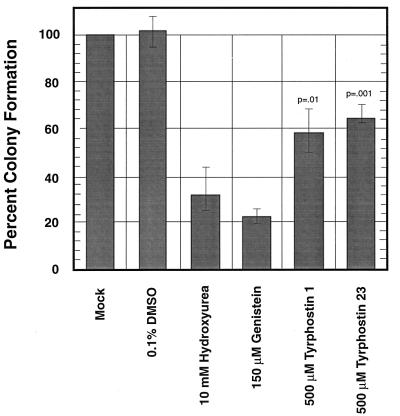
Effect of DMSO, HU, genistein, and tyrphostins on cell viability. Cytotoxicity assays with equivalent numbers of HeLa cells at optimal concentrations of each compound were performed under identical conditions as described in Materials and Methods. The P values for tyrphostin treatments compared with treatments with HU and genistein are indicated.
FIG. 4
FIG. 4
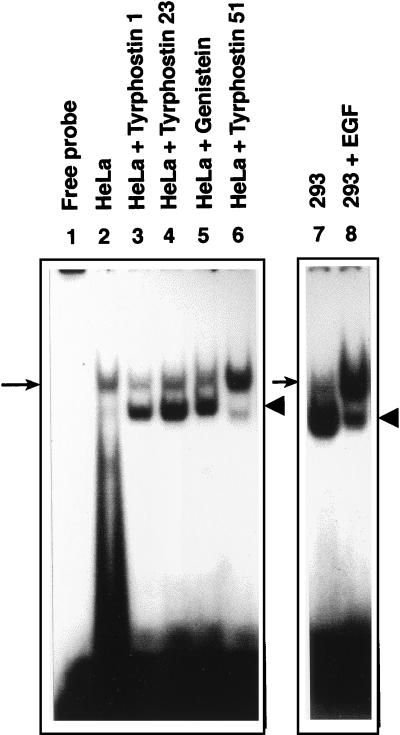
EMSA with WCE prepared from human HeLa and 293 cells. Equivalent amounts of WCE prepared from each indicated cell type were used in an EMSA with the D(−) probe as described in the text. The phosphorylated and dephosphorylated forms of the ssD-BP are indicated by the arrows and the arrowheads, respectively.
FIG. 5
FIG. 5
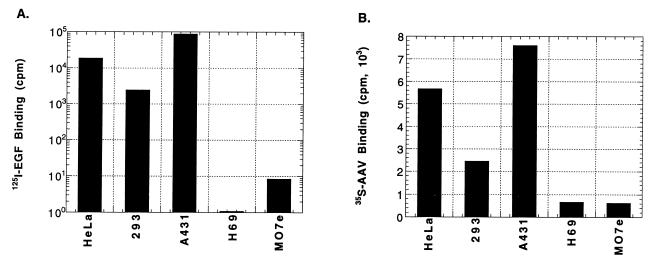
Analyses of binding of EGF and AAV to different cell types. Equivalent numbers of HeLa, 293, A431, H69, and M07e cells were analyzed in binding assays using either 125I-EGF (A) or 35S-AAV (B) as described in Materials and Methods.
FIG. 6
FIG. 6
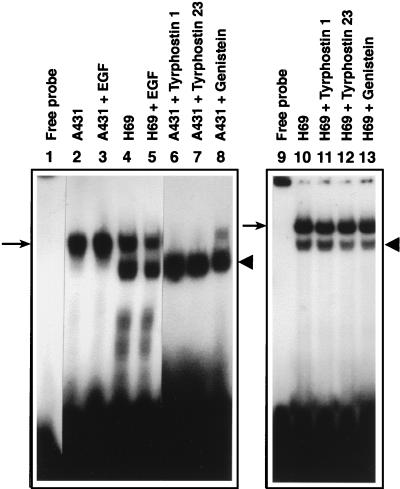
EMSA with WCE prepared from A431 and H69 cells following treatment with EGF, tyrphostin 1, tyrphostin 23, or genistein. Equivalent amounts of WCEs prepared from mock-treated A431 and H69 cells (lanes 2 and 4), from cells treated with EGF (lanes 3 and 5), and from A431 cells (lanes 6 to 8) and H69 cells (lanes 11 to 13) treated with tyrphostin 1, tyrphostin 23, and genistein, respectively, were used in an EMSA with the D(−) probe as described in Materials and Methods. The phosphorylated and dephosphorylated forms of the ssD-BP are indicated by the arrows and the arrowheads, respectively.
FIG. 7
FIG. 7
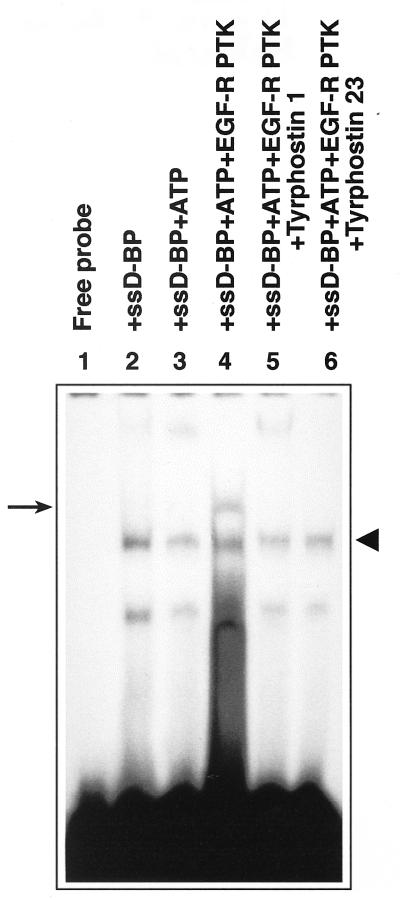
In vitro phosphorylation of the ssD-BP by the EGF-R PTK. Equivalent amounts of the affinity column-purified ssD-BP from 293 cells were incubated either alone (lane 2) or in the presence of ATP (lane 3), ATP plus EGF-R PTK (lane 4), ATP plus EGF-R PTK plus tyrphostin 1 (lane 5), or ATP plus EGF-R PTK plus tyrphostin 23 (lane 6) followed by EMSA with the D(−) probe as described in Materials and Methods. The phosphorylated and dephosphorylated forms of the ssD-BP are indicated by the arrow and the arrowhead, respectively.
FIG. 8
FIG. 8
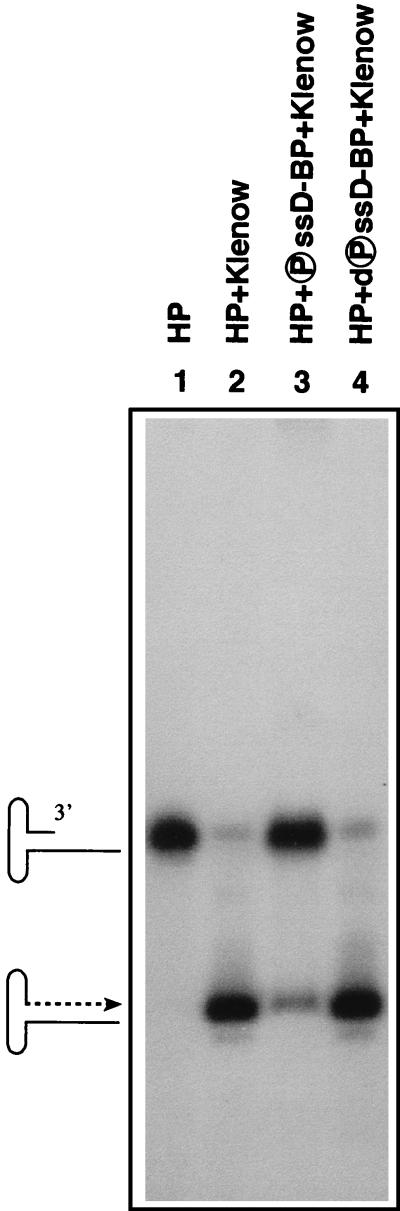
Effects of phosphorylated and dephosphorylated forms of the ssD-BP on AAV second-strand DNA synthesis in in vitro replication assays. The 32P-labeled single-stranded AAV DNA with the 3′ hairpin primer (lane 1) was used as a substrate for DNA synthesis with the Klenow fragment of E. coli DNA polymerase I and unlabeled deoxynucleoside triphosphates (lane 2) as well as in the presence of either the phosphorylated ssD-BP (lane 3) or the dephosphorylated ssD-BP (lane 4) under identical conditions. DNA samples were fractionated on a 6% polyacrylamide gel and autoradiographed as described in Materials and Methods.

References

    1. Akiyama T, Ishida J, Nakagawa S, Ogawara H, Watanabe S, Itoh N, Shibuya M, Fukami Y. Genistein, a specific inhibitor of tyrosine-specific protein kinases. J Biol Chem. 1987;262:5592–5595. - PubMed
    1. Alexander I E, Russell D W, Spence A M, Miller A D. Effects of gamma irradiation on the transduction of dividing and nondividing cells in brain and muscle of rats by recombinant adeno-associated virus vectors. Hum Gene Ther. 1996;7:841–850. - PubMed
    1. Barnes S, Peterson G T. Biochemical targets of the isoflavone genistein in tumor cell lines. Soc Exp Biol Med. 1995;280:103–109. - PubMed
    1. Berns K I, Bohenzky R A. Adeno-associated viruses: an update. Adv Virus Res. 1987;32:243–307. - PubMed
    1. Berns K I, Giraud C. Biology of adeno-associated virus. Curr Top Microbiol Immunol. 1996;218:1–23. - PubMed

Publication types