Comparative Study
. 1998 Dec;72(12):10157-64.
doi: 10.1128/JVI.72.12.10157-10164.1998.

The unique envelope gene of the subgroup J avian leukosis virus derives from ev/J proviruses, a novel family of avian endogenous viruses

Affiliations
Comparative Study

The unique envelope gene of the subgroup J avian leukosis virus derives from ev/J proviruses, a novel family of avian endogenous viruses

S J Benson et al. J Virol. 1998 Dec.

Abstract

A new subgroup of avian leukosis virus (ALV), designated subgroup J, was identified recently. Viruses of this subgroup do not cross-interfere with viruses of the avian A, B, C, D, and E subgroups, are not neutralized by antisera raised against the other virus subgroups, and have a broader host range than the A to E subgroups. Sequence comparisons reveal that while the subgroup J envelope gene includes some regions that are related to those found in env genes of the A to E subgroups, the majority of the subgroup J gene is composed of sequences either that are more similar to those of a member (E51) of the ancient endogenous avian virus (EAV) family of proviruses or that appear unique to subgroup J viruses. These data led to the suggestion that the ALV-J env gene might have arisen by multiple recombination events between one or more endogenous and exogenous viruses. We initiated studies to investigate the origin of the subgroup J envelope gene and in particular to determine the identity of endogenous sequences that may have contributed to its generation. Here we report the identification of a novel family of avian endogenous viruses that include env coding sequences that are over 95% identical to both the gp85 and gp37 coding regions of subgroup J viruses. We call these viruses the ev/J family. We also report the isolation of ev/J-encoded cDNAs, indicating that at least some members of this family are expressed. These data support the hypothesis that the subgroup J envelope gene was acquired by recombination with expressed endogenous sequences and are consistent with acquisition of this gene by only one recombination event.


Figures
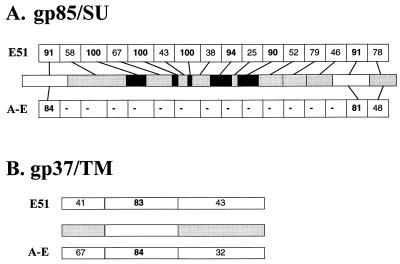
FIG. 1
FIG. 1
The SU and TM proteins of ALV-J include regions that are unique, regions that are similar to those of an ancient endogenous virus (E51), and regions related to those of other ALVs. The diagrams depict the predicted amino acid sequence of the gp85/SU (A) and gp37/TM (B) proteins of ALV-J compared with those of the ancient endogenous virus E51 and of the ALV A to E subgroups. White boxes depict regions that are common (over 80% identity) between all three env proteins, black boxes depict regions that are at least 90% identical between E51 and ALV-J Env, and shaded boxes depict regions that are less than 80% identical between any of the virus types.
FIG. 2
FIG. 2
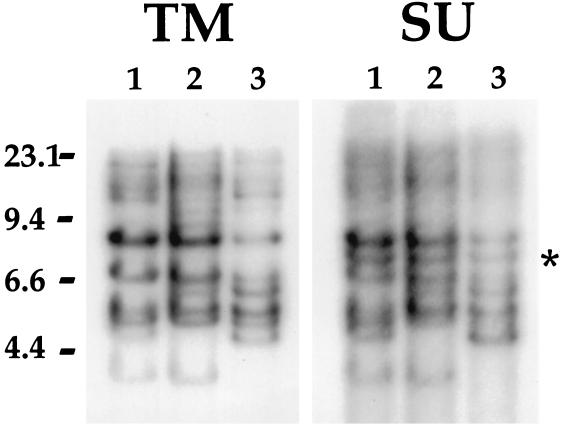
ALV-J-specific SU and TM probes detect endogenous sequences in Southern blots of ev-0 chicken genomic DNAs. Total genomic DNA isolated from three different ev-0 samples was purified, digested with EcoRI, and subjected to electrophoresis in 1% agarose gels. After Southern blotting, the filter was hybridized with probes generated by PCR by using the cloned isolate of ALV-J (ADOL-R5-4) as a template as described in Materials and Methods. (A) Results obtained with the 220-bp probe generated from the TM portion of the env gene. (B) Results obtained with the SU-specific probe. The filter was stripped between hybridizations and monitored to verify that the signal seen with the TM probe was removed before rehybridization with the SU probe. Lane 1, DF-1 DNA; lanes 2 and 3, erythrocyte DNA from two White Leghorn ev-0 chickens. As shown in panel A, the TM probe detects six clearly distinct EcoRI bands below 9.4 kbp in each sample; higher-molecular-weight fragments are variably present. Some bands are common to all samples, while others are unique to one sample. As shown in panel B, the SU probe detects the same fragments as were seen with the TM probe in addition to one unique fragment, marked by an asterisk. Numbers on the left are size markers in kilobase pairs.
FIG. 3
FIG. 3
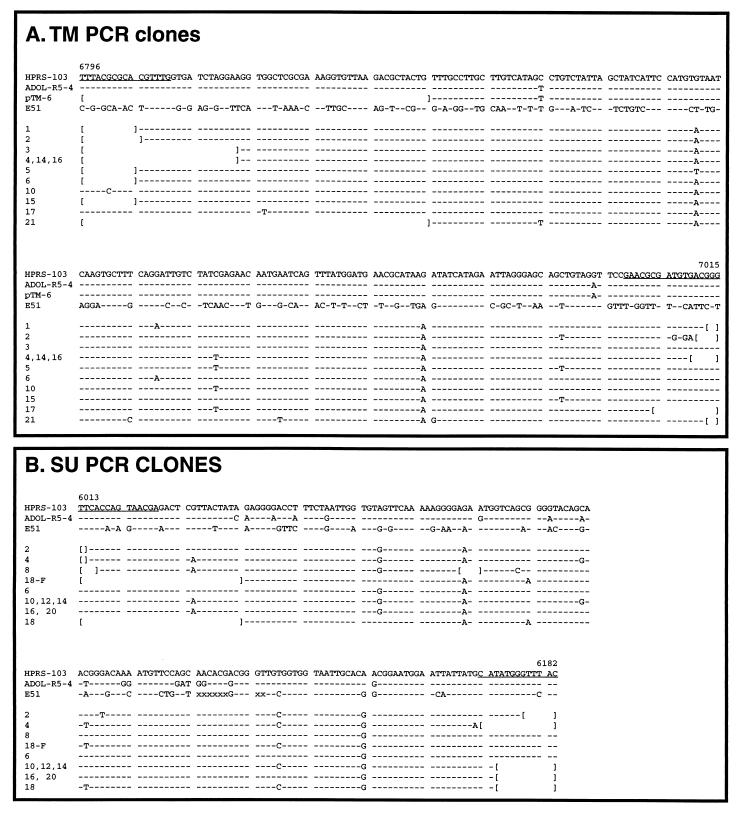
Sequence of endogenous ALV-J SU- and TM-related products amplified from ev-0 DNA. TM (A) and SU (B) sequences were amplified from DF-1 DNA by using the ALV-J-specific primers, cloned, and sequenced as described in Materials and Methods. The pTM6 clone is a subclone of the ADOL-R5-4 TM portion of the env gene that was amplified along with genomic DNA; the sequence obtained was identical to that of the original plasmid. Brackets indicate regions that were not sequenced, and dashes indicate sequence identity with the HPRS-103 sequence. Numbers above the HPRS-103 sequence are from reference . The underlined sequences define the oligonucleotides used in amplification reactions.
FIG. 4
FIG. 4
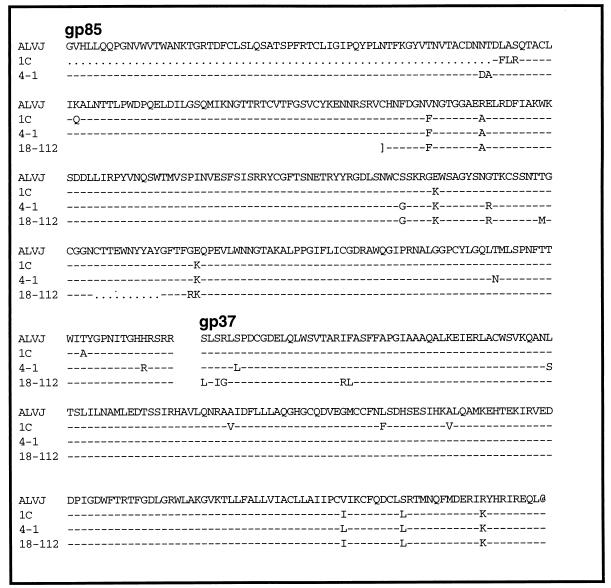
Predicted amino acid sequences of the ALV and ev/J env gene products. Endogenous env genes were sequenced from a phage clone isolated from a genomic library (1-C), a PCR product generated with ev/J-specific LTR primers (clone 4-1), and a c-DNA clone (18-112). The methods used to obtain each type of clone are described in Materials and Methods. The gap in the sequence denotes the boundary between gp85 and gp37. Dashes indicate identity with the ALV-J sequence, brackets define the boundary of sequenced regions, and dots indicate deletions in clones relative to ALV-J.

References

    1. Arshad S S, Bland A P, Hacker S M, Payne L N. A low incidence of histiocytic sarcomatosis associated with infection of chickens with the HPRS-103 strain of subgroup J avian leukosis virus. Avian Dis. 1997;41:947–956. - PubMed
    1. Astrin S M, Buss E G, Haywards W S. Endogenous viral genes are nonessential in the chicken. Nature. 1979;282:339–341. - PubMed
    1. Astrin S M, Robinson H L, Crittenden L B, Buss E G, Wyban J, Hayward W S. Ten genetic loci in the chicken that contain structural genes for endogenous avian leukosis viruses. Cold Spring Harbor Symp Quant Biol. 1980;44:1105–1109. - PubMed
    1. Bai J, Howes K, Payne L N, Skinner M A. Sequence of host-range determinants in the env gene of a full-length, infectious proviral clone of exogenous Avian Leukosis Virus HPRS-103 confirms that it represents a new subgroup (designated J) J Gen Virol. 1995;76:181–187. - PubMed
    1. Bai J, Payne L N, Skinner M A. HPRS-103 (exogenous avian leukosis virus, subgroup J) has an env gene related to those of endogenous elements EAV-0 and E51 and an E element found previously only in sarcoma viruses. J Virol. 1995;69:779–784. - PMC - PubMed

Publication types

Associated data

LinkOut - more resources