. 1998 Dec;72(12):10298-300.
doi: 10.1128/JVI.72.12.10298-10300.1998.

In vitro construction of pseudovirions of human papillomavirus type 16: incorporation of plasmid DNA into reassembled L1/L2 capsids

Affiliations

In vitro construction of pseudovirions of human papillomavirus type 16: incorporation of plasmid DNA into reassembled L1/L2 capsids

K Kawana et al. J Virol. 1998 Dec.

Abstract

Lack of permissive and productive cell cultures for the human papillomaviruses (HPVs) has hindered the study of virus-neutralizing antibodies and infection. We developed a cell-free system generating infectious HPV16 pseudovirions. HPV16 L1/L2 capsids, which had been self-assembled in insect cells (Sf9) expressing virion proteins L1 and L2, were disassembled with 2-mercaptoethanol (2-ME), a reducing agent, and reassembled by removal of 2-ME in the presence of a beta-galactosidase expression plasmid. Plasmid DNA purified together with the reassembled capsids was resistant to DNase I digestion. The reassembled pseudovirions mediated DNA transfer to COS-1 cells, as monitored by induced beta-galactosidase activity. Transfer was inhibited by anti-HPV16 L1 antiserum but not by antisera against L1s of HPV6 and HPV18. Construction in vitro of HPV pseudovirions containing marker plasmids would be potentially useful in developing methods to assay virus-neutralizing antibodies and to transfer exogenous genes to HPV-susceptible cells.


Figures
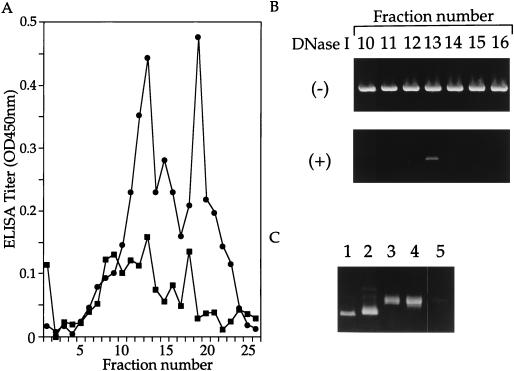
FIG. 1
FIG. 1
(A) Distributions of L1 and L2 in CsCl equilibrium density gradient centrifugation of reassembled HPV-16 L1/L2 capsids were examined by ELISA using anti-L1 and anti-L2 antibodies. The ELISA titer (optical density [OD] at 450 nm) for L1 (•) and for L2 (■) of each fraction was plotted. (B) Plasmid DNA in fractions was examined by PCR with primers specific for the β-galactosidase gene and template DNA extracted from the fractions with or without DNase I digestion. An amplified DNA fragment (838 bp) was electrophoresed on a 1% agarose gel and stained with ethidium bromide. (C) The linear form of pSV/β-gal obtained by digestion with HindIII (lane 1), the closed circular form (lane 2), the open circular form obtained by treatment with 10 units of topoisomerase I for 20 min at 37°C (lane 3), pSV/β-gal incubated in PBS containing 2-ME (5%) for 16 h at 4°C (lane 4), and DNA extracted from fraction 13 (lane 5) were electrophoresed on a 0.7% agarose gel and stained with ethidium bromide.
FIG. 2
FIG. 2
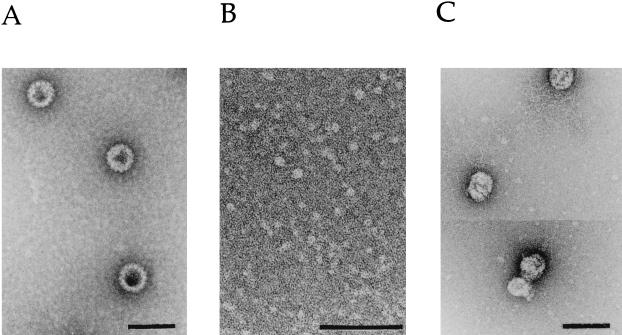
Electron microscopy of purified HPV-16 L1/L2 capsids (A), disassembled capsids (B), and reassembled capsids (C). Bars, 100 nm.
FIG. 3
FIG. 3
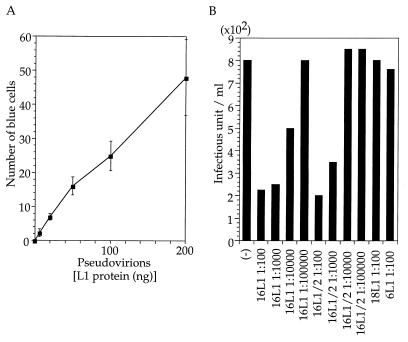
(A) Amount of L1 protein present in inoculum plotted against the number of blue cells. (B) Neutralization of pseudoinfection by antisera against HPV16 L1 capsids (16L1), HPV16 L1/L2 capsids (16L1/2), HPV18 L1 capsids (18L1), and HPV6 L1 capsids (6L1). Pseudovirions (80 ng) were mixed with PBS (−) or mouse antiserum diluted with PBS (indicated by, e.g., 1:100) and used to inoculate COS-1 cells. Infectivity was indicated by the number of blue cells (infectious unit) per ml.

References

    1. Hagensee M E, Olson N H, Baker T S, Galloway D A. Three-dimensional structure of vaccinia virus-produced human papillomavirus type 1 capsids. J Virol. 1994;68:4503–4505. - PMC - PubMed
    1. Kawana K, Matsumoto K, Yoshikawa H, Taketani Y, Kawana T, Yoshiike K, Kanda T. A surface immunodeterminant of human papillomavirus type 16 minor capsid protein L2. Virology. 1998;245:353–359. - PubMed
    1. Kirnbauer R, Taub J, Greenstone H, Roden R, Dürst M, Gissmann L, Lowy D R, Schiller J T. Efficient self-assembly of human papillomavirus type 16 L1 and L1-L2 into virus-like particles. J Virol. 1993;67:6929–6936. - PMC - PubMed
    1. Li M, Beard P, Estes P A, Lyon M K, Garcea R L. Intercapsomeric disulfide bonds in papillomavirus assembly and disassembly. J Virol. 1998;72:2160–2167. - PMC - PubMed
    1. Lorincz A T, Reid R, Jensen A B, Greenberg M D, Lancaster A W, Kurman R J. Human papillomavirus infection of the cervix: relative risk associations of 15 common anogenital types. Obstet Gynecol. 1991;79:328–337. - PubMed

Publication types

Substances

LinkOut - more resources