


Genetic instability of cancer cells is proportional to their degree of aneuploidy
- PMID: 9811862
- PMCID: PMC24881
- DOI: 10.1073/pnas.95.23.13692
Genetic instability of cancer cells is proportional to their degree of aneuploidy
Abstract
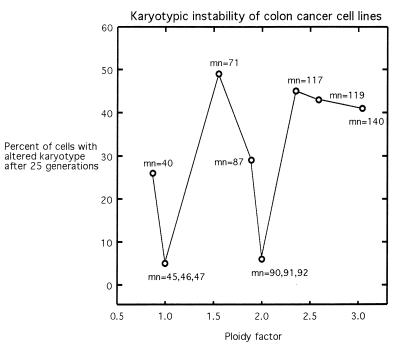
Genetic and phenotypic instability are hallmarks of cancer cells, but their cause is not clear. The leading hypothesis suggests that a poorly defined gene mutation generates genetic instability and that some of many subsequent mutations then cause cancer. Here we investigate the hypothesis that genetic instability of cancer cells is caused by aneuploidy, an abnormal balance of chromosomes. Because symmetrical segregation of chromosomes depends on exactly two copies of mitosis genes, aneuploidy involving chromosomes with mitosis genes will destabilize the karyotype. The hypothesis predicts that the degree of genetic instability should be proportional to the degree of aneuploidy. Thus it should be difficult, if not impossible, to maintain the particular karyotype of a highly aneuploid cancer cell on clonal propagation. This prediction was confirmed with clonal cultures of chemically transformed, aneuploid Chinese hamster embryo cells. It was found that the higher the ploidy factor of a clone, the more unstable was its karyotype. The ploidy factor is the quotient of the modal chromosome number divided by the normal number of the species. Transformed Chinese hamster embryo cells with a ploidy factor of 1.7 were estimated to change their karyotype at a rate of about 3% per generation, compared with 1.8% for cells with a ploidy factor of 0.95. Because the background noise of karyotyping is relatively high, the cells with low ploidy factor may be more stable than our method suggests. The karyotype instability of human colon cancer cell lines, recently analyzed by Lengnauer et al. [Lengnauer, C., Kinzler, K. W. & Vogelstein, B. (1997) Nature (London) 386, 623-627], also corresponds exactly to their degree of aneuploidy. We conclude that aneuploidy is sufficient to explain genetic instability and the resulting karyotypic and phenotypic heterogeneity of cancer cells, independent of gene mutation. Because aneuploidy has also been proposed to cause cancer, our hypothesis offers a common, unique mechanism of altering and simultaneously destabilizing normal cellular phenotypes.
Figures
References
-
- Nowell P C. Science. 1976;194:23–28. - PubMed
-
- Cairns J. Cancer: Science and Society. San Francisco: Freeman; 1978.
-
- Heim S, Mandahl N, Mitelman F. Cancer Res. 1988;48:5911–5916. - PubMed
-
- Sandberg A A. The Chromosomes in Human Cancer and Leukemia. 2nd Ed. New York: Elsevier; 1990.
-
- Mitelman F. Catalogue of Chromosome Aberrations in Cancer. 4th Ed. New York: Wiley–Liss; 1994. - PubMed
Publication types
MeSH terms
Substances
LinkOut - more resources
Full Text Sources
Other Literature Sources
