


Expanded diversity among Californian borrelia isolates and description of Borrelia bissettii sp. nov. (formerly Borrelia group DN127)
- PMID: 9817861
- PMCID: PMC105228
- DOI: 10.1128/JCM.36.12.3497-3504.1998
Expanded diversity among Californian borrelia isolates and description of Borrelia bissettii sp. nov. (formerly Borrelia group DN127)
Abstract
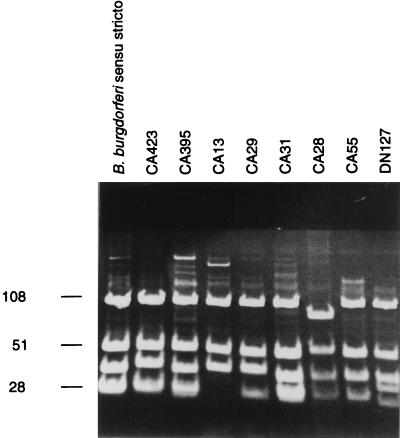
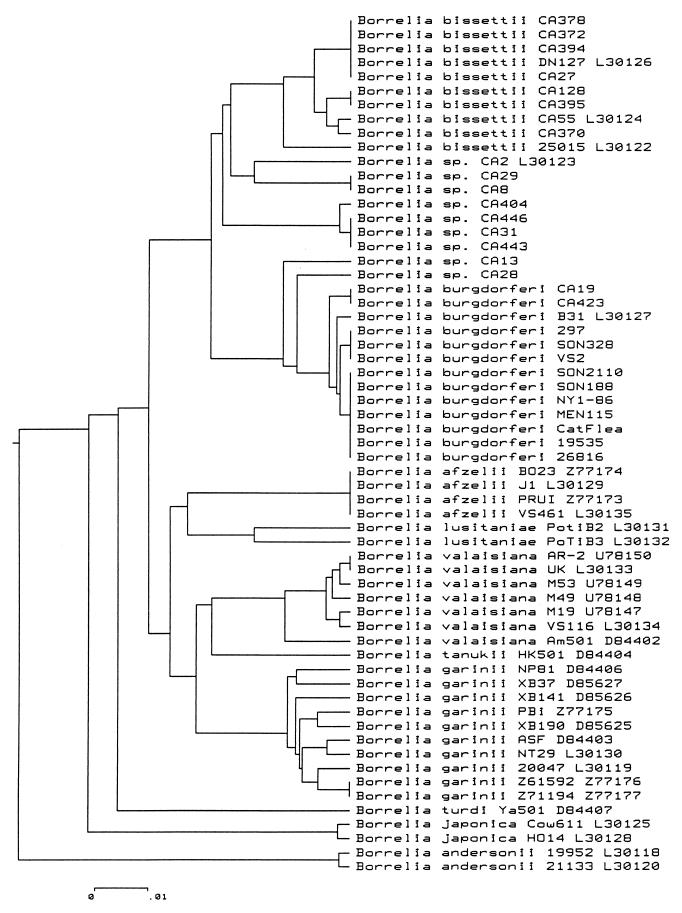
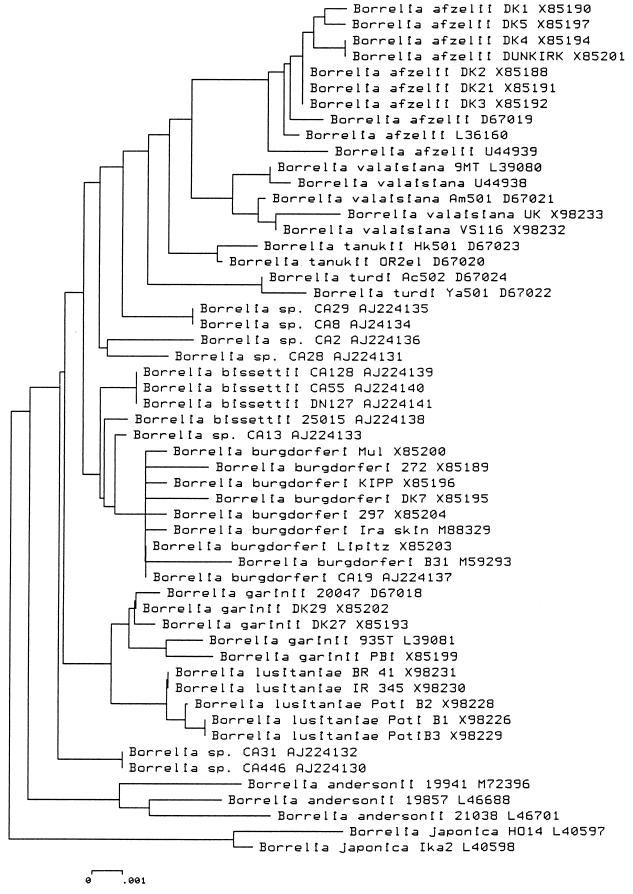
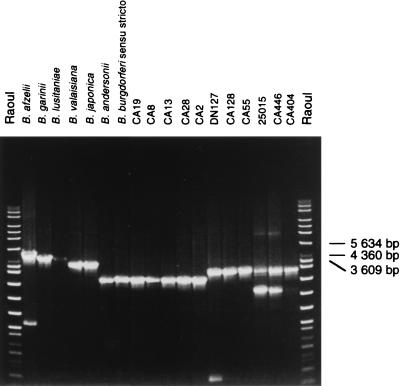
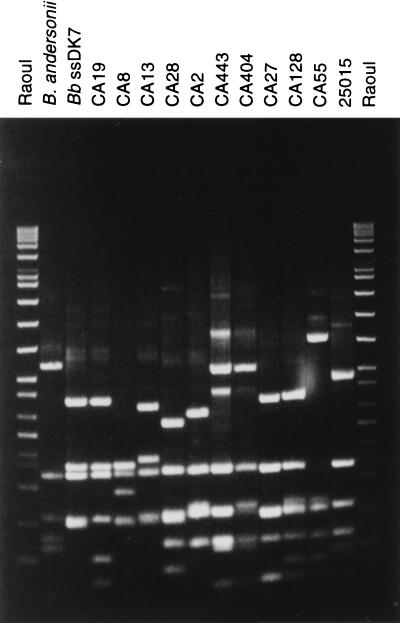
Up to now, the only species in the complex Borrelia burgdorferi sensu lato known to cause Lyme borreliosis in the United States has been B. burgdorferi sensu stricto. However, some atypical strains closely related to the previously designated genomic group DN127 have been isolated in the United States, mostly in California. To explore the diversity of B. burgdorferi sensu lato group DN127, we analyzed the nucleotide sequences of the rrf-rrl intergenic spacer regions from 19 atypical strains (18 from California and one from New York) and 13 North American B. burgdorferi sensu stricto strains (6 from California). The spacer region sequences from the entire B. burgdorferi sensu lato complex available in data banks were used for comparison. Phylogenetic analysis of sequences shows that the main species of the B. burgdorferi sensu lato complex (B. afzelii, B. garinii, B. andersonii, B. japonica, B. burgdorferi sensu stricto, B. valaisiana, and B. lusitaniae) each form a coherent cluster. A heterogeneous group comprising strains belonging to the previously designated group DN127 clustered separately from B. burgdorferi sensu stricto. Within this cluster, the deep branches expressing the distances between the rrf-rrl sequences reflect a high level of divergence. This unexpected diversity contrasts with the monomorphism exhibited by B. burgdorferi sensu stricto. To clarify the taxonomic status of this highly heterogeneous group, analysis of the rrs sequences of selected strains chosen from deeply separated branches was performed. The results show that these strains significantly diverge at a level that is compatible with several distinct genomic groups. We conclude that the taxonomy and phylogeny of North American B. burgdorferi sensu lato should be reevaluated. For now, we propose that the genomic group DN127 should be referred to as a new species, B. bissettii sp. nov., and that other related but distinct strains, which require further characterization, be referred to as Borrelia spp.
Figures
References
-
- Assous M V, Postic D, Paul G, Névot P, Baranton G. Western blot analysis of sera from Lyme borreliosis patients according to the genomic species of the Borrelia strains used as antigens. Eur J Clin Microbiol Infect Dis. 1993;12:261–268. - PubMed
-
- Assous M V, Postic D, Paul G, Névot P, Baranton G. Individualisation of two genomic groups among American Borrelia burgdorferi sensu lato strains. FEMS Microbiol Lett. 1994;121:93–98. - PubMed
-
- Balmelli T, Piffaretti J C. Analysis of the genetic polymorphism of Borrelia burgdorferi sensu lato by multilocus enzyme electrophoresis. Int J Syst Bacteriol. 1996;46:167–172. - PubMed
Publication types
MeSH terms
Grants and funding
LinkOut - more resources
Full Text Sources
Molecular Biology Databases
Miscellaneous
