


doi: 10.1128/JCM.36.12.3505-3508.1998.
Tick-borne relapsing fever in British Columbia, Canada: first isolation of Borrelia hermsii
Affiliations
- PMID: 9817862
- PMCID: PMC105229
- DOI: 10.1128/JCM.36.12.3505-3508.1998
Item in Clipboard
Tick-borne relapsing fever in British Columbia, Canada: first isolation of Borrelia hermsii
J Clin Microbiol.
1998 Dec.
Abstract
The spirochete that causes tick-borne relapsing fever, Borrelia hermsii, was isolated in pure culture during 1995 and 1996 from three acutely ill human patients infected in southern British Columbia, Canada. The geographic area of exposure is a known focus of this disease dating back to 1930 when the first case was recognized in a human. Analyses of plasmid DNA, protein profiles, and reactivity with a species-specific monoclonal antibody identified the new isolates of spirochetes as B. hermsii, all of which were most similar to an isolate of this spirochete from northern California described previously. These are the first reported isolates of B. hermsii from Canada.
Figures
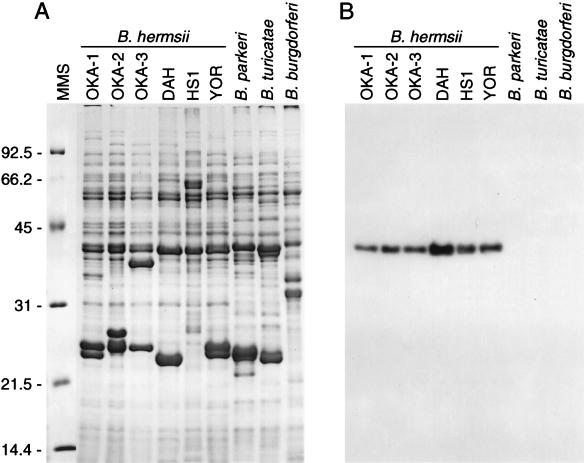
Sodium dodecyl sulfate-PAGE of Borrelia whole-cell lysates (A) and immunoblot analysis with monoclonal antibody H9826 (B). The 12.5% gel was stained with Coomassie brilliant blue, and molecular mass standards (MMS) are shown on the left (in kilodaltons). B. hermsii flagellin, which binds to antibody H9826, was detected by 125I-labeled protein A radiography.
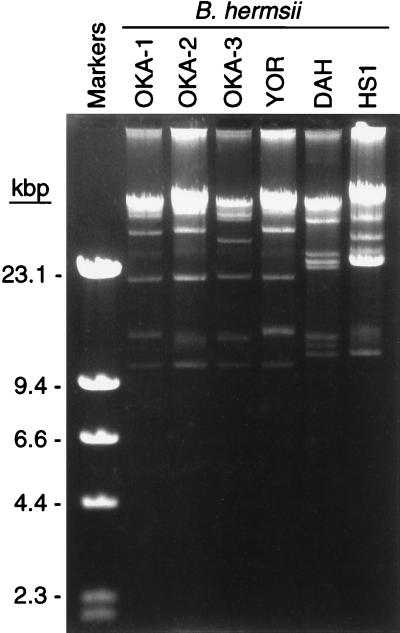
Agarose gel electrophoresis of Borrelia DNA demonstrating the similar plasmid profiles of the British Columbia isolates of B. hermsii compared to that of the YOR isolate from northern California. Size standards are shown on the left.
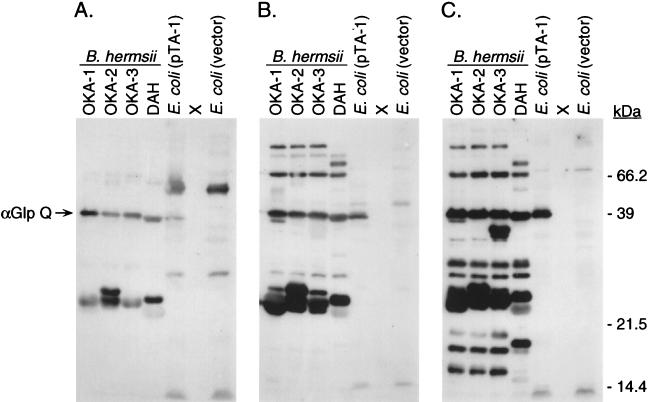
Immunoblots with serum samples from the three relapsing fever patients from southern British Columbia tested with lysates of B. hermsii originating from the same patients. (A) Serum from patient 3 collected 10 days after onset; (B) serum from patient 2 collected 22 days after onset; (C) serum from patient 1 collected 33 days after onset. All samples were tested at a 1:100 dilution, and bound antibody was detected by 125I-labeled protein A radiography. Antibody to GlpQ, 39 kDa, is indicated on the left, and estimated molecular masses are given on the right.
References
-
- Banerjee S N, Proctor E M. Lyme disease and relapsing fever in B.C. Dis Surveil. 1988;9:63–64.
-
- Banerjee S N, Proctor E M, O’Hanlon D P. Relapsing fever due to Borrelia hermsii in British Columbia. Dis Surveil. 1987;8:155–162.
-
- Boyer K M, Munford R S, Maupin G O, Pattison C P, Fox M D, Barnes A M, Jones W L, Maynard J E. Tick-borne relapsing fever: an interstate outbreak originating at Grand Canyon National Park. Am J Epidemiol. 1977;105:469–479. - PubMed
-
- Burgdorfer W, Barbour A G, Hayes S F, Benach J L, Grunwaldt E, Davis J P. Lyme disease—a tick-borne spirochetosis? Science. 1982;216:1317–1319. - PubMed
MeSH terms
Substances
LinkOut - more resources
Full Text Sources
