. 1998 Dec;18(12):6879-84.
doi: 10.1128/MCB.18.12.6879.

Embryo deadenylation element-dependent deadenylation is enhanced by a cis element containing AUU repeats

Affiliations

Embryo deadenylation element-dependent deadenylation is enhanced by a cis element containing AUU repeats

Y Audic et al. Mol Cell Biol. 1998 Dec.

Abstract

The deadenylation of maternal mRNAs in the Xenopus embryo is a sequence-specific process. One cis element that targets maternal mRNAs for deadenylation after fertilization is the embryo deadenylation element (EDEN). This element, composed of U/R repeats, is specifically bound by a protein, EDEN-BP. In the present study we show that the rate at which an RNA containing an EDEN is deadenylated can be increased by the presence of an additional cis element composed of three AUU repeats. This effect was observed for a natural EDEN (c-mos) and two synthetic EDENs. Hence, the enhancement of EDEN-dependent deadenylation conferred by the (AUU)3 motif is not due to an interaction with a particular EDEN sequence. Mutation of the (AUU)3 motif abrogated the enhancement of EDEN-dependent deadenylation. These data indicate that the rate at which a specific maternal mRNA is deadenylated in Xenopus embryos is probably defined by a cross talk between multiple cis elements.


Figures
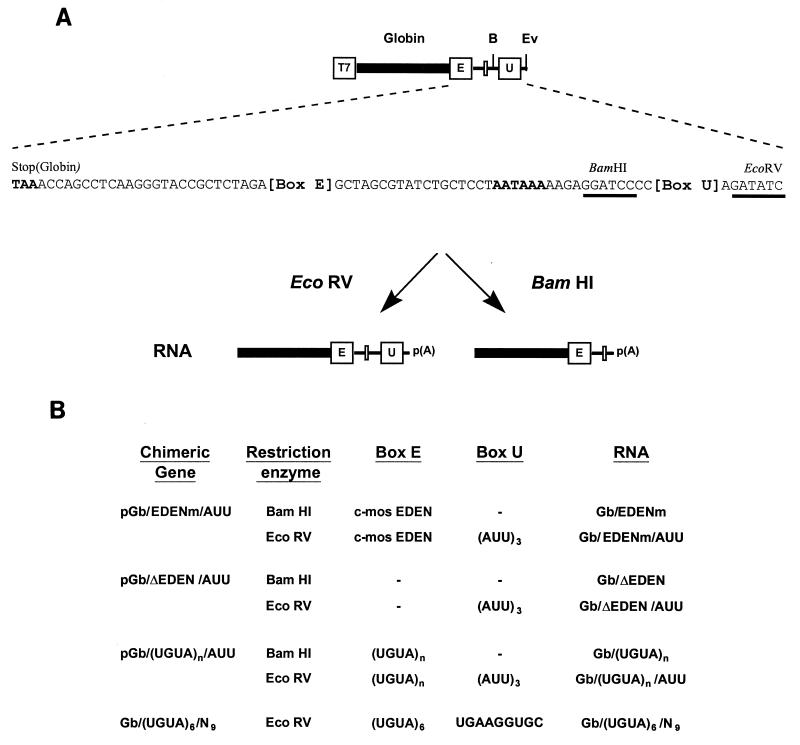
FIG. 1
FIG. 1
Structure of chimeric genes and composition of RNAs. (A) Generic structure and sequence of the 3′ UTR of the chimeric genes used in this study as transcription templates. Transcription was driven by the T7 promoter. The reporter sequence containing the globin open reading frame is indicated by a thick line; the position of the c-mos EDEN or of the n-fold UGUA repeats [(UGUA)n] is indicated by a boxed “E.” The position of the (AUU)3 motif or mutations of this motif is represented by a boxed “U.” The position of the AAUAAA nuclear polyadenylation signal is indicated by a narrow open box. In the 3′ UTR sequence the globin translational stop codon and the nuclear polyadenylation signals are in bold type. The positions of the EcoRV (Ev) and BamHI (B) restriction sites used to make the transcription templates for RNAs with or without the (AUU)3 motif are also shown and underlined in the sequence. p(A), poly(A) tail added to the RNA by E. coli PAP after transcription. (B) For each chimeric gene, the restriction enzymes used and the corresponding RNAs are indicated. The nature of the sequence at positions E and U is also indicated. The sequence of the c-mos EDEN is 5′TATATGTATGTGTTGTTTTATGTGTGTGTGTGTGCT3′.
FIG. 2
FIG. 2
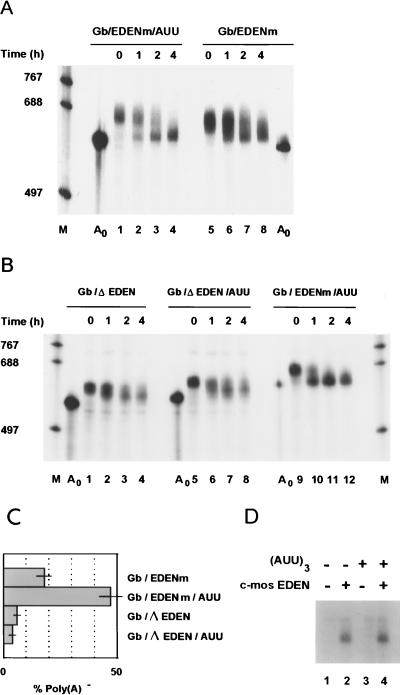
Effect of the (AUU)3 motif on c-mos EDEN-dependent deadenylation. (A) Between 0.15 and 0.3 fmol of the 32P-labeled and capped Gb/EDENm/AUU and Gb/EDENm RNAs were injected as polyadenylated transcripts into two-cell embryos as described in Materials and Methods. Samples of five embryos were taken for RNA extraction at the indicated times after injection, and aliquots of 2.5-embryo equivalents were analyzed in a 5% polyacrylamide-urea gel. After being dried the gel was subjected to autoradiography. Lane A0, nonadenylated RNAs before injection; lane M, RNA molecular weight markers; sizes are indicated on the left. (B) The chimeric RNAs devoid of an EDEN sequence (Gb/ΔEDEN and Gb/ΔEDEN/AUU) were synthesized as 32P-labeled, capped transcripts and polyadenylated in vitro prior to injection into two-cell embryos. As a control the polyadenylated Gb/EDENm/AUU RNA was similarly prepared and injected into two-cell embryos. At the indicated times after injection aliquots of five embryos were taken and further processed as described for panel A. Lanes A0 and M, same as for panel A. (C) Quantification of the proportion of poly(A) RNA produced 4 h after injection into two-cell embryos. For the chimeric transcripts used for panels A and B, the amount of poly(A) RNA, the final deadenylation product, relative to total RNA in each lane was calculated as described in Materials and Methods. (D) Effect of the (AUU)3 motif on the UV cross-linking of EDEN-BP to the c-mos EDEN. RNAs containing (lanes 2 and 4) or devoid of (lanes 1 and 3) the c-mos EDEN and with (lanes 3 and 4) or without (lanes 1 and 2) the (AUU)3 motif were incubated in activated egg extracts. After irradiation with UV light and treatment with RNase A, the proteins were resolved on a 10% polyacrylamide gel in the presence of SDS. Radiolabeled proteins were revealed by autoradiography of the dried gel.
FIG. 3
FIG. 3
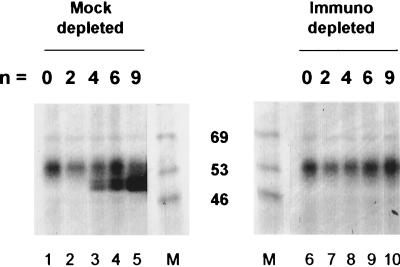
Detection by UV cross-linking of EDEN-BP binding to RNAs containing UGUA repeats. 32P-labeled Gb/(UGUA)n RNAs were incubated in activated egg extracts that had been treated with preimmune serum (mock depleted) or anti-EDEN-BP serum (immunodepleted). After irradiation with UV light the samples were processed as described in the legend to Fig. 2D. The numbers (n) of UGUA repeats in the different chimeric RNAs are indicated above the lanes. Lane M, molecular mass markers; sizes (in kilodaltons) are indicated between the two panels.
FIG. 4
FIG. 4
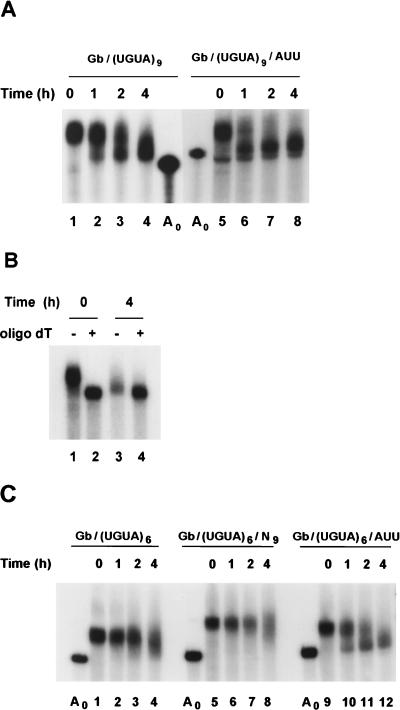
The (AUU)3 motif can stimulate EDEN-dependent deadenylation. (A) The Gb/(UGUA)9 and Gb/(UGUA)9/AUU RNAs were synthesized as 32P-labeled, capped transcripts and then polyadenylated in vitro with E. coli PAP. Between 0.15 and 0.3 fmol of these RNAs was injected into two-cell embryos. At the indicated times after injection, aliquots of five embryos were taken for RNA extraction and analysis as described in the legend to Fig. 2. Lanes A0, nonadenylated RNAs before injection. (B) Samples of five embryos injected with the radiolabeled, capped polyadenylated Gb/(UGUA)9 RNA were taken for RNA extraction at the indicated times after injection. Half of each sample was treated with RNase H in the presence (+) or absence (−) of oligo(dT). The samples were then analyzed as described in the legend to Fig. 2. (C) The three different chimeric RNAs, Gb/(UGUA)6, Gb/(UGUA)6/AUU, and Gb/(UGUA)6/N9, that all contained six UGUA repeats in the 3′ UTR were synthesized and polyadenylated in vitro. Two-cell embryos injected with these 32P-labeled RNAs were further processed as described for panel A. In Gb/(UGUA)6/AUU the (AUU)3 motif was present between the AAUAAA signal and the poly(A) tail. In Gb/(UGUA)6/N9 the (AUU)3 motif was replaced by an unrelated sequence, and in Gb/(UGUA)6 the motif was absent. Lanes A0, nonadenylated RNAs before injection.

References

    1. Audic Y, Omilli F, Osborne H B. Postfertilization deadenylation of mRNAs in Xenopus laevis embryos is sufficient to cause their degradation at the blastula stage. Mol Cell Biol. 1997;17:209–218. - PMC - PubMed
    1. Audic Y, Omilli F, Osborne H B, Landais L. Design and use of easily made RNA size markers. BioTechniques. 1997;23:612–616. - PubMed
    1. Bouvet P, Omilli F, Arlot-Bonnemains Y, Legagneux V, Roghi C, Bassez T, Osborne H B. The deadenylation conferred by the 3′ untranslated region of a developmentally controlled mRNA in Xenopus embryos is switched to polyadenylation by deletion of a short sequence element. Mol Cell Biol. 1994;14:1893–1900. - PMC - PubMed
    1. Chevalier S, Blow J J. Cell cycle control of replication initiation in eukaryotes. Curr Opin Cell Biol. 1996;8:815–821. - PubMed
    1. Fox C A, Sheets M D, Wickens M. Poly(A) addition during maturation of frog oocytes: distinct nuclear and cytoplasmic activities and regulation by the sequence UUUUUAU. Genes Dev. 1989;3:2151–2162. - PubMed

Publication types

MeSH terms

LinkOut - more resources