Emerging tobacco hazards in China: 1. Retrospective proportional mortality study of one million deaths
- PMID: 9822393
- PMCID: PMC28719
- DOI: 10.1136/bmj.317.7170.1411
Emerging tobacco hazards in China: 1. Retrospective proportional mortality study of one million deaths
Abstract
Objective: To assess the hazards at an early phase of the growing epidemic of deaths from tobacco in China.
Design: Smoking habits before 1980 (obtained from family or other informants) of 0.7 million adults who had died of neoplastic, respiratory, or vascular causes were compared with those of a reference group of 0.2 million who had died of other causes.
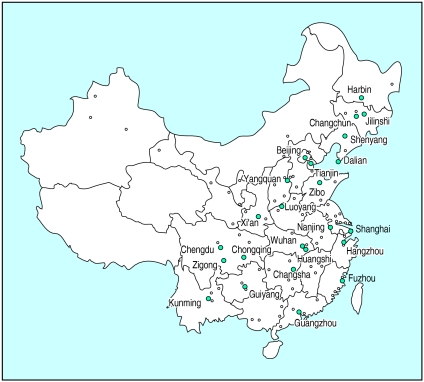
Setting: 24 urban and 74 rural areas of China.
Subjects: One million people who had died during 1986-8 and whose families could be interviewed.
Main outcome measures: Tobacco attributable mortality in middle or old age from neoplastic, respiratory, or vascular disease.
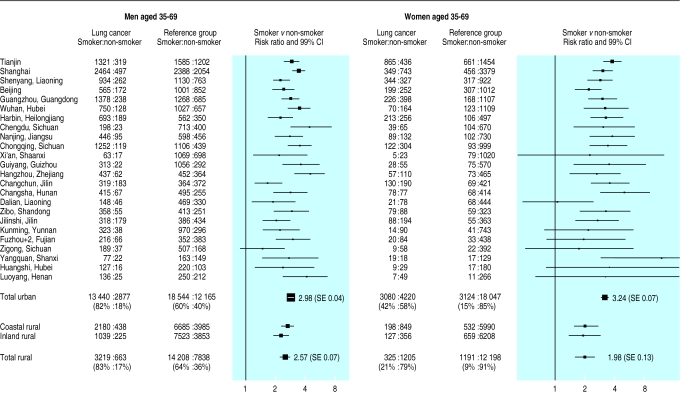
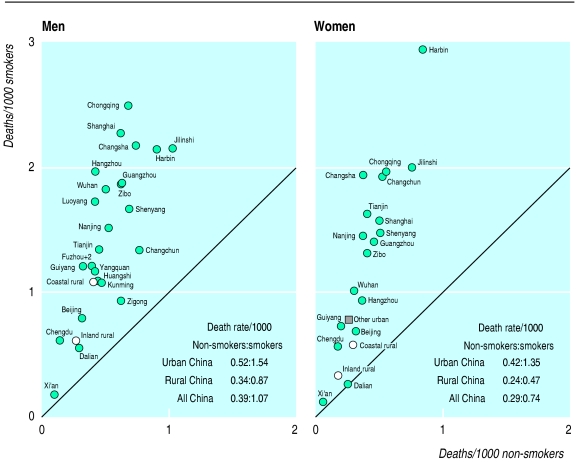
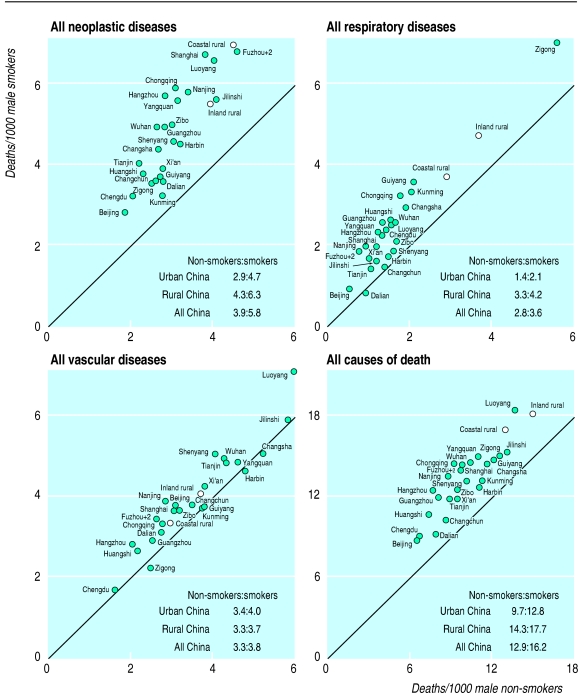
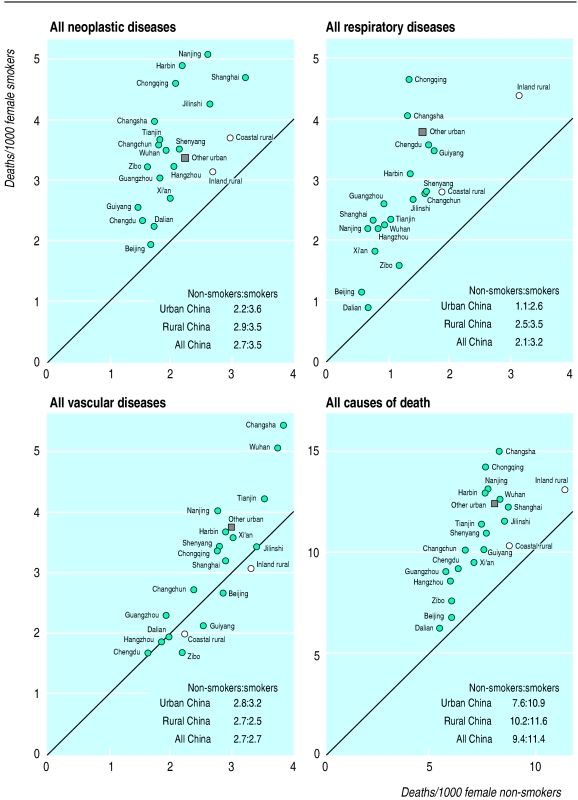
Results: Among male smokers aged 35-69 there was a 51% (SE 2) excess of neoplastic deaths, a 31% (2) excess of respiratory deaths, and a 15% (2) excess of vascular deaths. All three excesses were significant (P<0.0001). Among male smokers aged >/70 there was a 39% (3) excess of neoplastic deaths, a 54% (2) excess of respiratory deaths, and a 6% (2) excess of vascular deaths. Fewer women smoked, but those who did had tobacco attributable risks of lung cancer and respiratory disease about the same as men. For both sexes, the lung cancer rates at ages 35-69 were about three times as great in smokers as in non-smokers, but because the rates among non-smokers in different parts of China varied widely the absolute excesses of lung cancer in smokers also varied. Of all deaths attributed to tobacco, 45% were due to chronic obstructive pulmonary disease and 15% to lung cancer; oesophageal cancer, stomach cancer, liver cancer, tuberculosis, stroke, and ischaemic heart disease each caused 5-8%. Tobacco caused about 0.6 million Chinese deaths in 1990 (0.5 million men). This will rise to 0.8 million in 2000 (0.4 million at ages 35-69) or to more if the tobacco attributed fractions increase.
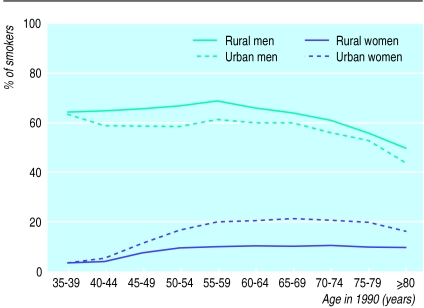
Conclusions: At current age specific death rates in smokers and non-smokers one in four smokers would be killed by tobacco, but as the epidemic grows this proportion will roughly double. If current smoking uptake rates persist in China (where about two thirds of men but few women become smokers) tobacco will kill about 100 million of the 0.3 billion males now aged 0-29, with half these deaths in middle age and half in old age.
Figures
Comment in
-
Counting the dead in China. Measuring tobacco's impact in the developing world.BMJ. 1998 Nov 21;317(7170):1399-400. doi: 10.1136/bmj.317.7170.1399. BMJ. 1998. PMID: 9822388 Free PMC article. No abstract available.
-
Emerging tobacco hazards in China. Is assumption of no association between smoking and other causes of death valid?BMJ. 1999 Jun 5;318(7197):1554-5. BMJ. 1999. PMID: 10356023 Free PMC article. No abstract available.
-
Emerging tobacco hazards in China. Double standards apply with importation of tobacco into developing countries.BMJ. 1999 Jun 5;318(7197):1555. BMJ. 1999. PMID: 10438208 No abstract available.
References
-
- Surgeon General. Reducing the health consequences of smoking: 25 years of progress. Report of the surgeon general, 1989. Rockville, MD: US Department of Health and Human Services; 1989.
-
- Doll R, Peto R. The causes of cancer. J Natl Cancer Inst. 1981;66:1191–1308. - PubMed
-
- Zaridze D, Peto R, editors. Tobacco: a major international health hazard. Lyons: International Agency for Research on Cancer; 1986. (IARC scientific publication No 74.)
-
- Peto R, Lopez AD, Boreham J, Thun M, Heath C. Mortality from tobacco in developed countries: indirect estimation from national vital statistics. Lancet. 1992;339:1268–1278. - PubMed
Publication types
MeSH terms
Grants and funding
LinkOut - more resources
Full Text Sources