


Identification and characterization of a monocarboxylate transporter (MCT1) in pig and human colon: its potential to transport L-lactate as well as butyrate
- PMID: 9824713
- PMCID: PMC2231331
- DOI: 10.1111/j.1469-7793.1998.719ba.x
Identification and characterization of a monocarboxylate transporter (MCT1) in pig and human colon: its potential to transport L-lactate as well as butyrate
Abstract
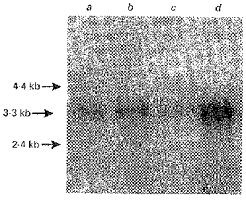
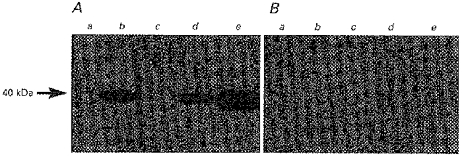
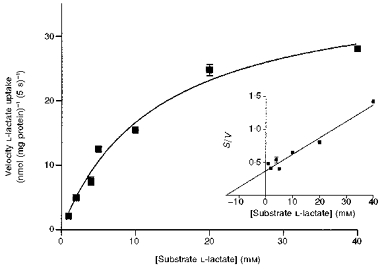
1. Oligonucleotide primers based on the human heart monocarboxylate transporter (MCT1) cDNA sequence were used to isolate a 544 bp cDNA product from human colonic RNA by reverse transcription-polymerase chain reaction (RT-PCR). The sequence of the RT-PCR product was identical to that of human heart MCT1. Northern blot analysis using the RT-PCR product indicated the presence of a single transcript of 3.3 kb in mRNA isolated from both human and pig colonic tissues. Western blot analysis using an antibody to human MCT1 identified a specific protein with an apparent molecular mass of 40 kDa in purified and well-characterized human and pig colonic lumenal membrane vesicles (LMV). 2. Properties of the colonic lumenal membrane L-lactate transporter were studied by the uptake of L-[U-14C]lactate into human and pig colonic LMV. L-Lactate uptake was stimulated in the presence of an outward-directed anion gradient at an extravesicular pH of 5.5. Transport of L-lactate into anion-loaded colonic LMV appeared to be via a proton-activated, anion exchange mechanism. 3. L-Lactate uptake was inhibited by pyruvate, butyrate, propionate and acetate, but not by Cl- and SO4(2-). The uptake of L-lactate was inhibited by phloretin, mercurials and alpha-cyano-4-hydroxycinnamic acid (4-CHC), but not by the stilbene anion exchange inhibitors, 4,4'-diisothiocyanostilbene-2, 2'-disulphonic acid (DIDS) and 4-acetamido-4'-isothiocyanostilbene-2, 2'-disulphonic acid (SITS). 4. The results indicate the presence of a MCT1 protein on the lumenal membrane of the colon that is involved in the transport of L-lactate as well as butyrate across the colonic lumenal membrane. Western blot analysis showed that the abundance of this protein decreases in lumenal membrane fractions isolated from colonic carcinomas compared with that detected in the normal healthy colonic tissue.
Figures
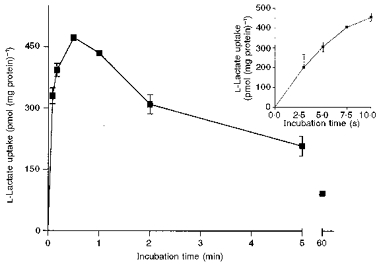
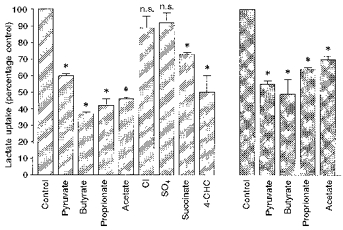
 ) and human (
 ) colon were preloaded with 100 m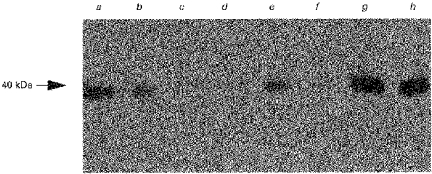
References
-
- Alonso de la Torre SRA, Serrano MA, Medina JM. Carrier-mediated β-D-hydroxybutyrate transport in brush-border membrane vesicles from rat placenta. Pediatric Research. 1992;32:317–323. - PubMed
-
- Balkovetz DF, Leibach FH, Mahesh VB, Ganapathy V. A proton gradient is the driving force for uphill transport of lactate in human placental brush-border membrane vesicles. Journal of Biological Chemistry. 1988;263:13823–13830. - PubMed
-
- Bergman EN. Energy contributions of volatile fatty acids from the gastrointestinal tract in various species. Physiological Reviews. 1990;70:567–590. - PubMed
-
- Berry RD, Paraskeva C. Expression of a carcinoembryonic antigen by the adenoma and carcinoma derived epithelial cell lines: possible marker of tumour progression and modulation of expression by sodium butyrate. Carcinogenesis. 1988;9:447–450. - PubMed
-
- Bröer S, Raham B, Pellegri G, Martin J-L, Verleysdonk S, Hamprecht B, Magistetti PJ. Comparison of lactate transport in astroglial cells and monocarboxylate transporter I (MCT1) expressing Xenopus laevis oocytes. Journal of Biological Chemistry. 1997;272:30096–30102. - PubMed
Publication types
MeSH terms
Substances
Grants and funding
LinkOut - more resources
Full Text Sources
Other Literature Sources
