. 1998 Dec;66(12):5876-81.
doi: 10.1128/IAI.66.12.5876-5881.1998.

Intranasal immunization with cytotoxic T-lymphocyte epitope peptide and mucosal adjuvant cholera toxin: selective augmentation of peptide-presenting dendritic cells in nasal mucosa-associated lymphoid tissue

Affiliations

Intranasal immunization with cytotoxic T-lymphocyte epitope peptide and mucosal adjuvant cholera toxin: selective augmentation of peptide-presenting dendritic cells in nasal mucosa-associated lymphoid tissue

A Porgador et al. Infect Immun. 1998 Dec.

Abstract

We previously reported that cholera toxin (CT) was required as a mucosal adjuvant for the induction of peptide-specific cytotoxic T lymphocytes (CTL) following intranasal immunization with CTL epitope peptides (A. Porgador et al., J. Immunol. 158:834-841, 1997). The present study was performed to identify the site and the antigen-presenting cell (APC) population responsible for the presentation of intranasally administered CTL epitope peptide immunogens and to determine whether CT directly affects antigen presentation by these APCs. For these experiments, C57BL/6 mice were intranasally immunized with the ovalbumin H-2Kb-restricted CTL epitope SIINFEKL with or without CT. Cells were then isolated from the cervical lymph nodes (CLN) and the nasal mucosa-associated lymphoid tissue (NALT) and tested for the ability to stimulate the B3Z T-cell hybridoma, which recognizes SIINFEKL in association with H-2Kb. Dendritic cell (DC)-enriched CLN cells from mice immunized with peptide and CT or peptide only could stimulate B3Z cells, while DC-depleted CLN cells from either group were unable to stimulate B3Z cells. NALT cells of mice immunized with peptide and CT, but not with peptide alone, were able to efficiently stimulate B3Z hybridomas. Depletion of N418-positive DC from these NALT cells resulted in significant reduction of B3Z activation. Our results indicate that DC are the APC responsible for the presentation of CTL epitope peptides following intranasal immunization and that CT augments the ability of dendritic cells in the NALT, but not in the draining CLN, to present CLT epitope peptides. This finding suggests that CT acts locally as a mucosal adjuvant and that NALT DC are the predominant APC involved with the induction of immunity after intranasal immunization with peptide immunogens and CT.


Figures
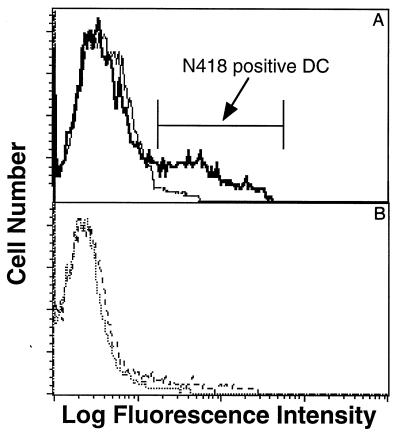
FIG. 1
FIG. 1
N418-positive DC in low- and high-density cells after metrizamide gradient column purification of LN cells. CLN cells from five mice immunized i.n. with SIINFEKL plus CT were pooled and digested as described in Materials and Methods. Suspended cells were layered over a metrizamide gradient column and centrifuged. Low-density (A, thick line) and high density (B, dashed line) cells were incubated with anti-FcγRII/III (clone 2.4G2) to block FcR binding and stained with anti-CD11c MAb N418 followed by FITC-labeled second antibody (goat anti-hamster, mouse and rat adsorbed). Second antibody controls for low-density (A, thin line) and high-density (B, dotted line) cells are also shown. A representative experiment is shown.
FIG. 2
FIG. 2
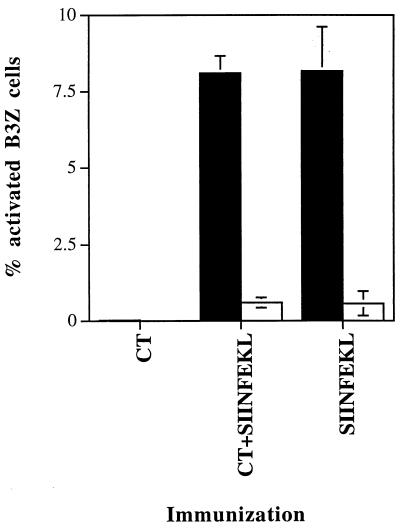
Antigen presentation by DC-enriched and DC-depleted CLN cells from mice (groups of four) immunized i.n. with CT, SIINFEKL plus CT, or SIINFEKL. CLN were harvested 4 h after immunization, pooled, and digested as described in Materials and Methods. Suspended cells were layered over a metrizamide gradient column and centrifuged. Low-density DC-enriched cells (■) and high-density DC-depleted cells (□) were incubated with B3Z T-hybridoma cells overnight (four APC per B3Z cell). Activation of B3Z cells was determined by β-Gal expression detected by incubation of cells with X-Gal substrate. Activated (blue) B3Z cells were counted in a Neubauer counting chamber. Similar results were obtained in another experiment. The results are expressed as mean percentages of the total number of B3Z cells present ± standard deviations.
FIG. 3
FIG. 3
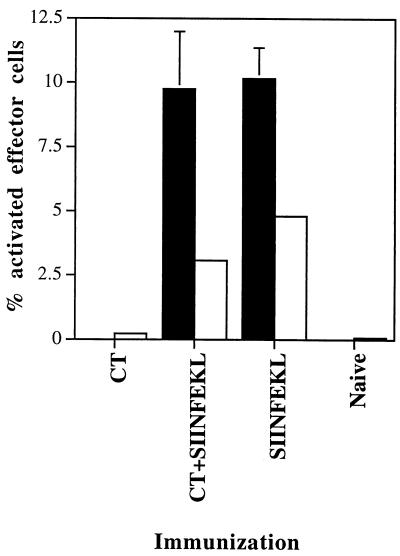
Comparison of antigen presentation by DC-enriched CLN cells to B3Z T-hybridoma cells and to TCR-transgenic T cells. Mice (groups of four) were immunized i.n. with CT, SIINFEKL plus CT, or SIINFEKL; CLN were harvested 19 h after immunization, pooled, and digested as described in Materials and Methods. DC-enriched cells (low-density cells after passage through a metrizamide column) were incubated either with B3Z cells overnight (■) or with TCR-transgenic T cells for 5 h (□). Activated B3Z cells were evaluated as described for Fig. 1, and the results are expressed as mean percentages of the total number of B3Z cells present ± standard deviations. Transgenic T cells were stained for IL-2 expression (see Methods), and percent IL-2-positive T cells as measured by flow cytometry is shown as percent activated effector T cells.
FIG. 4
FIG. 4
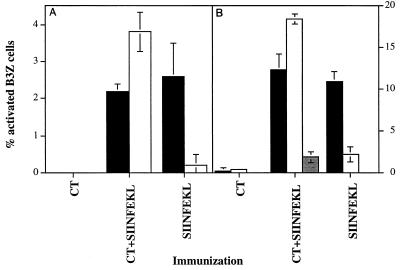
Presentation by NALT cells from mice immunized i.n. with CT, SIINFEKL plus CT, or SIINFEKL. Mice (groups of four) were immunized 18 h (A), or mice (groups of four) were immunized 24, 8, and 4 h (three immunizations per mouse; B), prior to harvesting of NALT and CLN. NALT and CLN tissues were pooled separately and digested as described in Materials and Methods. To deplete DC from NALT cells (B), cells were incubated with MAb N418 and then with biotin-conjugated goat F(ab′)2 anti-hamster antibody. N418-positive cells were removed via treatment with streptavidin-coupled Dynabeads M-280 (10 beads per cell). Mock-depleted NALT cells were exposed to the same procedure except for the first incubation with MAb N418. Presenting cells were incubated with B3Z cells overnight, and percent activated B3Z cells was calculated as described for Fig. 1. Results represent means ± standard deviations for a representative experiment. Similar results were obtained in one additional experiment. ■, DC-enriched CLN; □, NALT; formula image, DC-depleted NALT.

References

    1. Bergerot I, Ploix C, Petersen J, Moulin V, Rask C, Fabien N, Lindblad M, Mayer A, Czerkinsky C, Holmgren J, Thivolet C. A cholera toxoid-insulin conjugate as an oral vaccine against spontaneous autoimmune diabetes. Proc Natl Acad Sci USA. 1997;94:4610–4614. - PMC - PubMed
    1. Bowen J C, Nair S K, Reddy R, Rouse B T. Cholera toxin acts as a potent adjuvant for the induction of cytotoxic T-lymphocyte responses with non-replicating antigens. Immunology. 1994;81:338–342. - PMC - PubMed
    1. Bromander A, Holmgren J, Lycke N. Cholera toxin stimulates IL-1 production and enhances antigen presentation by macrophages in vitro. J Immunol. 1991;146:2908–2914. - PubMed
    1. Bromander A K, Kjerrulf M, Holmgren J, Lycke N. Cholera toxin enhances alloantigen presentation by cultured intestinal epithelial cells. Scand J Immunol. 1993;37:452–458. - PubMed
    1. Chen Y, Inobe J, Marks R, Gonnella P, Kuchroo V K, Weiner H L. Peripheral deletion of antigen-reactive T cells in oral tolerance. Nature. 1995;376:177–180. . (Erratum, 21:377.) - PubMed

LinkOut - more resources