. 1998 Nov 24;95(24):14118-23.
doi: 10.1073/pnas.95.24.14118.

Host factor I, Hfq, binds to Escherichia coli ompA mRNA in a growth rate-dependent fashion and regulates its stability

Affiliations

Host factor I, Hfq, binds to Escherichia coli ompA mRNA in a growth rate-dependent fashion and regulates its stability

O Vytvytska et al. Proc Natl Acad Sci U S A. .

Abstract

The stability of the ompA mRNA depends on the bacterial growth rate. The 5' untranslated region is the stability determinant of this transcript and the target of the endoribonuclease, RNase E, the key player of mRNA degradation. An RNA-binding protein with affinity for the 5' untranslated region ompA was purified and identified as Hfq, a host factor initially recognized for its function in phage Qbeta replication. The ompA RNA-binding activity parallels the amount of Hfq, which is elevated in bacteria cultured at slow growth rate, a condition leading to facilitated degradation of the ompA mRNA. In hfq mutant cells with a deficient Hfq gene product, the RNA-binding activity is missing, and analysis of the ompA mRNA showed that the growth-rate dependence of degradation is lost. Furthermore, the half-life of the ompA mRNA is prolonged in the mutant cells, irrespective of growth rate. Hfq has no affinity for the lpp transcript whose degradation, like that of bulk mRNA, is not affected by bacterial growth rate. Compatible with our results, we found that the intracellular concentration of RNase E and its associated degradosome components is independent of bacterial growth rate. Thus our results suggest a regulatory role for Hfq that specifically facilitates the ompA mRNA degradation in a growth rate-dependent manner.


Figures
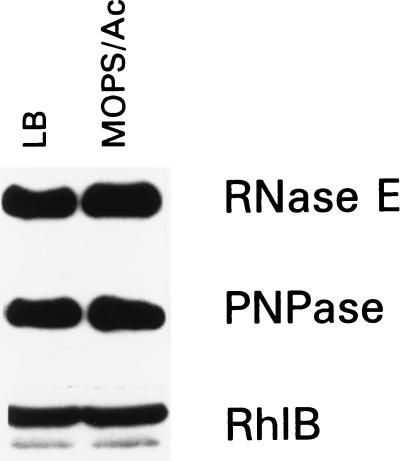
Figure 1
Figure 1
Comparison of the levels of the key degradosome components in MC4100 cells grown exponentially with high (LB) or slow (Mops-acetate medium) growth rate by Western blot analysis. Equal amounts of cells were withdrawn from each medium, and cell lysates were probed with antibodies against RNase E, PNPase, or RhlB helicase as described in Materials and Methods.
Figure 2
Figure 2
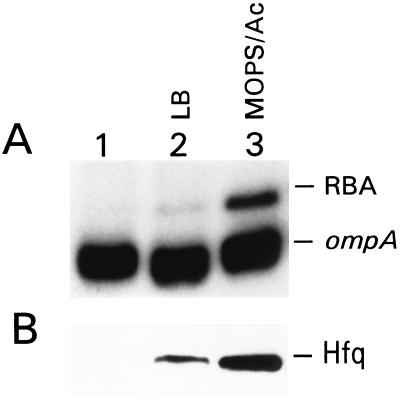
The level of the 5′ UTR ompA RBA in MC4100 cells grown exponentially with high (LB) or slow (Mops-acetate medium) growth rate. (A) Mobility-shift assay. S30 extracts (10 μg) were incubated with 32P-labeled ompA transcript and analyzed, as described in Materials and Methods. Lane 1, the ompA transcript alone; lanes 2 and 3, the ompA transcript incubated with extract obtained from cells grown in LB and Mops-acetate medium, respectively. (B) Western blot analysis of the same extracts as in A tested with Hfq-specific antibodies, as described in Materials and Methods.
Figure 3
Figure 3
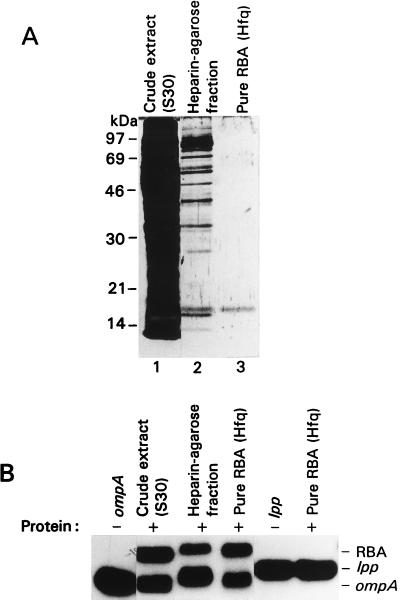
Analysis of the purified ompA mRNA-binding protein RBA. (A) Electrophoresis of crude and purified materials on an SDS-polyacrylamide gel visualized by silver staining. Purification steps of RBA described in Materials and Methods. Lane 1, crude extract (10 μg); lane 2, heparin-agarose fraction (0.1 μg); lane 3, finely purified material (Hfq) (0.005 μg). (B) Mobility-shift assay of crude cell extract and purified material as in A, using as an RNA substrate either ompA or lpp. The same amounts of protein as in A were incubated with 32P-labeled substrates and applied to the 4% native polyacrylamide gel.
Figure 4
Figure 4
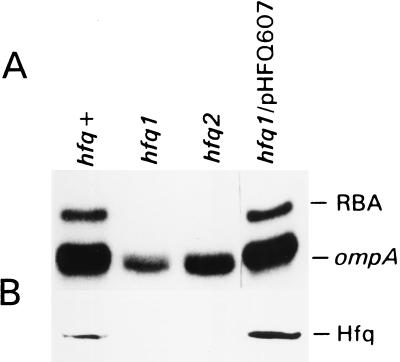
The hfq gene is responsible for RBA. (A) Mobility-shift assay of the ompA mRNA-binding activity of MC4100 strain (hfq+), its derivatives AM111 (hfq1) and AM112 (hfq2), and hfq1 strain provided with the plasmid pHFQ607, containing the hfq gene. Cells were grown in Mops-acetate medium, and 10 μg of S30 extracts were used for the RNA–protein complex formation. (B) Western blot analysis of the same extracts as in A tested with Hfq-specific antibodies, as described in Materials and Methods.
Figure 5
Figure 5
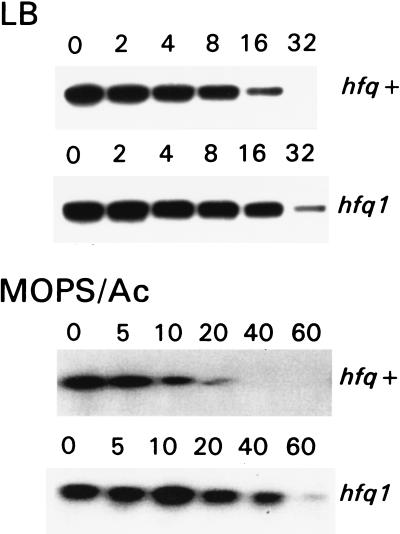
Influence of the hfq1 mutation on the ompA mRNA stability analyzed by Northern blotting. Mutant and parent cells were cultured in either LB or Mops-acetate medium. In the middle of exponential phase, transcription was blocked by rifampicin and aliquots were taken out at the indicated (in min) time points. Total RNAs were isolated by the method of hot phenol extraction, separated on 1% agarose gels, transferred to nitrocellulose filter, and hybridized with the 32P-labeled DNA probe, complemented to the coding region of the ompA gene.

References

    1. Lundberg U, Kaberdin V, von Gabain A. In: Manual of Industrial Microbiology and Biotechnology. Demain A L, Davies R M, Cohen G, Hershberg C L, Sherman D H, Willson R C, Wu J-H D, editors. Washington, DC: Am. Soc. Microbiol.; 1999. , in press.
    1. Nilsson G, Belasco J G, Cohen S N, von Gabain A. Nature (London) 1984;312:75–77. - PubMed
    1. Georgellis D, Arvidson S, von Gabain A. J Bacteriol. 1992;174:5382–5390. - PMC - PubMed
    1. Maaløe O. In: Biological Regulation and Development. Goldberger R F, editor. New York: Plenum; 1979. pp. 487–542.
    1. Chen L-H, Emory S A, Bricker A L, Bouvet P, Belasco J G. J Bacteriol. 1991;173:4578–4586. - PMC - PubMed

Publication types

MeSH terms

LinkOut - more resources