. 1998 Nov 24;95(24):14564-9.
doi: 10.1073/pnas.95.24.14564.

Characterization of a murine type II sodium-phosphate cotransporter expressed in mammalian small intestine

Affiliations

Characterization of a murine type II sodium-phosphate cotransporter expressed in mammalian small intestine

H Hilfiker et al. Proc Natl Acad Sci U S A. .

Abstract

An isoform of the mammalian renal type II Na/Pi-cotransporter is described. Homology of this isoform to described mammalian and nonmammalian type II cotransporters is between 57 and 75%. Based on major diversities at the C terminus, the new isoform is designed as type IIb Na/Pi-cotransporter. Na/Pi-cotransport mediated by the type IIb cotransporter was studied in oocytes of Xenopus laevis. The results indicate that type IIb Na/Pi-cotransport is electrogenic and in contrast to the renal type II isoform of opposite pH dependence. Expression of type IIb mRNA was detected in various tissues, including small intestine. The type IIb protein was detected as a 108-kDa protein by Western blots using isolated small intestinal brush border membranes and by immunohistochemistry was localized at the luminal membrane of mouse enterocytes. Expression of the type IIb protein in the brush borders of enterocytes and transport characteristics suggest that the described type IIb Na/Pi-cotransporter represents a candidate for small intestinal apical Na/Pi-cotransport.


Figures
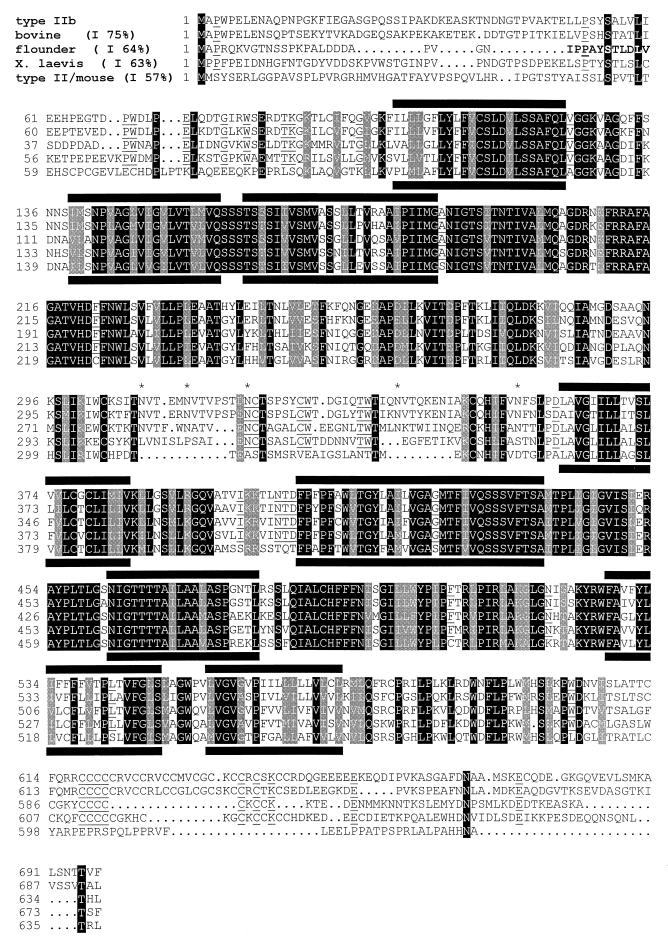
Figure 1
Figure 1
Amino acid sequence comparisons. Sequences of type II Na/Pi-cotransporters were aligned by pileup (sequence analysis software package; Genetics Computer Group, Madison, WI). Shaded boxes indicate consensus residues in all species listed. Additionally, equal residues among the type IIb, bovine, flounder, and X. laevis isoforms are underlined. Predicted transmembrane regions are indicated by bars, and potential N-glycosylation sites of the proposed extracellular loop are indicated by an asterisk. Numbers given in parentheses (x%) indicate the percentage of overall homologies to the type IIb sequence.
Figure 2
Figure 2
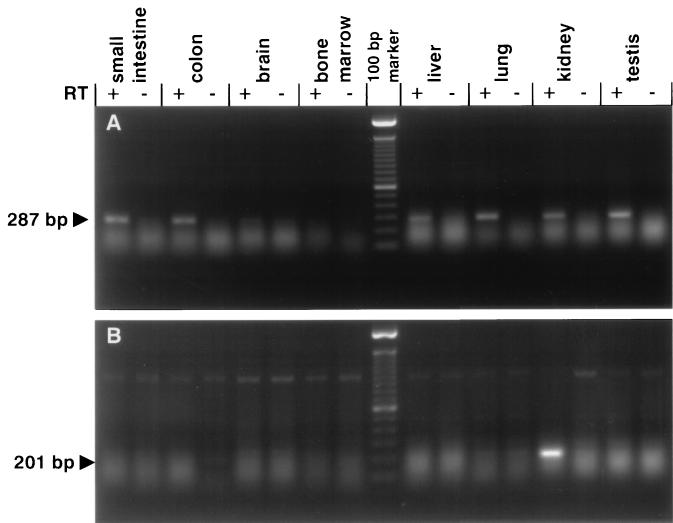
RT-PCR analysis using primers specific for the type IIb (A) or the renal type II (NaPi-7) (B) Na/Pi-cotransporter. All reactions were performed in the presence or absence of reverse transcriptase (RT; +, −). Integrity of the RNA preparations was confirmed by Northern blots using probes specific for β-actin (not shown).
Figure 3
Figure 3
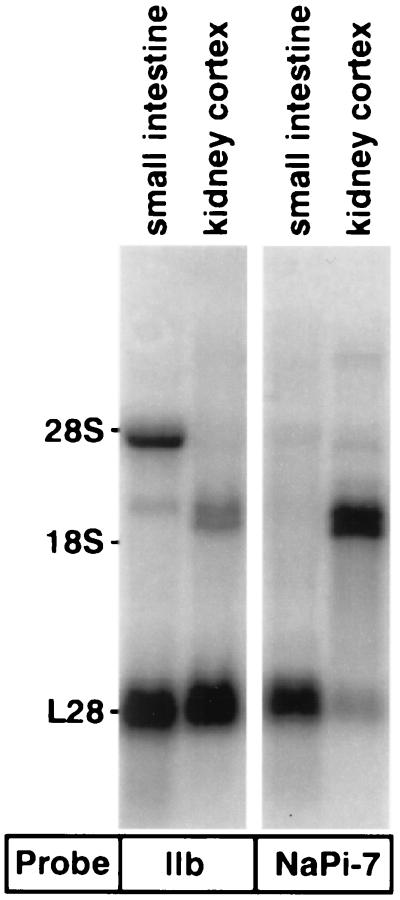
Northern blot analysis of poly(A)+RNA isolated from mouse upper small intestinal mucosa and kidney cortex. Blots were hybridized with probes derived from a 900-bp 5′ end fragment of type IIb cDNA or from the full length cDNA of the mouse renal type II Na/Pi-cotransporter. Hybridization to the ribosomal protein L28 mRNA was used to confirm equal loadings. In the case of the NaPi-7 probe, five times less poly(A)+RNA of kidney cortex was loaded.
Figure 4
Figure 4
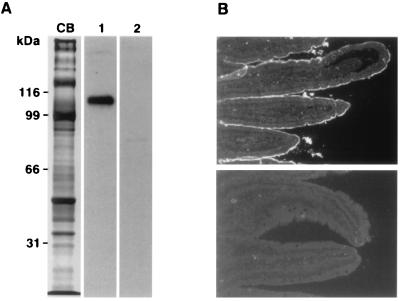
Immunodetection of the type IIb Na/Pi-cotransporter. (A) Western blots of isolated mouse small intestinal brush border membranes (35 μg protein per lane). CB, Coomassie blue staining. Incubation with the first antibody was performed in the absence (lane 1) or presence (lane 2) of the antigenic peptide. (B) Immunofluorescence detection of the type IIb cotransporter in the apical membrane of enterocytes. Incubation with the primary antibody was performed in the absence (Upper) or presence (Lower) of antigenic peptide (100 μg/ml).
Figure 5
Figure 5
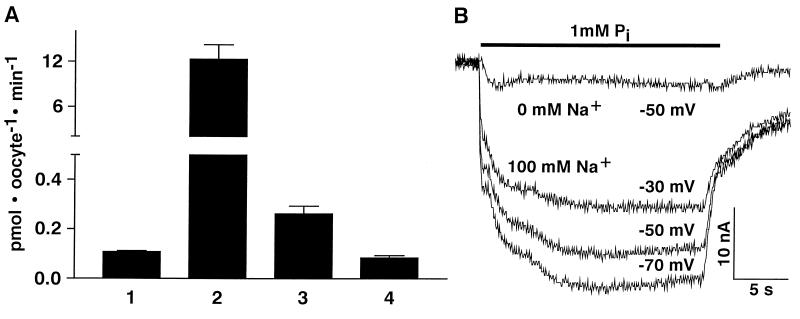
Characterization of Na/Pi-cotransport in oocytes injected with type IIb cRNA. (A) Isotope flux measurements performed at 0.5 mM phosphate (1, 2, 3) or 1 mM sulfate (4) (mean ± SD of 8–10 oocytes; two experiments). Bar 1: Pi-uptake in the presence of NaCl into oocytes injected with water; bars 2 and 3: Pi-uptake into oocytes injected with type IIb cRNA in the presence of NaCl (2) or choline-Cl (3). (B) Inwardly directed currents measured under steady state conditions by using the two-electrode voltage clamp. Oocytes were voltage clamped at indicated voltages and were superfused with 1 mM phosphate in the absence or presence of NaCl (see refs. and 14).
Figure 6
Figure 6
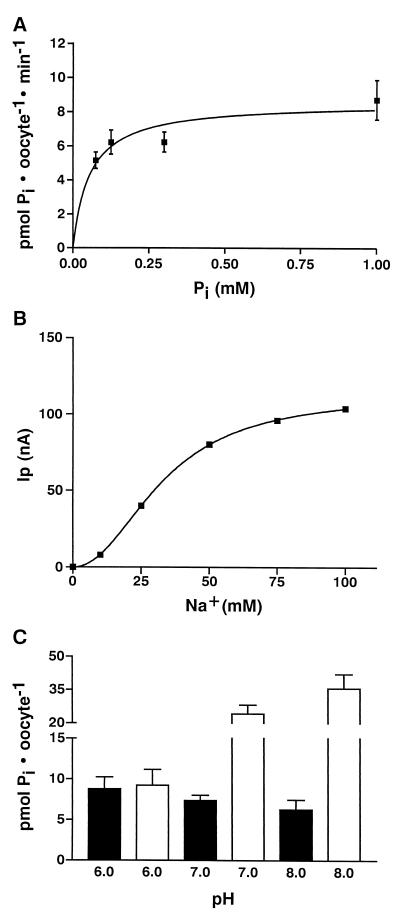
Characterization of type IIb-mediated Na/Pi-cotransport. (A) Isotope flux measurements were performed at different Pi concentrations in the presence of sodium and were corrected by the values obtained from oocytes injected with water. The calculated value for Km(Pi) was 50 μM. (B) Electrophysiological determination of the Km(Na). The calculated Km(Na) was 33 mM, and the stoichiometry was >2. (C) pH dependence of type IIb (black bars) and the renal type II (NaPi-7) Na/Pi-cotransport (open bars). Values were corrected with uptake in the presence of choline-Cl, which was not changed by the different pH values. The data represent the mean ± SD of 8–10 oocytes. All experiments have been performed at least twice. The data given in C were derived from one oocyte. The same result was obtained with different oocytes from different batches.

References

    1. Murer H, Biber J. Eur J Physiol. 1997;433:379–389. - PubMed
    1. Levi M, Kempson S A, Lötscher M, Biber J, Murer H. J Membr Biol. 1996;154:1–9. - PubMed
    1. Gupta A, Guo X L, Alvarez U M, Hruska K A. J Clin Invest. 1997;100:539–549. - PMC - PubMed
    1. Kavanaugh M P, Kabat D. Kidney Int. 1996;49:959–963. - PubMed
    1. Cross H S, Debiec H, Peterlik M. Miner Electrolyte Metab. 1990;16:115–124. - PubMed

Publication types

MeSH terms

Associated data