. 1998 Dec;180(23):6187-92.
doi: 10.1128/JB.180.23.6187-6192.1998.

Rpb4, a subunit of RNA polymerase II, enables the enzyme to transcribe at temperature extremes in vitro

Affiliations

Rpb4, a subunit of RNA polymerase II, enables the enzyme to transcribe at temperature extremes in vitro

S Rosenheck et al. J Bacteriol. 1998 Dec.

Abstract

Rpb4 is a subunit of Saccharomyces cerevisiae RNA polymerase II (Pol II). It associates with the polymerase preferentially in stationary phase and is essential for some stress responses. Using the promoter-independent initiation and chain elongation assay, we monitored Pol II enzymatic activity in cell extracts. We show here that Rpb4 is required for the polymerase activity at temperature extremes (10 and 35 degreesC). In contrast, at moderate temperature (23 degreesC) Pol II activity is independent of Rpb4. These results are consistent with the role previously attributed to Rpb4 as a subunit whose association with Pol II helps Pol II to transcribe during extreme temperatures. The enzymatic inactivation of Pol II lacking Rpb4 at the nonoptimal temperature was prevented by the addition of recombinant Rpb4 produced in Escherichia coli prior to the in vitro reaction assay. This finding suggests that modification of Rpb4 is not required for its functional association with the other Pol II subunits. Sucrose gradient and immunoprecipitation experiments demonstrated that Rpb4 is present in the cell in excess over the Pol II complex during all growth phases. Nevertheless, the rescue of Pol II activity at the nonoptimal temperature by Rpb4 is possible only when cell extracts are obtained from postlogarithmic cells, not from logarithmically growing cells. This result suggests that Pol II molecules should be modified in order to recruit Rpb4; the portion of the modified Pol II molecules is small during logarithmic phase and becomes predominant in stationary phase.


Figures
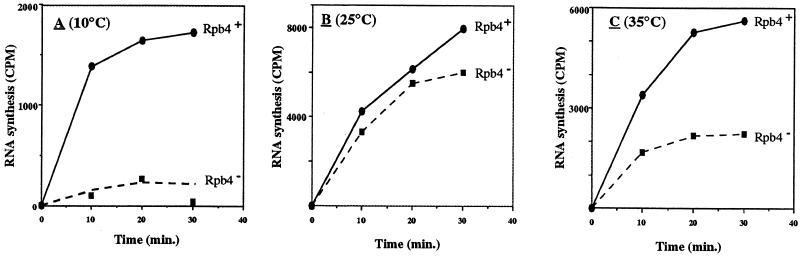
FIG. 1
FIG. 1
Rpb4 is required for Pol II activity at high and low, but not moderate, temperatures. Wild-type and rpb4 cells were grown in rich medium (YPD) at 26°C to stationary phase. Cell extracts were obtained as described in Materials and Methods. Pol II activity was tested at the indicated temperatures in the promoter-independent assay (see Materials and Methods). Rpb4+ and Rpb4 represent incorporation kinetics for extracts from wild-type and rpb4 cells, respectively. The reactions at 25 and 35°C (B and C) were done in the same experimental setup. The reactions at 10°C (A) were done in a different experiment, and therefore the extent of incorporation should not be compared to those in panels B and C. All reactions were done at least three times with at least three different batches of cell extracts. The extent of incorporation varied between the batches. However, the relative kinetics of wild-type Pol II versus pol IIΔ4 at each specific temperature was highly reproducible.
FIG. 2
FIG. 2
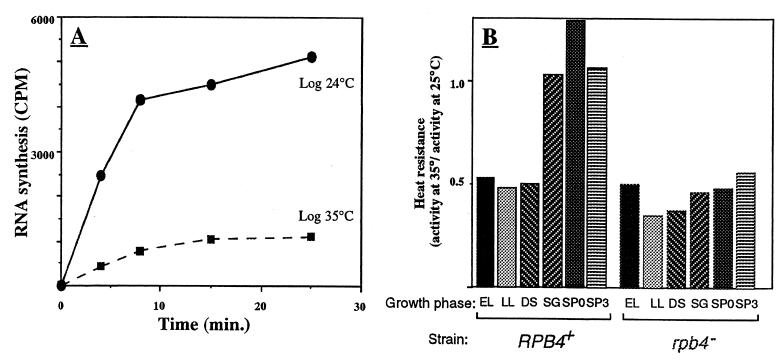
Rescue of Pol II activity at high temperature is dependent on the growth phase of the cells used to extract the proteins. Wild-type (RPB4+) and rpb4 cells were grown in rich medium (YPD) at 26°C. Equal amounts of cells were harvested at various growth phases. Cell extracts were prepared and Pol II activity was assayed as for Fig. 1. A. Incorporation kinetics for extracts prepared from RPB4+ cells harvested at early log phase was determined at 24 and 35°C. (B) Heat resistance of Pol II as a function of growth phase of the cells used as a source of protein extract. Heat resistance is defined as the ratio between the Pol II-specific radioactivity incorporated at 35°C during 30 min and that incorporated at 25°C during 30 min. EL, early log; LL, late log; DS, diauxic shift; SG, slow-growth phase; SP0, beginning of stationary phase; SP3, 3 days into stationary phase.
FIG. 3
FIG. 3
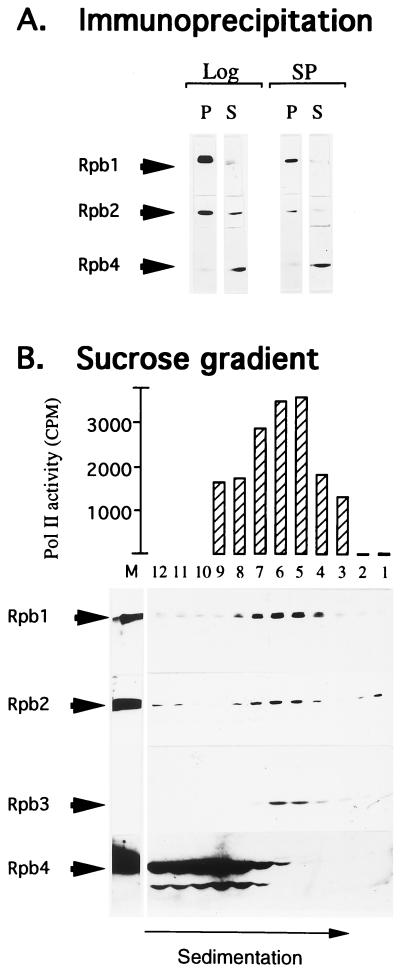
Pol II-free Rpb4 is present in excess over Pol II-associated Rpb4. (A) Immunoprecipitation experiment. Pol II was immunoprecipitated from extract obtained from logarithmically growing cells (Log) or from stationary-phase cells (SP). Immunoprecipitation, using a monoclonal antibody against the C-terminal domain of Rpb1 (8WG16), was carried out as described previously (5). Following immunoprecipitation, both the immunoprecipitated material (lanes P) and one half of the unprecipitated supernatant (lanes S) were electrophoresed, then electrotransferred onto a nitrocellulose filter, and probed with antibodies against the indicated Pol II subunits (see Materials and Methods). Antibody 8WG16 was used to detect Rpb1, affinity-purified rabbit anti-Rpb2 polyclonal antibodies were used to detect Rpb2, and affinity-purified rabbit anti-Rpb4 polyclonal antibodies were used to detect Rpb4. (B) Sucrose gradient. Protein extract (270 μg) obtained from Z277, a strain carrying hemagglutinin epitope-tagged Rpb3 (11), was sedimented through a 5 to 20% (wt/wt) sucrose gradient, using an SW60 rotor at 60,000 rpm (485,000 × g) for 2.5 h at 4°C. Gradient was fractionated into 12 fractions, and Pol II activity in 9 fractions was monitored at 24°C as described in Materials and Methods (upper panel). Fifty microliters from each fraction was added to 1× Laemli sample buffer and boiled for 3 min, and samples were electrophoresed. Following electrophoresis, proteins were electrotransferred onto nitrocellulose filters and probed with antibodies against the indicated subunits as described previously (5). Rpb1, Rpb2, and Rpb4 were detected by the antibodies used for panel A. To detect the epitope-tagged-Rpb3, antibody 12CA5 was used. Lane M, purified Pol II (carrying wild-type Rpb3, which is not detected by antibody 12CA5).
FIG. 4
FIG. 4
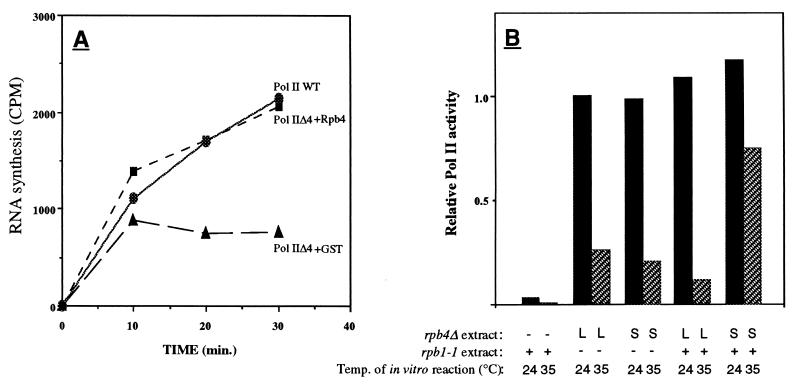
Activity at high temperature of Pol IIΔ4 extracted from post-log-phase but not from logarithmically growing cells can be rescued by Rpb4. (A) Reconstitution of Pol IIΔ4 activity at high temperature with recombinant Rpb4 produced in E. coli. Rpb4-GST fusion protein was expressed in E. coli by using plasmid pGEX-2T (Pharmacia) followed by purification on a glutathione-Sepharose column, as instructed by the manufacturer. The fusion protein was cleaved with thrombin, and the release of free Rpb4 was ascertained by Western analysis (not shown). Reactions were carried out at 35°C as described in Materials and Methods. Pol IIΔ4+Rpb4 (squares), the thrombin digest (0.5 μg) was preincubated with 33 μg of extract from stationary rpb4 cells at 30°C for 15 min followed by 10 min at 25°C and 1 min at 35°C before the reaction commenced; Pol IIΔ4+GST (triangles), 33 μg of extract from stationary rpb4 cells preincubated with 0.5 μg of GST as described above; Pol II WT (circles), 33 μg of extract from stationary wild-type (RPB4+) cells. (B) In vitro complementation between rpb4 and heat-treated rpb1-1 extracts. Cell were grown at 25°C in YPD and harvested at the indicated growth phase, and their proteins were extracted, as described in Materials and Methods. Extracts were prepared from logarithmically growing (L) rpb1-1 cells or from logarithmically growing or stationary (S) rpb4 cells, and the protein concentration in each extract was brought to 2.5 mg/ml in PEB (see Materials and Methods). The rpb1-1 extract was preheated at 42°C for 18 min to inactivate Pol II. Equal volumes of extracts, containing equal amounts of protein, were mixed at various combinations, specified below the columns, before transcription reactions were initiated. In the reactions containing only one extract, an equal volume of PEB was added (-). Note that in these mixtures the concentration of the bulk protein is lower than that in the other mixtures. However, preliminary experiments demonstrated that this difference had no significant effect on Pol II activity. The various mixtures were incubated at 30°C for 15 min, then at 23°C for 45 min, and finally for at 38°C for 1 min. After cooling in ice, each mixture was divided into two equal samples and transcription was assayed at 24 or 35°C as described in Materials and Methods. Relative Pol II activity was calculated with respect to the activity in extract from the logarithmically growing rpb4 cells at 24°C (defined arbitrarily as 1).

References

    1. Acker J, de Graaff M, Cheynel I, Khazak V, Kedinger C, Vigneron M. Interactions between the human RNA polymerase II subunits. J Biol Chem. 1997;272:16815–16821. - PubMed
    1. Austrias F J, Meredith G D, Poglitsch C L, Kornberg R D. Two conformation of RNA polymerase II revealed by electron crystallography. J Mol Biol. 1997;272:536–540. - PubMed
    1. Choder M. A general topoisomerase I-dependent transcriptional repression in the stationary phase in yeast. Genes Dev. 1991;5:2315–2326. - PubMed
    1. Choder M. A growth rate limiting process in the last growth phase of the yeast life cycle involves RPB4, a subunit of RNA polymerase II. J Bacteriol. 1993;175:6358–6363. - PMC - PubMed
    1. Choder M, Young R A. A portion of RNA polymerase II molecules have a component essential for stress responses and stress survival. Mol Cell Biol. 1993;13:6984–6991. - PMC - PubMed

Publication types

MeSH terms

LinkOut - more resources