Potassium currents in freshly dissociated uterine myocytes from nonpregnant and late-pregnant rats
- PMID: 9834143
- PMCID: PMC2229446
- DOI: 10.1085/jgp.112.6.737
Potassium currents in freshly dissociated uterine myocytes from nonpregnant and late-pregnant rats
Abstract
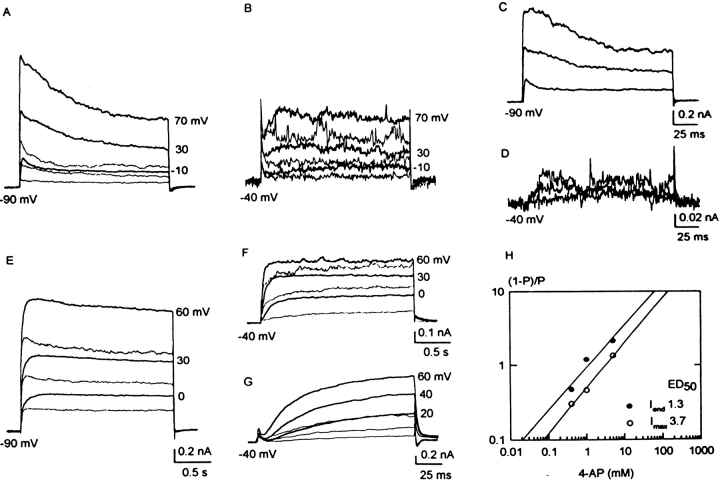
In freshly dissociated uterine myocytes, the outward current is carried by K+ through channels highly selective for K+. Typically, nonpregnant myocytes have rather noisy K+ currents; half of them also have a fast-inactivating transient outward current (ITO). In contrast, the current records are not noisy in late pregnant myocytes, and ITO densities are low. The whole-cell IK of nonpregnant myocytes respond strongly to changes in [Ca2+]o or changes in [Ca2+]i caused by photolysis of caged Ca2+ compounds, nitr 5 or DM-nitrophene, but that of late-pregnant myocytes respond weakly or not at all. The Ca2+ insensitivity of the latter is present before any exposure to dissociating enzymes. By holding at -80, -40, or 0 mV and digital subtractions, the whole-cell IK of each type of myocyte can be separated into one noninactivating and two inactivating components with half-inactivation at approximately -61 and -22 mV. The noninactivating components, which consist mainly of iberiotoxin-susceptible large-conductance Ca2+-activated K+ currents, are half-activated at 39 mV in nonpregnant myocytes, but at 63 mV in late-pregnant myocytes. In detached membrane patches from the latter, identified 139 pS, Ca2+-sensitive K+ channels also have a half-open probability at 68 mV, and are less sensitive to Ca2+ than similar channels in taenia coli myocytes. Ca2+-activated K+ currents, susceptible to tetraethylammonium, charybdotoxin, and iberiotoxin contribute 30-35% of the total IK in nonpregnant myocytes, but <20% in late-pregnant myocytes. Dendrotoxin-susceptible, small-conductance delayed rectifier currents are not seen in nonpregnant myocytes, but contribute approximately 20% of total IK in late-pregnant myocytes. Thus, in late-pregnancy, myometrial excitability is increased by changes in K+ currents that include a suppression of the ITO, a redistribution of IK expression from large-conductance Ca2+-activated channels to smaller-conductance delayed rectifier channels, a lowered Ca2+ sensitivity, and a positive shift of the activation of some large-conductance Ca2+-activated channels.
Figures




References
-
- Amman, D. 1986. Ion Selective Microelectrodes. Springer Verlag GmbH & Co. Berlin, Germany. 109–207.
-
- Blatz AL, Magleby KL. Single apamine-blocked Ca2+-activated K+channels of small conductance in cultured rat skeletal muscle. Nature. 1986;323:718–720. - PubMed
-
- Chandy, K.G., and G.A. Gutman. 1995. Voltage-gated potassium channel genes. In Handbook of Receptors and Channels, Ligand and Voltage-Gated Ion Channels. R.A. North, editor. CRC Press. Boca Raton, FL. 1–71.
Publication types
MeSH terms
Substances
Grants and funding
LinkOut - more resources
Full Text Sources
Miscellaneous