


Induction of resistance to azole drugs in Trypanosoma cruzi
- PMID: 9835521
- PMCID: PMC106029
- DOI: 10.1128/AAC.42.12.3245
Induction of resistance to azole drugs in Trypanosoma cruzi
Abstract
Trypanosoma cruzi is the protozoan parasite that causes Chagas' disease, a frequently fatal illness affecting the heart and gastrointestinal systems. An estimated 16 million to 18 million people in Latin America and 50,000 to 100,000 people in the United States are infected with this pathogen. Treatment options for T. cruzi infections are suboptimal due to the toxicities and limited effectiveness of the available drugs. Azole antimicrobial agents have been discovered to have antitrypanosomal activity by inhibition of ergosterol synthesis. The triazole itraconazole was recently shown to produce a parasitologic cure rate of 53% in chronically infected patients (W. Apt et al., Am. J. Trop. Med. Hyg. 59:133-138, 1998), a result which may lead to more use of this family of drugs for the treatment of T. cruzi infections. In the experiments reported on here, resistance to azoles was induced in vitro by serial passage of mammalian-stage parasites in the presence of fluconazole for 4 months. These parasites were cross resistant to the other azoles, ketoconazole, miconazole, and itraconazole. They remained susceptible to benznidazole and amphotericin B. The azole-resistant phenotype was stable for more than 2 months of in vitro serial passage without fluconazole. In addition, the parasites resisted treatment in mice receiving ketoconazole. The rapid development of azole resistance in T. cruzi in vitro suggests that resistance to azole drugs has the potential to occur in patients and may pose an impediment to the progress being made in the treatment of T. cruzi infection.
Figures
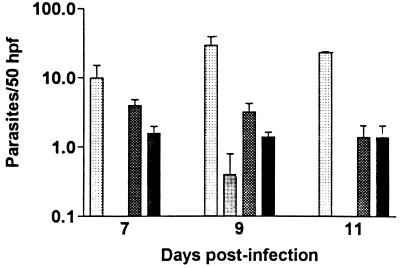
 ) and ketoconazole-treated
(
) and ketoconazole-treated
( ) mice infected with the parent
line on all 3 days (P < 0.05), whereas the levels of
parasitemia were not significantly different between the
placebo-treated (▩) and ketoconazole-treated (■) mice infected with
the azole-resistant T. cruzi strain on all 3 days
(P > 0.10). hpf, high-power field.
) mice infected with the parent
line on all 3 days (P < 0.05), whereas the levels of
parasitemia were not significantly different between the
placebo-treated (▩) and ketoconazole-treated (■) mice infected with
the azole-resistant T. cruzi strain on all 3 days
(P > 0.10). hpf, high-power field.References
-
- Ajioka J, Swindle J. The calmodulin-ubiquitin (CUB) genes of Trypanosoma cruziare essential for parasite viability. Mol Biochem Parasitol. 1996;78:217–225. - PubMed
-
- Apt W, Aguilera X, Arribada A, Perez C, Miranda C, Sanchez G, Zulantay I, Cortes P, Rodriguez J, Juri D. Treatment of chronic Chagas’ disease with itraconazole and allopurinol. Am J Trop Med Hyg. 1998;59:133–138. - PubMed
-
- Bacchi C J. Resistance to clinical drugs in African trypanosomes. Parasitol Today. 1993;9:190–193. - PubMed
-
- Beverley S M. Gene amplification in Leishmania. Annu Rev Microbiol. 1991;45:417–444. - PubMed
Publication types
MeSH terms
Substances
Grants and funding
LinkOut - more resources
Full Text Sources
Other Literature Sources
