


The mitochondrial toxin produced by Streptomyces griseus strains isolated from an indoor environment is valinomycin
- PMID: 9835560
- PMCID: PMC90920
- DOI: 10.1128/AEM.64.12.4767-4773.1998
The mitochondrial toxin produced by Streptomyces griseus strains isolated from an indoor environment is valinomycin
Abstract
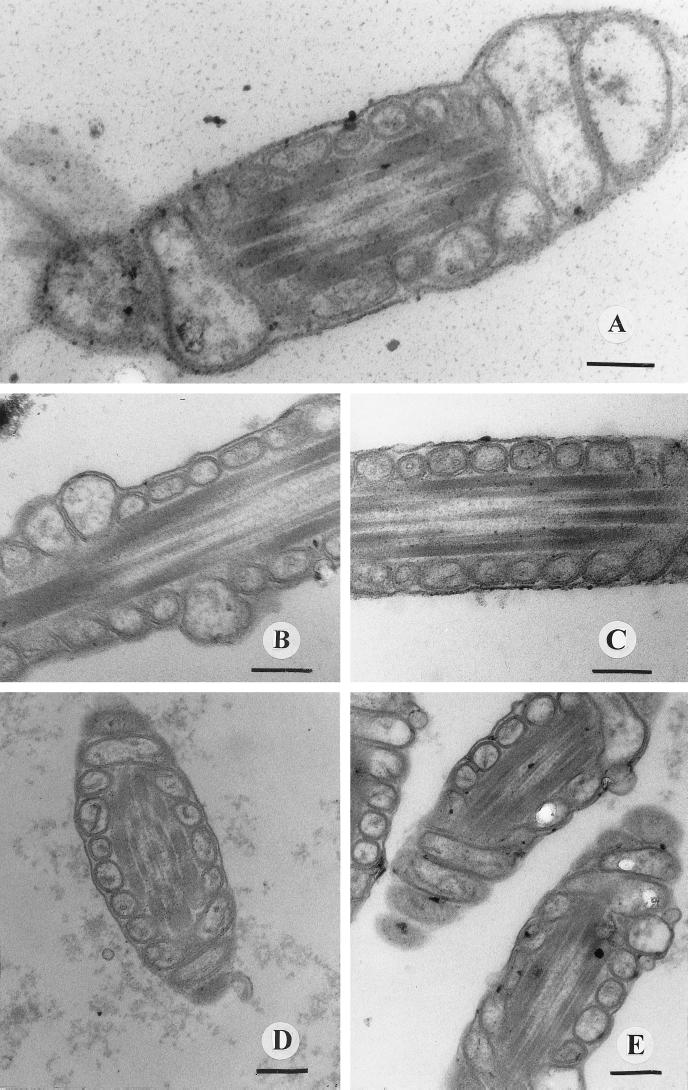
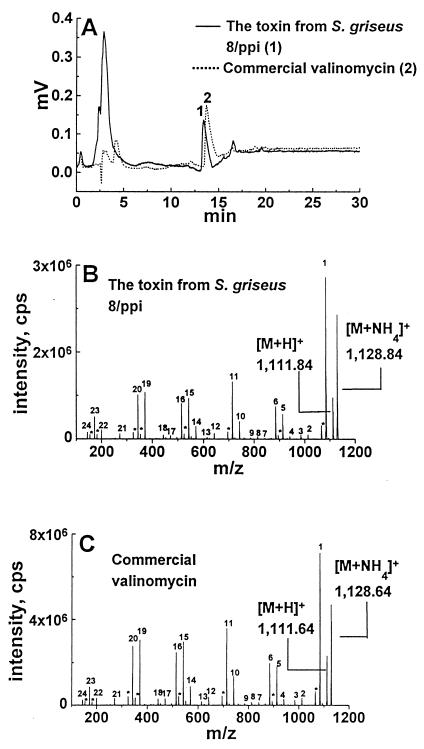
Actinomycete isolates from indoor air and dust in water-damaged schools and children's day care centers were tested for toxicity by using boar spermatozoa as an indicator. Toxicity was detected in extracts of four strains which caused a loss of sperm motility, and the 50% effective concentrations (EC50) were 10 to 63 ng (dry weight) ml of extended boar semen-1. The four strains were identified as Streptomyces griseus strains by 16S ribosomal DNA and chemotaxonomic methods. The four S. griseus strains had similar effects on sperm cells, including loss of motility and swelling of mitochondria, but we observed no loss of plasma membrane integrity or depletion of cellular ATP. None of the effects was observed with sperm cells exposed to extracts of other indoor actinomycete isolates at concentrations of >/=5,000 to 72,000 ng ml-1. The toxin was purified from all four strains and was identified as a dodecadepsipeptide, and the fragmentation pattern obtained by tandem mass spectrometry was identical to that of valinomycin. Commercial valinomycin had effects in sperm cells that were identical to the effects of the four indoor isolates of S. griseus. The EC50 of purified toxin from the S. griseus strains were 1 to 3 ng ml of extended boar semen-1, and the EC50 of commercial valinomycin was 2 ng ml of extended boar semen-1. To our knowledge, this is the first report of the presence of ionophoric toxin producers in an indoor environment and the first report of valinomycin-producing strains identified as S. griseus.
Figures
References
-
- Agata N, Ohta M, Masashi M, Isobe M. A novel dodecadepsipeptide, cereulide, is an emetic toxin of Bacillus cereus. FEMS Microbiol Lett. 1995;129:17–20. - PubMed
-
- Annila A, Lehtimäki J, Mattila K, Eriksson J, Sivonen K, Rantala T, Drakenberg T. Solution structure of nodularin, an inhibitor of serine/threonine-specific protein phosphatases. J Biol Chem. 1996;271:16695–16702. - PubMed
-
- Booth I. Bacterial transport energetics and mechanisms. In: Anthony C, editor. Bacterial energy transduction. London, United Kingdom: Academic Press; 1988. pp. 377–428.
Publication types
MeSH terms
Substances
Associated data
- Actions
- Actions
- Actions
- Actions
- Actions
- Actions
- Actions
LinkOut - more resources
Full Text Sources
Other Literature Sources
Medical
Molecular Biology Databases
Miscellaneous
