


Cloning of the Alcaligenes latus polyhydroxyalkanoate biosynthesis genes and use of these genes for enhanced production of Poly(3-hydroxybutyrate) in Escherichia coli
- PMID: 9835580
- PMCID: PMC90940
- DOI: 10.1128/AEM.64.12.4897-4903.1998
Cloning of the Alcaligenes latus polyhydroxyalkanoate biosynthesis genes and use of these genes for enhanced production of Poly(3-hydroxybutyrate) in Escherichia coli
Abstract
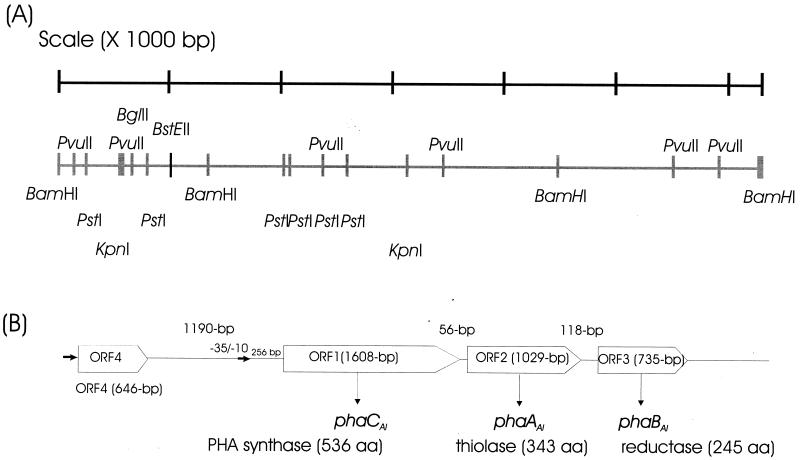
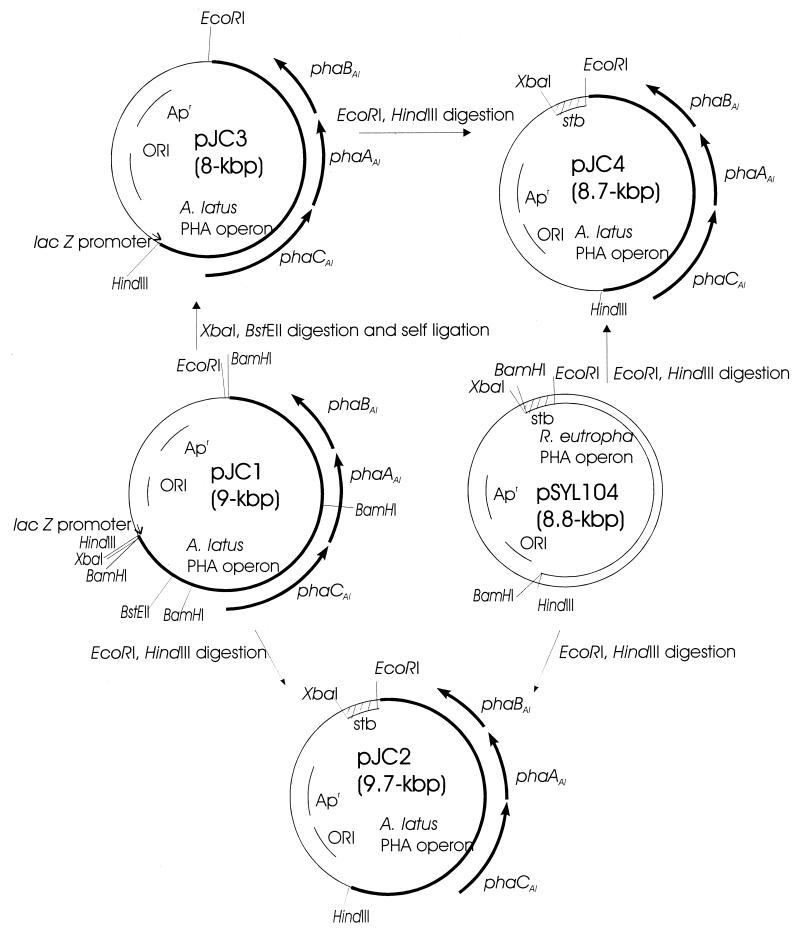
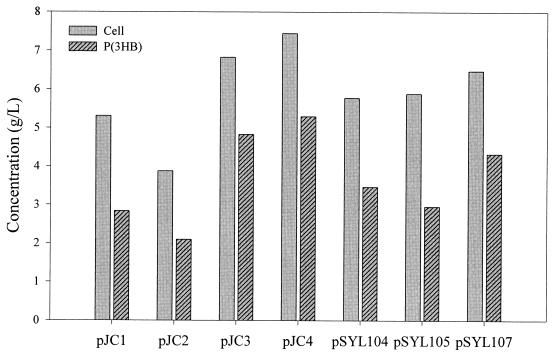
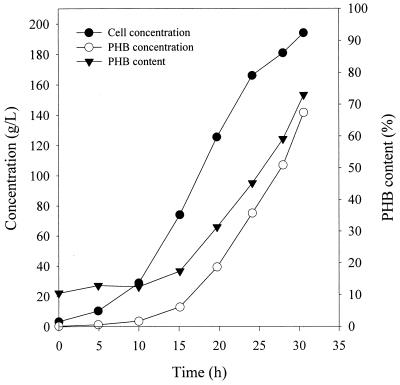
Polyhydroxyalkanoates (PHAs) are microbial polyesters that can be used as completely biodegradable polymers, but the high production cost prevents their use in a wide range of applications. Recombinant Escherichia coli strains harboring the Ralstonia eutropha PHA biosynthesis genes have been reported to have several advantages as PHA producers compared with wild-type PHA-producing bacteria. However, the PHA productivity (amount of PHA produced per unit volume per unit time) obtained with these recombinant E. coli strains has been lower than that obtained with the wild-type bacterium Alcaligenes latus. To endow the potentially superior PHA biosynthetic machinery to E. coli, we cloned the PHA biosynthesis genes from A. latus. The three PHA biosynthesis genes formed an operon with the order PHA synthase, beta-ketothiolase, and reductase genes and were constitutively expressed from the natural promoter in E. coli. Recombinant E. coli strains harboring the A. latus PHA biosynthesis genes accumulated poly(3-hydroxybutyrate) (PHB), a model PHA product, more efficiently than those harboring the R. eutropha genes. With a pH-stat fed-batch culture of recombinant E. coli harboring a stable plasmid containing the A. latus PHA biosynthesis genes, final cell and PHB concentrations of 194.1 and 141.6 g/liter, respectively, were obtained, resulting in a high productivity of 4.63 g of PHB/liter/h. This improvement should allow recombinant E. coli to be used for the production of PHB with a high level of economic competitiveness.
Figures
References
-
- Braunegg G, Sonnleitner B, Lafferty R M. A rapid gas chromatographic method for the determination of poly-β-hydroxybutyric acid in microbial biomass. Eur J Appl Microbiol Biotechnol. 1978;6:29–37.
-
- Byrom D. Polymer synthesis by microorganisms: technology and economics. Trends Biotechnol. 1987;5:246–250.
-
- Choi J, Lee S Y. Process analysis and economic evaluation for poly(3-hydroxybutyrate) production by fermentation. Bioprocess Eng. 1997;17:335–342.
-
- Doi Y. Microbial polyesters. New York, N.Y: VCH; 1990.
Publication types
MeSH terms
Substances
Associated data
- Actions
LinkOut - more resources
Full Text Sources
Other Literature Sources
