Intrapartum risk factors for newborn encephalopathy: the Western Australian case-control study
- PMID: 9836653
- PMCID: PMC28733
- DOI: 10.1136/bmj.317.7172.1554
Intrapartum risk factors for newborn encephalopathy: the Western Australian case-control study
Abstract
Objective: To identify intrapartum predictors of newborn encephalopathy in term infants.
Design: Population based, unmatched case-control study.
Setting: Metropolitan area of Western Australia, June 1993 to September 1995.
Subjects: All 164 term infants with moderate or severe newborn encephalopathy; 400 randomly selected controls.
Main outcome measures: Adjusted odds ratio estimates.
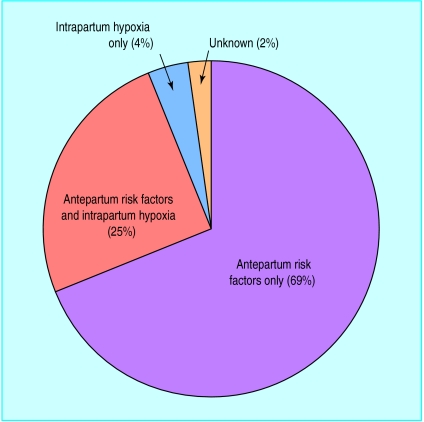
Results: The birth prevalence of moderate or severe newborn encephalopathy was 3.8/1000 term live births. The neonatal fatality was 9.1%. Maternal pyrexia (odds ratio 3.82), a persistent occipitoposterior position (4.29), and an acute intrapartum event (4.44) were all risk factors for newborn encephalopathy. More case infants than control infants were induced (41.5% and 30.5%, respectively) and fewer case infants were delivered by caesarean section without labour (3.7% and 14.5%, respectively). Operative vaginal delivery (2.34) and emergency caesarean section (2.17) were both associated with an increased risk. There was an inverse relation between elective caesarean section (0.17) and newborn encephalopathy. After application of a set of consensus criteria for elective caesarean section only three (7%) eligible case mothers compared with 33 (65%) eligible control mothers were sectioned electively. Of all the case infants, 113 (69%) had only antepartum risk factors for newborn encephalopathy identified; 39 (24%) had antepartum and intrapartum factors; eight (5%) had only intrapartum factors; and four (2%) had no recognised antepartum or intrapartum factors.
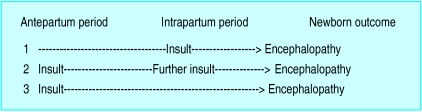
Conclusions: The causes of newborn encephalopathy are heterogeneous and many relate to the antepartum period. Elective caesarean section has an inverse association with newborn encephalopathy. Intrapartum hypoxia alone accounts for only a small proportion of newborn encephalopathy. These results question the view that most risk factors for newborn encephalopathy lie in the intrapartum period.
Figures
Comment in
-
Neonatal encephalopathies. Time to reconsider the cause of encephalopathies.BMJ. 1998 Dec 5;317(7172):1537-8. doi: 10.1136/bmj.317.7172.1537. BMJ. 1998. PMID: 9836647 Free PMC article. No abstract available.
-
Antepartum risk factors for newborn encephalopathy. Inverse association of risk may be due to easier delivery with elective caesarean section.BMJ. 1999 May 22;318(7195):1414-15. BMJ. 1999. PMID: 10391710 No abstract available.
References
-
- Nelson KB, Leviton A. How much of neonatal encephalopathy is due to birth asphyxia? Am J Dis Child. 1991;145:1325–1331. - PubMed
-
- Finer NN, Robertson CM, Richards RT, Pinnell LE, Peters KL. Hypoxic-ischemic encephalopathy in term neonates: perinatal factors and outcome. J Pediatr. 1981;98:112–117. - PubMed
-
- Ergander U, Eriksson M, Zetterstrom R. Severe neonatal asphyxia. Incidence and prediction of outcome in the Stockholm area. Acta Paediatr. 1983;72:321–325. - PubMed
-
- Levene ML, Kornberg J, Williams THC. The incidence and severity of post-asphyxial encephalopathy in full-term infants. Early Hum Develop. 1985;11:21–26. - PubMed
-
- Hull J, Dodd KL. Falling incidence of hypoxic-ischaemic encephalopathy in term infants. Br J Obstet Gynaecol. 1992;99:386–391. - PubMed
MeSH terms
LinkOut - more resources
Full Text Sources
Medical