Review
. 1998 Dec;62(4):1415-34.
doi: 10.1128/MMBR.62.4.1415-1434.1998.

Antisense RNA: function and fate of duplex RNA in cells of higher eukaryotes

Affiliations
Review

Antisense RNA: function and fate of duplex RNA in cells of higher eukaryotes

M Kumar et al. Microbiol Mol Biol Rev. 1998 Dec.

Abstract

There is ample evidence that cells of higher eukaryotes express double-stranded RNA molecules (dsRNAs) either naturally or as the result of viral infection or aberrant, bidirectional transcriptional readthrough. These duplex molecules can exist in either the cytoplasmic or nuclear compartments. Cells have evolved distinct ways of responding to dsRNAs, depending on the nature and location of the duplexes. Since dsRNA molecules are not thought to exist naturally within the cytoplasm, dsRNA in this compartment is most often associated with viral infections. Cells have evolved defensive strategies against such molecules, primarily involving the interferon response pathway. Nuclear dsRNA, however, does not induce interferons and may play an important posttranscriptional regulatory role. Nuclear dsRNA appears to be the substrate for enzymes which deaminate adenosine residues to inosine residues within the polynucleotide structure, resulting in partial or full unwinding. Extensively modified RNAs are either rapidly degraded or retained within the nucleus, whereas transcripts with few modifications may be transported to the cytoplasm, where they serve to produce altered proteins. This review summarizes our current knowledge about the function and fate of dsRNA in cells of higher eukaryotes and its potential manipulation as a research and therapeutic tool.


Figures

FIG. 1
FIG. 1
Temporal regulation of polyomavirus transcript levels. (A) During the early phase of viral infection, early-strand transcripts accumulate preferentially over late-strand transcripts. Late-strand transcripts are processed inefficiently and are relatively unstable. Before DNA replication, the ratio of late-strand to early-strand RNAs is less than 1:10. (B) During the late phase of infection, after the onset of DNA replication, late-strand transcripts are more abundant than early-strand transcripts. Transcription termination is inefficient during this period, allowing RNA polymerase II to encircle the genome multiple times. The resulting multigenomic transcripts contain sequences complementary to early-strand transcripts and act as natural antisense regulators within the nucleus (166). Hatched lines denote transcripts that are downregulated posttranscriptionally.
FIG. 2
FIG. 2
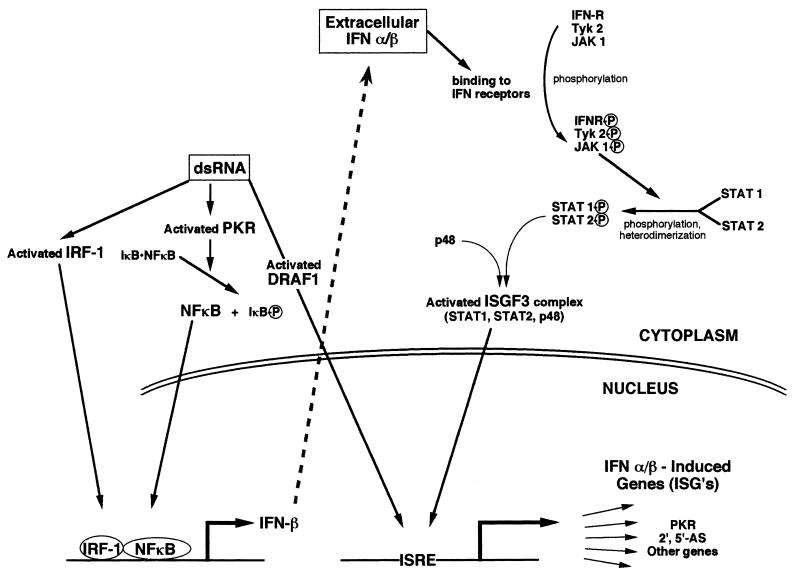
Signaling pathways of IFN-α, IFN-β, and cytoplasmic dsRNA. The major known pathways of signaling by cytoplasmic dsRNA and IFN-α/β are shown and are discussed in detail in the text. dsRNA directly activates PKR, IRF-1, and DRAF1. PKR phosphorylates IκB, which in turn leads to the nuclear localization of the transcription factor NF-κB. IRF-1 and NF-κB activate the IFN-β promoter, while DRAF1 can activate IFN-α- and IFN-β-induced genes (ISGs). IFN-β is secreted from cells (dashed arrow) and then binds to IFN receptors, leading to the activation of the signal transduction pathway shown, which itself stimulates the expression of ISGs.
FIG. 3
FIG. 3
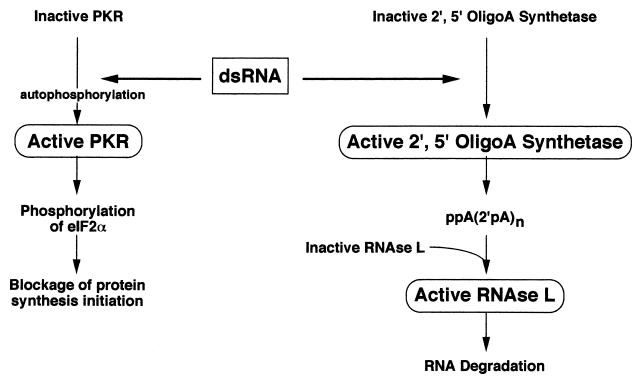
Cytoplasmic effects of dsRNA. The PKR pathway and the 2′,5′-AS/RNase L pathway are directly activated by dsRNA, as described in the text. Activated PKR phosphorylates eIF-2α, which leads to the inhibition of protein synthesis initiation. Activated 2′,5′-AS generates oligoadenylates which activate RNase L, which can degrade viral and cellular RNAs.
FIG. 4
FIG. 4
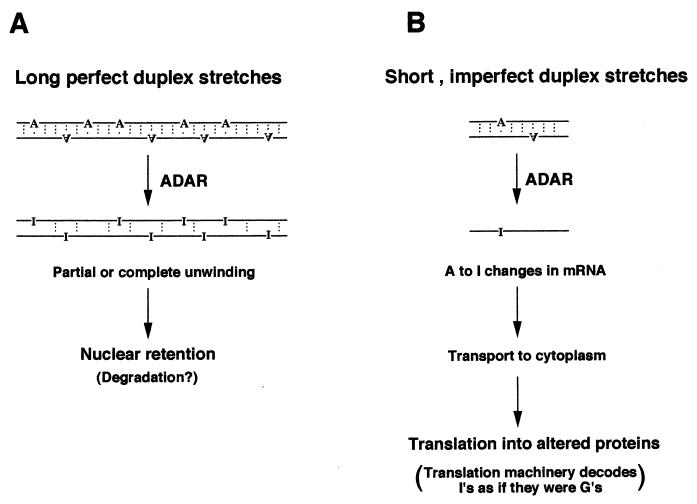
Nuclear effects of dsRNA. Antisense RNA within the nucleus most probably leads to adenosine modifications by a member of the ADAR family of dsRNA-dependent adenosine deaminases, as discussed in the text. (A) For long duplex stretches, extensive editing occurs. The two RNA strands are partially or fully unwound and are retained exclusively within the nucleus. (B) Short duplex stretches might lead to limited editing, with only one or a few adenosine-to-inosine modifications. Such edited mRNAs can be transported to the cytoplasm, where they are translated.

References

    1. Acheson N. Transcription during productive infection with polyoma virus and SV40. Cell. 1976;8:1–12. - PubMed
    1. Acheson N. Efficiency of processing of viral RNA during the early and late phases of productive infection by polyoma virus. J Virol. 1981;37:628–635. - PMC - PubMed
    1. Acheson N. Kinetics and efficiency of polyadenylation of late polyomavirus nuclear RNA: generation of oligomeric polyadenylated RNAs and their processing into mRNA. Mol Cell Biol. 1984;4:722–729. - PMC - PubMed
    1. Acheson N, Buetti E, Scherrer K, Weil R. Transcription of the polyoma virus genome: synthesis and cleavage of giant late polyoma specific RNA. Proc Natl Acad Sci USA. 1971;68:2231–2235. - PMC - PubMed
    1. Acheson N H. Polyoma giant RNAs contain tandem repeats of the nucleotide sequence of the entire viral genome. Proc Natl Acad Sci USA. 1978;75:4754–4758. - PMC - PubMed

Publication types

LinkOut - more resources