


Effects of maternal antibodies on protection and development of antibody responses to human rotavirus in gnotobiotic pigs
- PMID: 9847321
- PMCID: PMC103822
- DOI: 10.1128/JVI.73.1.186-197.1999
Effects of maternal antibodies on protection and development of antibody responses to human rotavirus in gnotobiotic pigs
Abstract
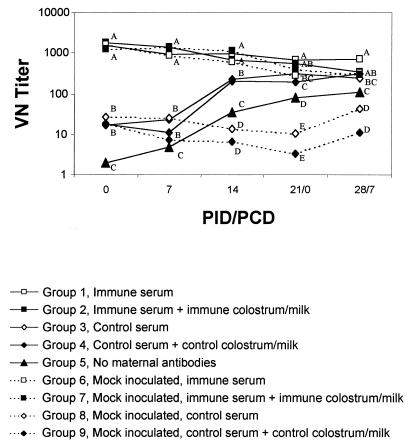
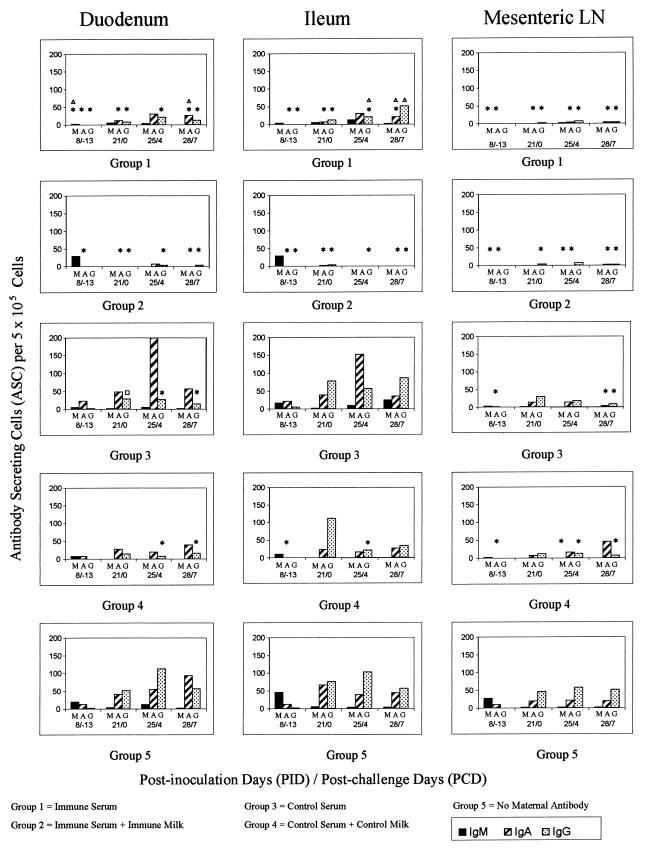
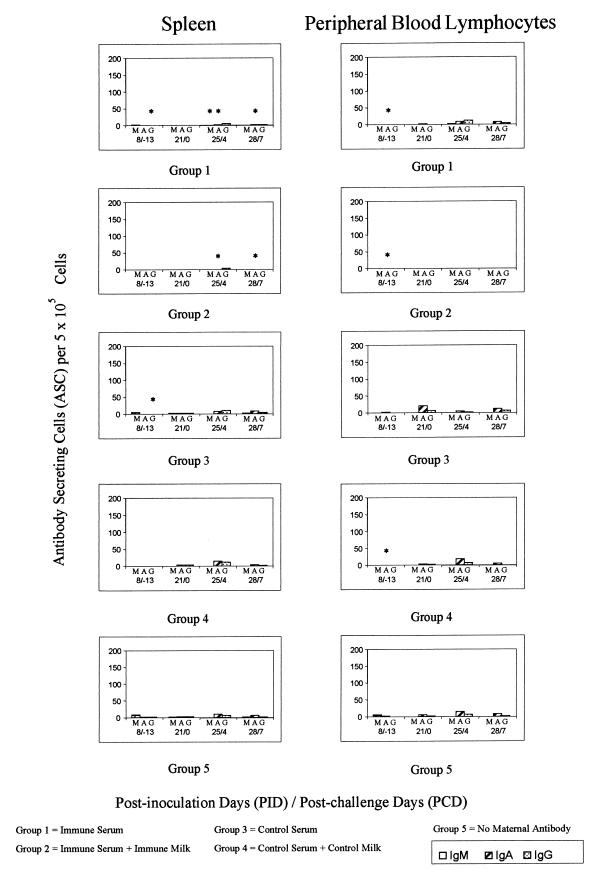
Although maternal antibodies can protect against infectious disease in infancy, they can also suppress active immune responses. The effects of circulating maternal antibodies, with and without colostrum and milk antibodies, on passive protection and active immunity to human rotavirus (HRV) were examined in gnotobiotic pigs. Pigs received intraperitoneal injections of high-titer serum (immune pigs [groups 1 and 2]) from immunized sows, low-titer serum from naturally infected sows (control pigs [groups 3 and 4]), or no serum (group 5). Immune or control colostrum and milk were added to the diet of groups 2 and 4, respectively. After inoculation (3 to 5 days of age) and challenge (postinoculation day [PID] 21) with virulent HRV, the effects of maternal antibodies on protection (from diarrhea and virus shedding), and on active antibody responses (measured by quantitation of antibody-secreting cells [ASC] in intestinal and systemic lymphoid tissues by ELISPOT) were evaluated. Groups 1 and 2 had significantly less diarrhea and virus shedding after inoculation but higher rates of diarrhea and virus shedding after challenge than did groups 3 and 5. Group 1 and 2 pigs had significantly fewer immunoglobulin A (IgA) ASC in intestinal tissues at PID 21 and at postchallenge day (PCD) 7 compared to group 5. Significantly fewer IgG ASC were present in the intestines of group 2 pigs at PID 21 and PCD 7 compared to group 5. There was a trend towards fewer ASC in intestinal tissues of group 2 than group 1, from PID 21 on, with significantly fewer IgA ASC at PCD 7. IgG ASC in the duodenum and mesenteric lymph nodes of group 3 and 4 pigs were significantly fewer than in group 5 at PCD 7. These decreases in ASC emphasize the role of passive antibodies in impairing induction of ASC rather than in merely suppressing the function of differentiated B cells. To be successful, vaccines intended for populations with high titers of maternal antibodies (infants in developing countries) may require higher titers of virus, multiple doses, or improved delivery systems, such as the use of microencapsulation or immune stimulating complexes, to overcome the suppressive effects of maternal antibodies.
Figures



References
-
- Barrios C, Brawand P, Berney M, Brandt C, Lambert P H, Siegrist C A. Neonatal and early life immune responses to various forms of vaccine antigens qualitatively differ from adult responses: predominance of a Th2-biased pattern which persists after adult boosting. Euro J Immunol. 1996;26:1489–1496. - PubMed
-
- Bernstein D I, Sander D S, Smith V E, Schiff G M, Ward R L. Protection from rotavirus reinfection: 2 year prospective study. J Infect Dis. 1991;164:277–283. - PubMed
-
- Bhan M K, Lew J F, Sazawal S, Das B M, Gentsch J R, Glass R I. Protection conferred by neonatal rotavirus infection against subsequent rotavirus diarrhea. J Infect Dis. 1993;168:282–287. - PubMed
Publication types
MeSH terms
Substances
Grants and funding
LinkOut - more resources
Full Text Sources
Other Literature Sources
Miscellaneous
