Comparative Study
. 1998 Dec;180(24):6713-8.
doi: 10.1128/JB.180.24.6713-6718.1998.

Comparison in vitro of a high- and a low-abundance chemoreceptor of Escherichia coli: similar kinase activation but different methyl-accepting activities

Affiliations
Comparative Study

Comparison in vitro of a high- and a low-abundance chemoreceptor of Escherichia coli: similar kinase activation but different methyl-accepting activities

A N Barnakov et al. J Bacteriol. 1998 Dec.

Abstract

In Escherichia coli, high-abundance chemoreceptors are present in cellular amounts approximately 10-fold greater than low-abundance chemoreceptors. Cells containing only low-abundance receptors exhibit abnormally low tumble frequencies and do not migrate effectively in spatial gradients. These defects reflect an inherent activity difference between the two receptor classes. We used in vitro assays to investigate this difference. The low-abundance receptor Trg mediated an approximately 100-fold activation of the kinase CheA, only twofold less than activation by the high-abundance receptor Tar. In contrast, Trg was less than 1/20 as active as Tar for in vitro methylation. As observed for high-abundance receptors, kinase activation by Trg varied with the extend of modification at methyl-accepting sites; low methylation corresponded to low kinase activation. Thus, in Trg-only cells, low receptor methylation would result in low kinase activation, correspondingly low content of phospho-CheY, and a decreased dynamic range over which attractant binding could modulate kinase activity. These features could account for the low tumble frequency and inefficient taxis exhibited by Trg-only cells. Thus, the crucial functional difference between the receptor classes is likely to be methyl-accepting activity. We investigated the structural basis for this functional difference by introducing onto the carboxy terminus of Trg a CheR-binding pentapeptide, usually found only at the carboxy termini of high-abundance receptors. This addition enhanced the in vitro methyl-accepting activity of Trg 10-fold.


Figures
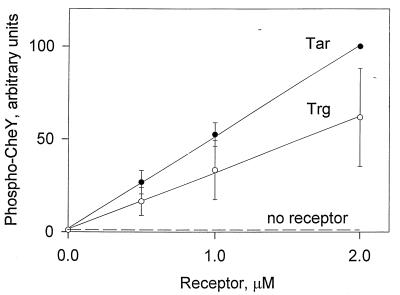
FIG. 1
FIG. 1
Concentration dependence of kinase activation by Trg and Tar. Isolated membranes containing no receptor, Trg, or Tar were incubated with CheA, CheW, CheY, and [γ-32P]ATP under conditions under which phosphorylation of CheA was the rate-limiting step for the appearance of phospho-CheY (9). 32P-labeled phospho-CheY produced over 10 s was quantified by SDS-PAGE and phosphorimaging. The dotted line represents the small amount of 32P-labeled phospho-CheY formed through the low activity of CheA autophosphorylation in the absence of activating receptor. In experiments not shown here, addition of 1 mM aspartate to mixtures containing Tar reduced phospho-CheY ∼50-fold. The data are averages from four independent experiments, but several other experiments showed the same patterns. The error bars represent standard errors. Prior to averaging, the data sets were normalized by using the values for 2 μM Tar, and thus that point does not have error bars.
FIG. 2
FIG. 2
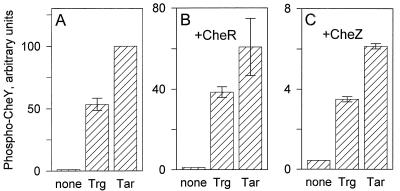
Relative kinase activation by Trg and Tar. Assays were performed as described in the legend to Fig. 1, using 1 μM receptor. Isolated membranes containing no receptor, Trg, or Tar were incubated with CheA, CheW, CheY, and [γ-32P]ATP with no other additions (A), with the addition of a cell lysate, providing 1 to 2 μM CheR (B), or with the addition of 0.6 μM CheZ (C). The data are averages from two independent experiments, but many other experiments showed similar patterns. The error bars represent standard errors. Prior to averaging, the data sets were normalized by using the values for Tar-mediated production in the absence of CheR or CheZ. For this reason there are no error bars for the Tar value in panel A.
FIG. 3
FIG. 3
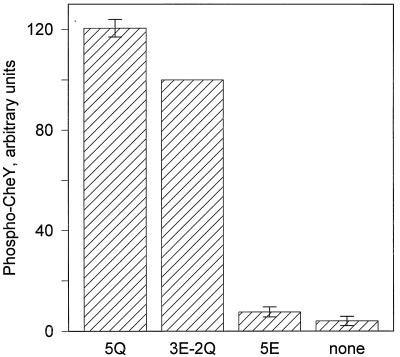
Kinase activation by Trg (5Q), Trg (3E-2Q), and Trg (5E). Assays were performed as described in the legend to Fig. 1, using 1 μM receptor. The data are averages from three independent experiments, including one with several replicates. Prior to averaging, the average values from independent experiments were normalized by using the value for Trg (3E-2Q). For this reason there are no error bars for that value. The error bars represent standard errors.
FIG. 4
FIG. 4
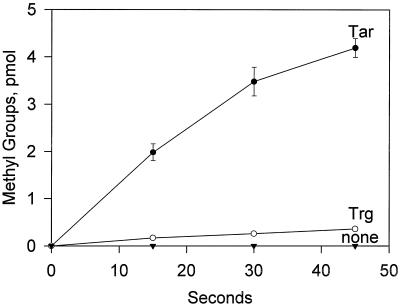
Time courses of methylation in vitro. Isolated membranes containing no receptor, Trg, or Tar were incubated with a cellular extract containing ∼1 μM CheR and 50 μM AdoMet at receptor concentrations of ∼5 μM. At the indicated times samples containing ∼50 pmol of receptor were removed, processed, and analyzed as described in Materials and Methods. The data are averages from three independent experiments, and the error bars show standard errors. Points without bars had standard errors within the size of the symbol.
FIG. 5
FIG. 5
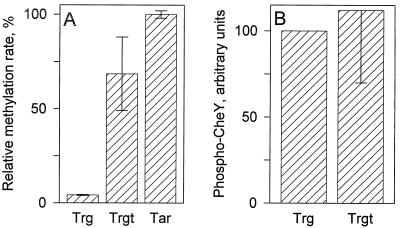
Effects of adding to Trg the 19-residue, carboxy-terminal tail of Tsr. Tar, Trg, and the hybrid receptor Trgt were tested for methyl-accepting activity (A) and kinase activation (B) as described in the legends to Fig. 4 and 2, respectively. Methylation rates were determined after a 1-min incubation and were expressed as a percentage relative to the rate for Tar. Kinase activation was expressed as a percentage relative to the Trg-mediated value. The data are averages from two independent experiments, and the error bars show standard errors.

References

    1. Alex L A, Simon M I. Protein histidine kinases and signal transduction in prokaryotes and eukaryotes. Trends Genet. 1994;10:133–138. - PubMed
    1. Ames P, Yu Y A, Parkinson J S. Methylation segments are not required for chemotactic signaling by cytoplasmic fragments of Tsr, the methyl-accepting serine chemoreceptor of Escherichia coli. Mol Microbiol. 1996;19:737–746. - PubMed
    1. Appleby J L, Parkinson J S, Bourret R B. Signal transduction via the multi-step phosphorelay: not necessarily a road less traveled. Cell. 1996;86:845–848. - PubMed
    1. Bibikov S I, Biran R, Rudd K E, Parkinson J S. A signal transducer for aerotaxis in Escherichia coli. J Bacteriol. 1997;179:4075–4079. - PMC - PubMed
    1. Bogonez E, Koshland D E., Jr Solubilization of a vectorial transmembrane receptor in a functional form: aspartate receptor of chemotaxis. Proc Natl Acad Sci USA. 1985;82:4891–4895. - PMC - PubMed

Publication types

MeSH terms