. 1998 Dec 15;18(24):10579-93.
doi: 10.1523/JNEUROSCI.18-24-10579.1998.

Amphetamine-induced behavior, dopamine release, and c-fos mRNA expression: modulation by environmental novelty

Affiliations

Amphetamine-induced behavior, dopamine release, and c-fos mRNA expression: modulation by environmental novelty

A Badiani et al. J Neurosci. .

Abstract

We have shown recently that the psychomotor activating effects of amphetamine in the rat are much greater when this drug is administered in association with environmental novelty than when it is given in a home environment. The main purpose of the present study was to explore the neural basis of this phenomenon. We found, using in situ hybridization of c-fos mRNA, that the pattern of neuronal activation in the cortex, in the caudate, in the shell and core of the nucleus accumbens, and in other subcortical structures was markedly different when amphetamine (2.0 mg/kg, i.p.) was given in association with exposure to environmental novelty relative to when it was given at home. In most brain regions the magnitude of c-fos expression was over two times greater in rats given amphetamine plus novelty than in rats given amphetamine alone. In contrast, an in vivo microdialysis study indicated that environmental novelty did not affect amphetamine-induced dopamine release in either caudate or nucleus accumbens. Furthermore, a unilateral 6-hydroxydopamine lesion of the mesostriatal dopamine system reduced amphetamine- but not novelty-induced c-fos expression. Finally, we found no differences in the amount of corticosterone secreted after exposure to novelty, amphetamine, or both, suggesting that corticosterone does not play a critical role in the ability of novelty to modulate amphetamine-induced psychomotor activation. In conclusion, it seems that environmental novelty alters the neurobiological effects of amphetamine independently of the primary neuropharmacological actions of this drug in the striatum.


Figures
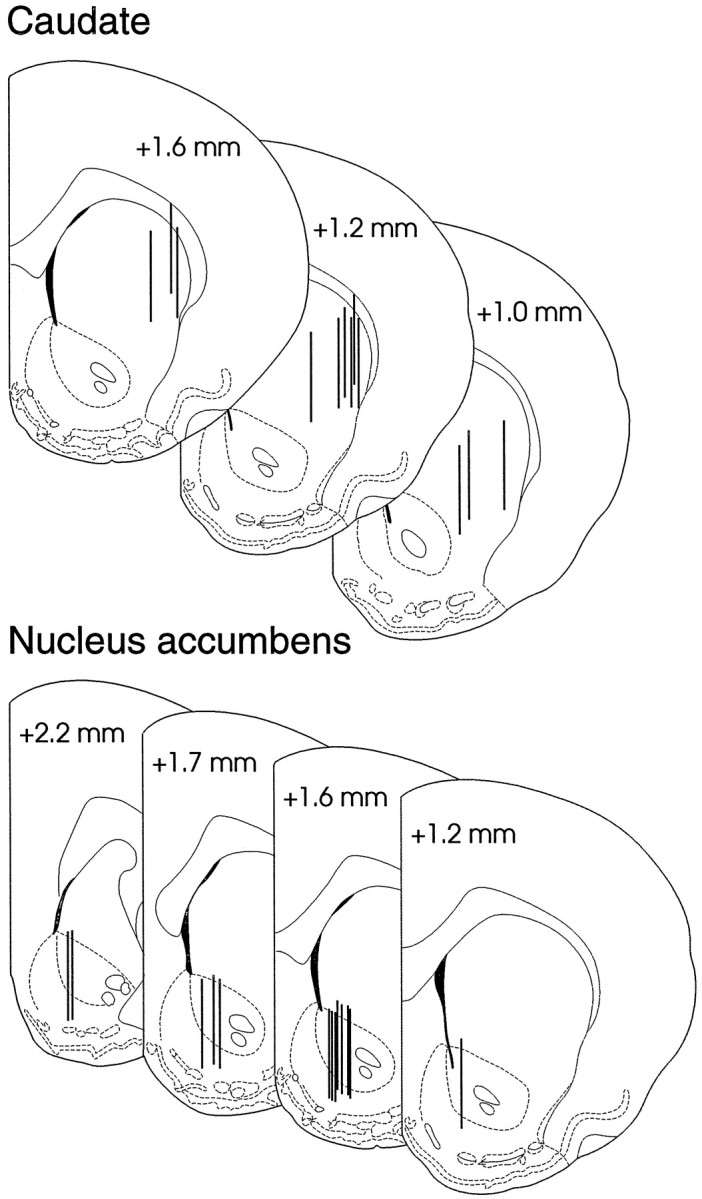
Fig. 1.
Fig. 1.
Schematic drawings illustrating the placement (vertical lines) of the microdialysis probes. This figure was obtained by digital modification of plates from Paxinos and Watson (1982). The values in millimeters indicate distance from bregma.
Fig. 2.
Fig. 2.
Effects of amphetamine on rotational behavior and striatal DA overflow in animals exposed to amphetamine alone (Amphetamine) or to amphetamine in association with environmental novelty (Amphetamine + Novelty). A, Mean (± SEM) number of rotations during a 100 min test session. Baseline activity (time 0) was negligible. A two-way ANOVA with repeated measures on one factor indicated a significant effect of environment [F(1,23) = 15.54; p < 0.001] and of time [F(4,92) = 18.14;p < 0.0001] and an environment times time interaction [F(4,92) = 2.82;p = 0.029]. B, C, Mean (± SEM) DA concentrations in the dialysates expressed as the percent of the baseline value (mean DA concentration in the 60 min before treatment; time 0). A two-way ANOVA with repeated measures on one factor indicated no effect of environment in either the caudate [B; F(1,9) = 0.01;p = 0.92] or the nucleus accumbens [C; F(1,11) = 0.03;p = 0.86].
Fig. 3.
Fig. 3.
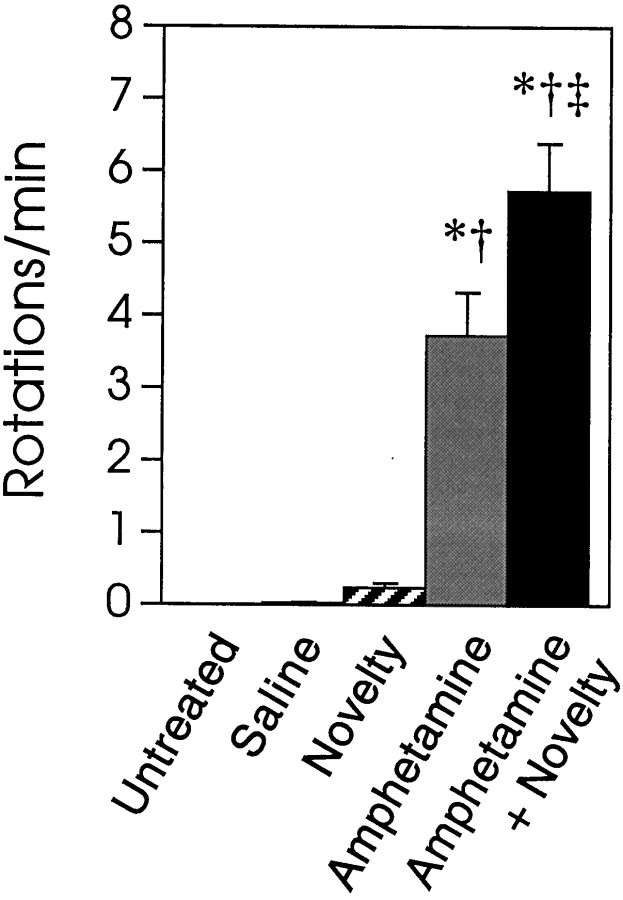
Rate of rotational behavior (mean number of rotations/5 min ± SEM) as a function of treatment and of environmental condition. The behavior was quantified immediately before decapitation in untreated animals (Untreated) or 45–50 min after an intraperitoneal injection of saline (Saline), an intraperitoneal injection of amphetamine (Amphetamine; 2.0 mg/kg), exposure to environmental novelty (Novelty), or exposure to both amphetamine and novelty (Amphetamine + Novelty). A one-way ANOVA indicated significant group differences [F(4,38) = 24.56;p < 0.0001]. Asterisks indicate a difference from saline (p < 0.05); adagger indicates a difference from novelty (p < 0.05); and double daggers indicate a difference from amphetamine (p < 0.05).
Fig. 4.
Fig. 4.
Representative densitograms taken from three different levels of the neuroaxis (+1.6, +0.5, and −1.3 mm from bregma), showing the signal from hybridized 35S-riboprobes for c-fos mRNA as a function of treatment and of environmental condition (see Fig. 3). Progressively greater intensity of the signal from the hybridized 35S-riboprobe for c-fos mRNA is indicated by the transition fromblue to yellow to red. All densitograms were oriented so that the lesion side appears on theright. The quantitative analyses of optical density values are illustrated below (see Figs. 5-7, 9-11).
Fig. 5.
Fig. 5.
c-fos mRNA levels (mean optical density ± SEM) in different regions of the striatal complex, as a function of treatment and of environmental condition (see Fig. 3). A–C, One-way ANOVAs indicated significant group differences in the caudate [A;F(4,43) = 50.91; p < 0.0001] and in the core [B;F(4,42) = 32.88; p < 0.0001] and shell [C;F(4,42) = 24.42; p < 0.0001] of the nucleus accumbens. The dotted linesrefer to expected values predicted by a simple additive model of amphetamine and novelty interaction (see text). D, Correlation between c-fos mRNA levels in the caudate and rate of rotational behavior is shown. The dashed linerefers to the overall correlation for the amphetamine-treated animals (r = 0.75; p < 0.0001). Thesolid gray and solid black lines refer to the same correlation for the amphetamine group (r = 0.68; p < 0.02) and the amphetamine + novelty group (r = 0.71; p < 0.02), respectively. E, F, No significant correlation was seen for either amphetamine or amphetamine + novelty groups in either the shell (F) or the core (E) of the nucleus accumbens (p ≥ 0.5 for both). For the meaning of thesymbols, see Figure 3.
Fig. 6.
Fig. 6.
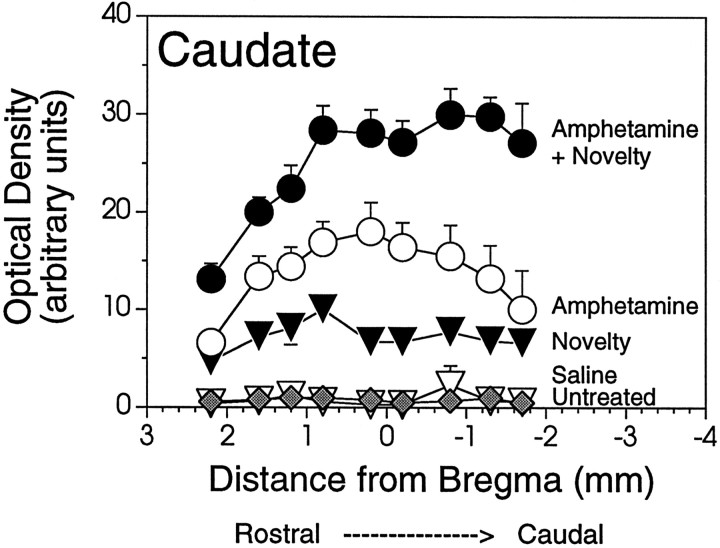
Rostrocaudal gradient of c-fos mRNA (mean optical density ± SEM) in the caudate, as a function of treatment and of environmental condition (see Fig. 3).
Fig. 7.
Fig. 7.
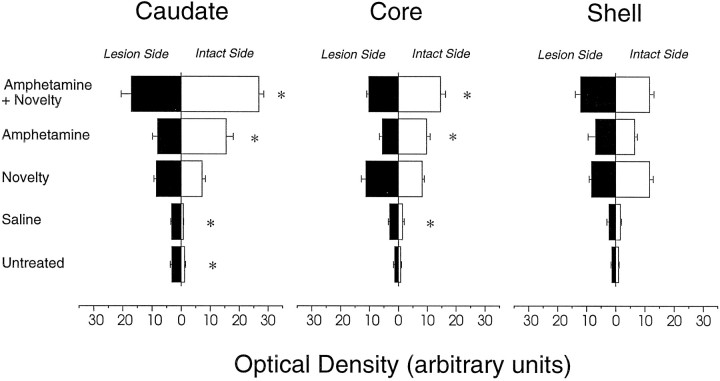
Effect of a unilateral 6-OHDA lesion on c-fos mRNA levels (mean optical density ± SEM) in the caudate and in the core and shell of the nucleus accumbens, as a function of treatment and of environmental condition (see Fig. 3). Two-way ANOVAs with repeated measures on one factor indicated a significant effect of lesion in the caudate [F(1,43) = 11.81; p = 0.001] and in the core [F(1,42) = 3.98;p = 0.053] but not in the shell [F(1,42) = 2.4; p < 0.13] of the nucleus accumbens. There was also a group times lesion interaction in the caudate [F(1,42) = 8.42;p < 0.0001] and in the core [F(4,42) = 6.34; p < 0.001] but not in the shell [F(1,42) = 1.13; p = 0.36] of the nucleus accumbens. For the meaning of the asterisks, see Figure 3.
Fig. 8.
Fig. 8.
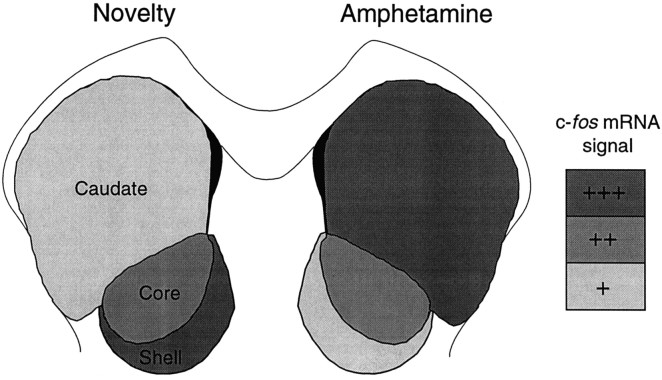
Schematic drawing [obtained by digital modification of a plate from Paxinos and Watson (1982)] summarizing the magnitude of the effects of novelty alone (left) and amphetamine alone (right) on c-fosexpression in the three regions of the striatal complex.
Fig. 9.
Fig. 9.
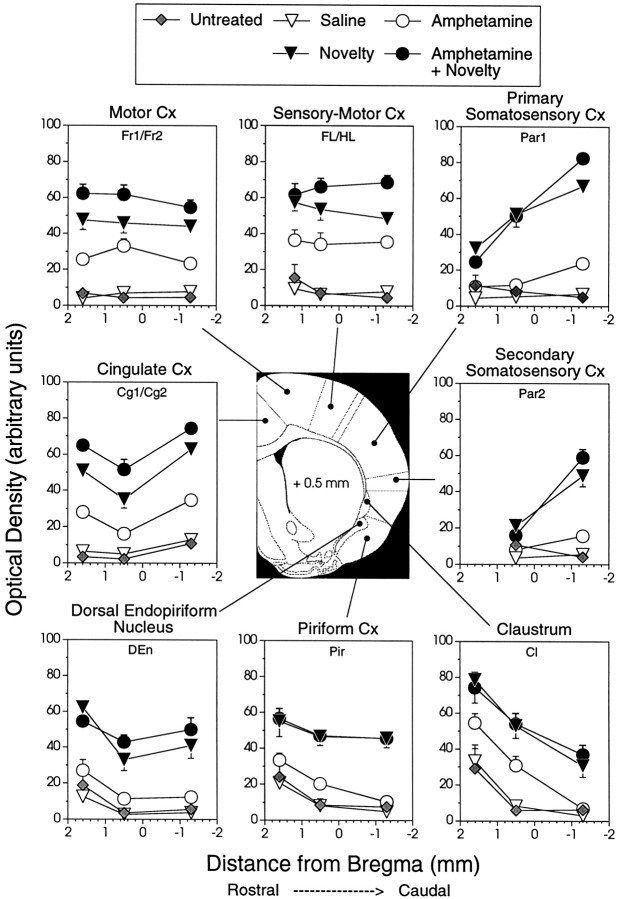
c-fos mRNA levels (mean optical density ± SEM) in different cortical and subcortical regions at three different levels of the neuroaxis, as a function of treatment and of environmental condition (see Fig. 3). The center panel was obtained by digital modification of a plate fromPaxinos and Watson (1982). One-way ANOVAs indicated significant group differences in all regions and at all levels (pvalues ≤ 0.001), except at level +0.5 of Par2(p = 0.11). Fisher’s PLSD tests gave the following results. For untreated versus saline, there were no significant differences (p values > 0.3) in any region. For novelty versus saline, there were significant differences (p < 0.05) in all regions and at all levels. For amphetamine versus saline, there were significant differences at all levels of Cg1/Cg2,Fr1/Fr2, andFL/HL; at the most rostral level (−1.3) of Par1 and Par2; and at the intermediate level (+0.5) of Pir and Cl. For amphetamine versus novelty, there were significant differences in all regions and at all levels, except for level +0.5 of Par2and level +1.6 of Cl. For amphetamine + novelty versus saline and versus amphetamine, there were significant differences in all regions and at all levels (except for level +0.5 ofPar2). For amphetamine + novelty versus novelty, there were significant differences at all levels ofCg1/Cg2,Fr1/Fr2, andFL/HL; at the most rostral level (−1.3) of Par1 and Par2; and at the intermediate level (+0.5) of DEn. Cx, Cortex.
Fig. 10.
Fig. 10.
Rostrocaudal gradient of c-fosmRNA (mean optical density ± SEM) in Par1, as a function of treatment and of environmental condition (see Fig.3). The schematic drawing [top; modified fromDawson and Killackey (1987)] illustrates the functional subdivision ofPar1.
Fig. 11.
Fig. 11.
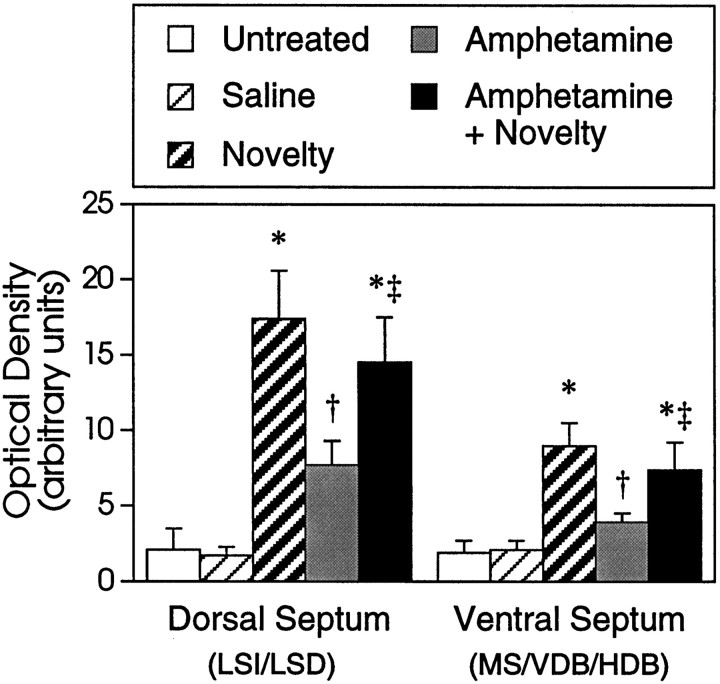
c-fos mRNA levels (mean optical density ± SEM) in the septum, as a function of treatment and of environmental conditions (see Fig. 3). A one-way ANOVA indicated significant group differences in both the dorsolateral [F(4,41) = 9.37; p < 0.0001] and the ventromedial [F(4,41) = 6.62; p < 0.001] septum. For the meaning of thesymbols, see Figure 3.
Fig. 12.
Fig. 12.
Schematic drawing [obtained by digital modification of a plate from Paxinos and Watson (1982)] summarizing the magnitude of the effects of novelty alone (left) and amphetamine alone (right) on c-fosexpression in various cortical and subcortical regions (+0.5 mm from bregma). Also see Figures 9 and 11.
Fig. 13.
Fig. 13.
Plasma corticosterone (means ± SEM) as a function of treatment and of environmental condition (see Fig. 3). A one-way ANOVA indicated significant group differences [F(4,43) = 4.96; p = 0.002]. For the meaning of the asterisks, see Figure3.

References

    1. Badiani A, Anagnostaras S, Robinson TE. The development of sensitization to the psychomotor stimulant effects of amphetamine is enhanced in a novel environment. Psychopharmacology (Berl) 1995a;117:443–452. - PubMed
    1. Badiani A, Morano MI, Akil H, Robinson TE. Circulating adrenal hormones are not necessary for the development of sensitization to the psychomotor activating effects of amphetamine. Brain Res. 1995b;673:13–24. - PubMed
    1. Badiani A, Browman KE, Robinson TE. Influence of novel versus home environments on sensitization to the psychomotor stimulant effects of cocaine and amphetamine. Brain Res. 1995c;674:291–298. - PubMed
    1. Badiani A, Camp DM, Robinson TE. Enduring enhancement of amphetamine sensitization by drug-associated environmental stimuli. J Pharmacol Exp Ther. 1997;282:787–794. - PubMed
    1. Badiani A, Oates MM, Day HEW, Watson S, Akil H, Robinson TE. Effects of environmental novelty on amphetamine-induced c-fos expression in D1 and D2 striatal neurons. Soc Neurosci Abstr. 1998;24:954.

Publication types

MeSH terms

LinkOut - more resources