. 1999 Jan;19(1):577-84.
doi: 10.1128/MCB.19.1.577.

Elevated levels of a U4/U6.U5 snRNP-associated protein, Spp381p, rescue a mutant defective in spliceosome maturation

Affiliations

Elevated levels of a U4/U6.U5 snRNP-associated protein, Spp381p, rescue a mutant defective in spliceosome maturation

S Lybarger et al. Mol Cell Biol. 1999 Jan.

Abstract

U4 snRNA release from the spliceosome occurs through an essential but ill-defined Prp38p-dependent step. Here we report the results of a dosage suppressor screen to identify genes that contribute to PRP38 function. Elevated expression of a previously uncharacterized gene, SPP381, efficiently suppresses the growth and splicing defects of a temperature-sensitive (Ts) mutant prp38-1. This suppression is specific in that enhanced SPP381 expression does not alter the abundance of intronless RNA transcripts or suppress the Ts phenotypes of other prp mutants. Since SPP381 does not suppress a prp38::LEU2 null allele, it is clear that Spp381p assists Prp38p in splicing but does not substitute for it. Yeast SPP381 disruptants are severely growth impaired and accumulate unspliced pre-mRNA. Immune precipitation studies show that, like Prp38p, Spp381p is present in the U4/U6.U5 tri-snRNP particle. Two-hybrid analyses support the view that the carboxyl half of Spp381p directly interacts with the Prp38p protein. A putative PEST proteolysis domain within Spp381p is dispensable for the Spp381p-Prp38p interaction and for prp38-1 suppression but contributes to Spp381p function in splicing. Curiously, in vitro, Spp381p may not be needed for the chemistry of pre-mRNA splicing. Based on the in vivo and in vitro results presented here, we propose that two small acidic proteins without obvious RNA binding domains, Spp381p and Prp38p, act in concert to promote U4/U5.U6 tri-snRNP function in the spliceosome cycle.


Figures
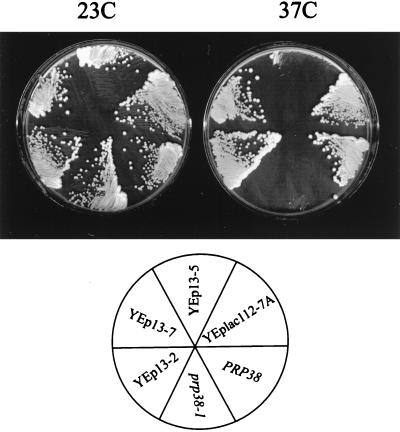
FIG. 1
FIG. 1
Identification of dosage suppressors of the Ts prp38-1 mutation. Yeast cultures were streaked on nonselective medium and incubated at 23 and 37°C. The colony sizes of the untransformed prp38-1 mutant and wild-type (PRP38) yeast strains are compared with those of the prp38-1 mutant transformed with the indicated multi-copy plasmids. The plasmids encoded a functional PRP38 gene (YEp13-2), a weak suppressor of prp38-1 (YEp13-5), or an efficient suppressor of prp38-1 (YEp13-7 and YEplac112-7A).
FIG. 2
FIG. 2
Predicted amino acid sequence encoded by ORF YBR152w (SPP381). The acidic serine-rich elements common to Prp38p and Spp381p are underlined. The putative PEST sequence is represented by bold italics. Spp381p has a predicted molecular mass of 33.8 kDa and a predicted pI of 5.4. In comparison, Prp38p is a 28-kDa protein with a predicted pI of 5.0 (5).
FIG. 3
FIG. 3
Influence of suppressor gene expression on cellular pre-mRNA splicing. RNA was isolated from the indicated yeast cultures grown continuously at 23°C and after a 2-h shift to 37°C. The hybridization probe consisted of exon and intron sequences of the yeast RP51A gene, and the positions of pre-mRNA (P) and mRNA (M) are noted. The cultures were from untransformed wild-type yeast (PRP38), the untransformed mutant strain ts192 (prp38-1), and the prp38-1 mutant after transformation with the indicated plasmids containing the PRP38 gene (YEp13-2), a weak suppressor of prp38-1 (YEp13-5), or an efficient suppressor of ts192 (YEp13-7 and YEplac112-7A). Plasmid YEp13-R was a negative-control plasmid from the YEp13 library that did not suppress the prp38-1 mutation.
FIG. 4
FIG. 4
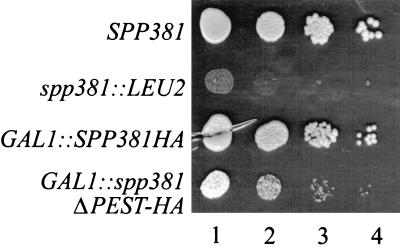
Comparison of growth in SPP381 and spp381::LEU2 mutant yeast cells. Yeast cultures were grown to saturation in nonselective broth with 2% galactose. Each strain was adjusted to a culture density at 600 nm of 0.150. The presence of equivalent cell numbers in each culture was confirmed microscopically. Serial 10-fold dilutions (positions 1 to 4) were spotted in 5-μl volumes on galactose-containing agar medium and incubated for 4 days at 30°C. The strains used were the wild-type parent (SPP381), the untransformed spp381::LEU2 mutant, and the spp381::LEU2 mutant transformed with the GAL1::SPP381HA fusion gene or its ΔPEST-HA derivative.
FIG. 5
FIG. 5
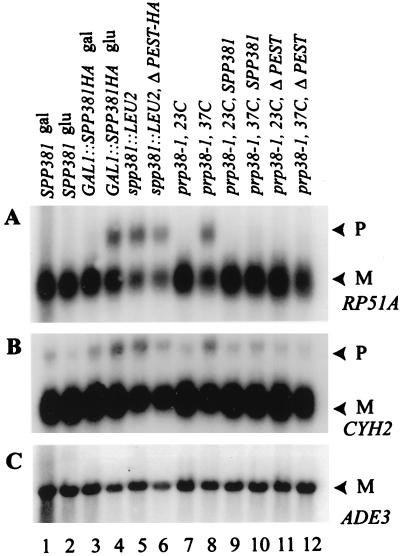
Contribution of SPP381 to the efficiency of pre-mRNA splicing in vivo. RNA was isolated from wild-type yeast (lanes 1 and 2) and the spp381::LEU2 disruptant before (lane 5) and after transformation with GAL1::SPP381HA (lanes 3 and 4) or with GAL1::spp381ΔPEST-HA (lane 6). Galactose (gal) or glucose (glu) was used to activate or repress the GAL1 fusion constructs as indicated. Lanes 7 to 12, RNA from the untransformed prp38-1 mutant (lanes 7 and 8) and the same strain after transformation with the high-copy-number (i.e., YEp112) plasmid bearing SPP381 (lanes 9 and 10) or its ΔPEST (YEplac112-based) derivative (lanes 11 and 12). The RNA was recovered from cultures grown continuously at the permissive temperature for prp38-1 (23°C) or after 2.5 h at the restrictive temperature (37°C). The positions of pre-mRNA (P) and spliced mRNA (M) are indicated by arrowheads. (A) Hybridization with an RP51A-specific intron-plus-exon probe. (B) Hybridization with a CYH2-specific intron-plus-exon probe. (C) Hybridization with an ADE3 gene body probe.
FIG. 6
FIG. 6
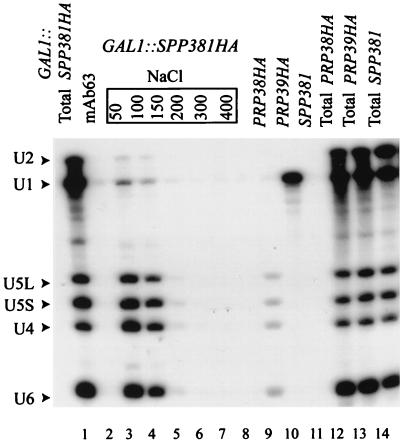
Coprecipitation of snRNA with HA-tagged proteins. Extracts of untagged yeast (lanes 11 and 14) and HA-tagged Spp381HAp (lanes 1 to 8), Prp38HAp (lanes 9 and 12), and Prp39HAp (lanes 10 and 13) were immune precipitated with the HA-specific antibody HA.11 (lanes 3 to 10) or the irrelevant antibody mAb63 (lane 2). The immune pellets were fractionated on a denaturing 5% polyacrylamide gel and transferred to a membrane, and the blot was hybridized with probes specific for the spliceosomal snRNAs (indicated by arrowheads). Immune pellets in lanes 3 to 8 were washed with buffer containing the indicated levels of NaCl; all other pellets were washed with buffer adjusted to 100 mM NaCl. For comparison of relative snRNAs, nonprecipitated extract RNAs (Total) were resolved in parallel (lanes 1 and 12 to 14).
FIG. 7
FIG. 7
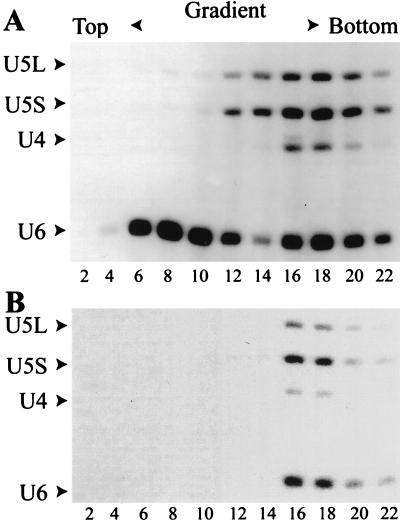
Cofractionation of Spp381HAp with the U4/U6.U5 tri-snRNP particle. The yeast splicing extract was fractionated on a linear 10 to 35% glycerol gradient. (A) Even-numbered fractions were assayed by Northern blotting for the presence of U5 (the long and short forms, U5L and U5S, respectively), U4, and U6 snRNA. (B) Spp381HAp was immune precipitated from the fractions presented in panel A with the anti-HA antibody HA.11 and was assayed for coassociated snRNAs by Western blotting with the same antibody.
FIG. 8
FIG. 8
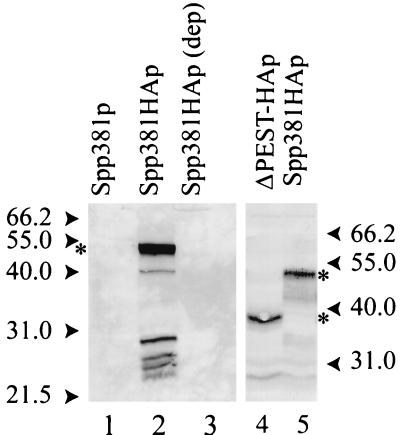
Identification of Spp381HAp. Sixty micrograms of yeast extract protein was resolved on 12% (lanes 1 to 3) and 10% (lanes 4 and 5) polyacrylamide gels. A Western blot from each gel was hybridized with the anti-HA antibody HA.11 to reveal the presence of Spp381HAp and its ΔPEST-HAp derivative (indicated by asterisks). Numbers on the left and right show the positions of protein molecular weight markers (mid-range; Promega) run in adjacent lanes. The extracts assayed included an untagged yeast strain (lane 1), a GAL1::SPP381HA strain grown continuously in galactose (lanes 2 and 5) or shifted to a glucose-based medium for 18 h (lane 3), and extract prepared from the GAL1::ΔPEST-HA derivative (lane 4).

References

    1. Arenas J E, Abelson J N. Prp43: an RNA helicase-like factor involved in spliceosome disassembly. Proc Natl Acad Sci USA. 1997;94:11798–11802. - PMC - PubMed
    1. Barnes J A, Gomes A V. PEST sequences in calmodulin-binding proteins. Mol Cell Biochem. 1995;149/150:17–27. - PubMed
    1. Behrens S-E, Tyc K, Kaster B, Reichelt J, Lührmann R. Small nuclear ribonucleoprotein (RNP) U2 contains numerous additional proteins and has a bipartite RNP structure under splicing conditions. Mol Cell Biol. 1993;13:307–319. - PMC - PubMed
    1. Beickman, K., and B. C. Rymond. Unpublished data.
    1. Berben G, Dumont J, Gilliquet V, Bolle P-A, Hilger F. The YDp plasmids: a uniform set of vectors bearing versatile gene disruption cassettes for Saccharomyces cerevisiae. Yeast. 1991;7:475–477. - PubMed

Publication types

MeSH terms