


C-Terminal binding protein is a transcriptional repressor that interacts with a specific class of vertebrate Polycomb proteins
- PMID: 9858600
- PMCID: PMC83934
- DOI: 10.1128/MCB.19.1.777
C-Terminal binding protein is a transcriptional repressor that interacts with a specific class of vertebrate Polycomb proteins
Abstract
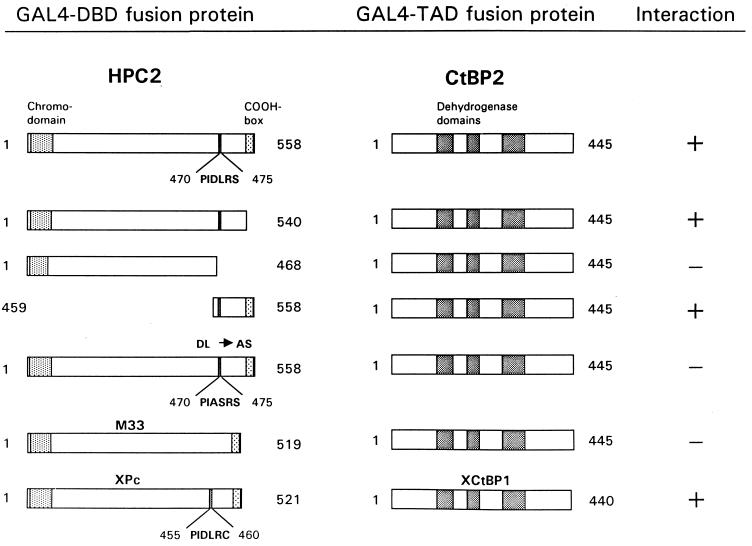
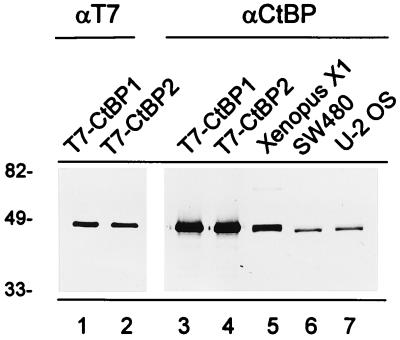
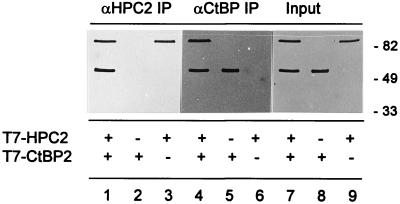
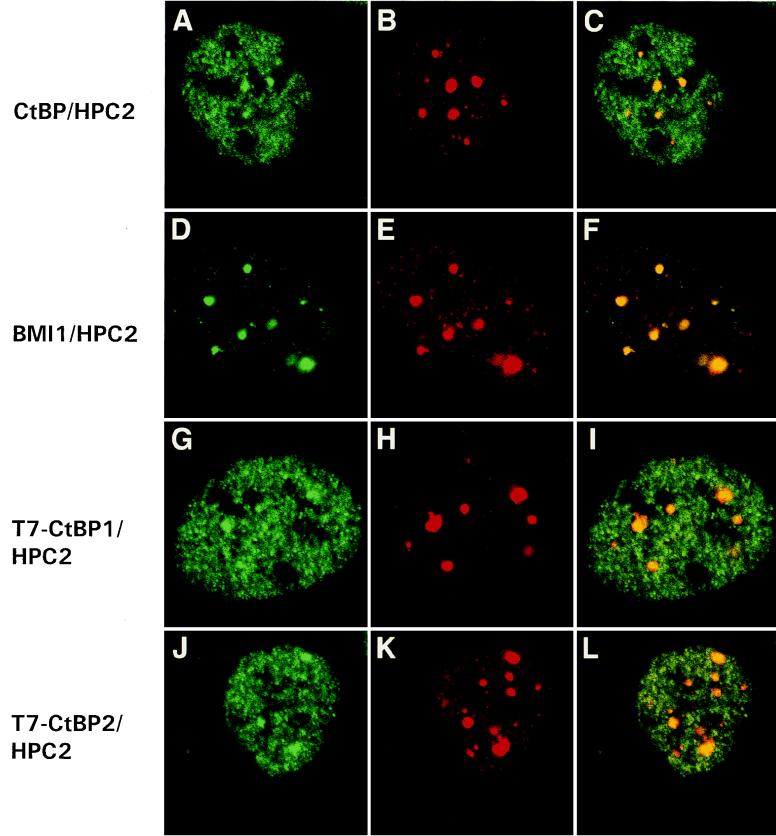
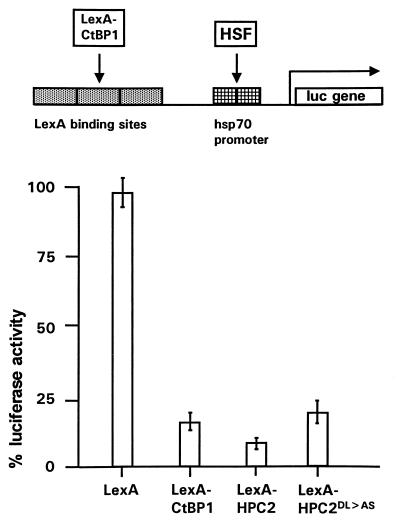
Polycomb (Pc) is part of a Pc group (PcG) protein complex that is involved in repression of gene activity during Drosophila and vertebrate development. To identify proteins that interact with vertebrate Pc homologs, we performed two-hybrid screens with Xenopus Pc (XPc) and human Pc 2 (HPC2). We find that the C-terminal binding protein (CtBP) interacts with XPc and HPC2, that CtBP and HPC2 coimmunoprecipitate, and that CtBP and HPC2 partially colocalize in large PcG domains in interphase nuclei. CtBP is a protein with unknown function that binds to a conserved 6-amino-acid motif in the C terminus of the adenovirus E1A protein. Also, the Drosophila CtBP homolog interacts, through this conserved amino acid motif, with several segmentation proteins that act as repressors. Similarly, we find that CtBP binds with HPC2 and XPc through the conserved 6-amino-acid motif. Importantly, CtBP does not interact with another vertebrate Pc homolog, M33, which lacks this amino acid motif, indicating specificity among vertebrate Pc homologs. Finally, we show that CtBP is a transcriptional repressor. The results are discussed in terms of a model that brings together PcG-mediated repression and repression systems that require corepressors such as CtBP.
Figures

References
-
- Alkema M J, Bronk M, Verhoeven E, Otte A P, Van ’t Veer L J, Berns A, Van Lohuizen M. Identification of Bmi1-interacting proteins as constituents of a multimeric mammalian Polycomb complex. Genes Dev. 1997;11:226–240. - PubMed
-
- Boyd J M, Subramanian T, Schaeper U, La Regina M, Bayley S, Chinnadurai G. A region in the C-terminus of adenovirus 2/5 E1A protein is required for association with a cellular phosphoprotein and important for the negative modulation of T24-ras mediated transformation, tumorigenesis and metastasis. EMBO J. 1993;12:469–478. - PMC - PubMed
-
- Breiling A, Paro R. Mechanisms of heritable gene silencing during development of Drosophila. In: Van Driel R, Otte A P, editors. Nuclear organization, chromatin structure, and gene expression. Oxford, United Kingdom: Oxford University Press; 1997. pp. 236–249.
-
- Durfee T, Becherer K, Chen P-L, Yeh S-H, Yang Y, Kilburn A E, Lee W-H, Elledge S J. The retinoblastoma protein associates with the protein phophatase type I catalytic subunit. Genes Dev. 1993;7:555–569. - PubMed
Publication types
MeSH terms
Substances
Associated data
- Actions
- Actions
LinkOut - more resources
Full Text Sources
Other Literature Sources
Molecular Biology Databases
