. 1999 Jan;19(1):796-806.
doi: 10.1128/MCB.19.1.796.

Histone acetyltransferase and protein kinase activities copurify with a putative Xenopus RNA polymerase I holoenzyme self-sufficient for promoter-dependent transcription

Affiliations

Histone acetyltransferase and protein kinase activities copurify with a putative Xenopus RNA polymerase I holoenzyme self-sufficient for promoter-dependent transcription

A C Albert et al. Mol Cell Biol. 1999 Jan.

Abstract

Mounting evidence suggests that eukaryotic RNA polymerases preassociate with multiple transcription factors in the absence of DNA, forming RNA polymerase holoenzyme complexes. We have purified an apparent RNA polymerase I (Pol I) holoenzyme from Xenopus laevis cells by sequential chromatography on five columns: DEAE-Sepharose, Biorex 70, Sephacryl S300, Mono Q, and DNA-cellulose. Single fractions from every column programmed accurate promoter-dependent transcription. Upon gel filtration chromatography, the Pol I holoenzyme elutes at a position overlapping the peak of Blue Dextran, suggesting a molecular mass in the range of approximately 2 MDa. Consistent with its large mass, Coomassie blue-stained sodium dodecyl sulfate-polyacrylamide gels reveal approximately 55 proteins in fractions purified to near homogeneity. Western blotting shows that TATA-binding protein precisely copurifies with holoenzyme activity, whereas the abundant Pol I transactivator upstream binding factor does not. Also copurifying with the holoenzyme are casein kinase II and a histone acetyltransferase activity with a substrate preference for histone H3. These results extend to Pol I the suggestion that signal transduction and chromatin-modifying activities are associated with eukaryotic RNA polymerases.


Figures
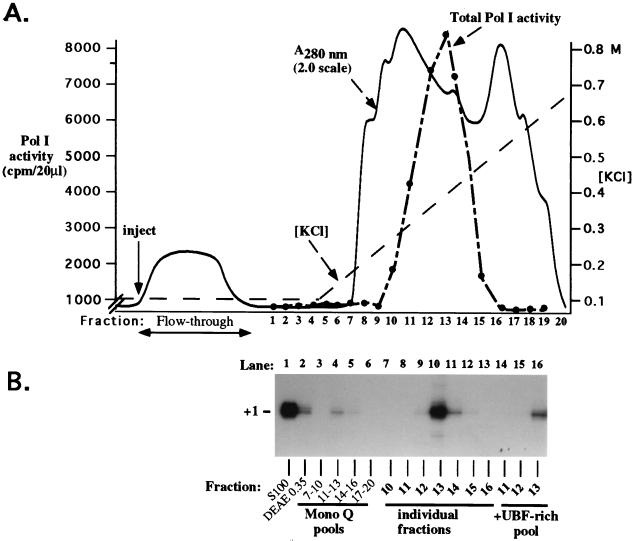
FIG. 1
FIG. 1
Coelution of all proteins required for RNA Pol I transcription in single Mono Q fractions. (A) Assay for total Pol I activity. Proteins eluted from DEAE-Sepharose with 350 mM KCl were subjected to chromatography on Mono Q by fast protein liquid chromatography. After being washed at 0.1 M KCl, the column was eluted with a linear gradient from 0.1 to 0.7 M KCl. Aliquots (20 μl) of individual fractions were tested for total Pol I activity on nicked calf thymus DNA in the presence of 150 μg of α-amanitin per ml. (B) Assay for promoter-dependent transcription. Equal aliquots of three to four Mono Q fractions were mixed to form pools and tested alone and in various combinations for their ability to support transcription from an X. laevis rRNA minigene promoter. Transcripts were detected by S1 nuclease protection. The pools of fractions 11 to 13 and 14 to 16 tested positive in this assay (panel B and data not shown). Individual Mono Q fractions from the positive pools were then tested (lanes 7 to 16) and compared to the activity of the pooled fractions (lanes 3 to 6). Fraction 13 corresponded to the peak of both total and promoter-dependent Pol I transcription. UBF peaked in fractions 14 and 15 (data not shown). Addition of the UBF-rich pool (fractions 14 to 16) to fractions 11 to 13 did not improve their promoter-dependent transcription activity.
FIG. 2
FIG. 2
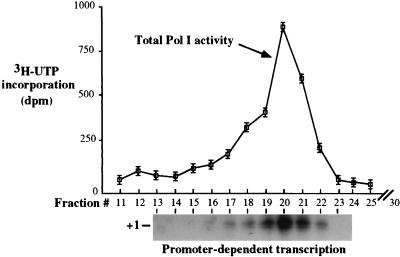
Individual fractions support accurate transcription initiation following sedimentation of DE350 fractions through glycerol gradients. Gradients (11.5 ml) were fractionated into 30 fractions and tested for total Pol I activity on nicked calf thymus DNA (top). Reactions were performed in triplicate, and the mean values for each fraction were plotted. Error bars represent the standard errors of the means. Fractions were also tested for their ability to program accurate, promoter-dependent Pol I transcription (autoradiogram at bottom). Transcripts were detected by S1 nuclease protection. Fraction 20 represented the peak in both assays.
FIG. 3
FIG. 3
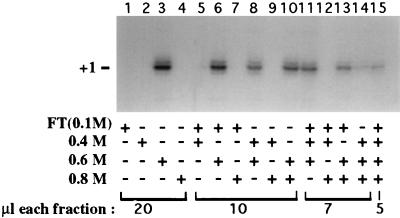
Coelution of all activities essential for promoter-dependent Pol I transcription from Biorex 70. Mono Q fraction 13 (Fig. 1) in 0.1 M KCl buffer was applied to a 0.5-ml Biorex column. The flowthrough (FT) was collected, and the column was washed with CB100. Bound proteins were sequentially eluted with buffer containing 0.4, 0.6, and 0.8 M KCl. Individual fractions and combined fractions were tested for their ability to direct accurate transcription from the Xenopus minigene promoter. Transcripts were detected by S1 nuclease protection.
FIG. 4
FIG. 4
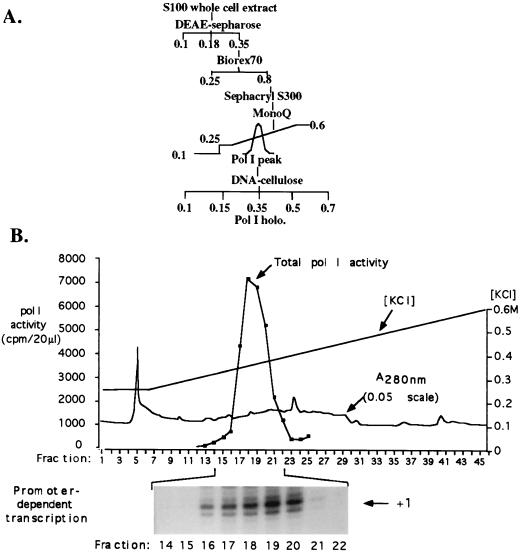
Extensive purification of the putative Xenopus holoenzyme. (A) Purification scheme. DNase-treated S100 extract (in CB100) was subjected to chromatography on DEAE-Sepharose. The 350 mM KCl fraction was diluted to 250 mM KCl and injected onto Biorex 70. Proteins eluting at 800 mM KCl were injected onto a 195-ml Sephacryl S300 gel filtration column equilibrated in CB100. The peak of total Pol I activity eluted near the Blue Dextran peak well in advance of thyroglobulin (669 kDa) and ferritin (450 kDa) molecular mass markers. The Sephacryl peak fractions were pooled and injected onto Mono Q, which was eluted with a gradient from 250 to 600 mM KCl. Peak fractions, eluting near 400 mM KCl, were dialyzed against CB100 and loaded onto a DNA-cellulose column. After being washed in CB100, fractions were eluted with CB150, CB350, CB500, and CB700. Pol I activity eluted in the 350 mM KCl fraction; other fractions had negligible activity. (B) Purification of the putative holoenzyme on the penultimate Mono Q column. The elution profile of total Pol I activity is shown in the graph. Individual fractions in the vicinity of the Pol I peak were then tested for their ability to direct accurate, promoter-dependent transcription (autoradiogram just below graph) by using 400 ng of supercoiled plasmid DNA containing the Xenopus rRNA minigene Ψ40.
FIG. 5
FIG. 5
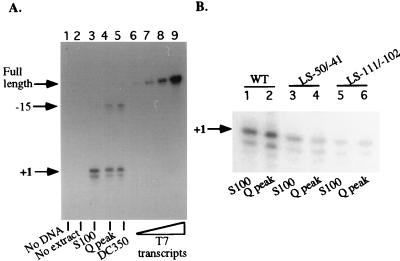
Accuracy and promoter specificity of highly purified holoenzyme fractions. (A) In lanes 3 to 5, S100, Mono Q, and DNA-cellulose (DC350) peak fractions were compared for their ability to program accurate transcription initiation from the Ψ40 minigene (400 ng). A reaction containing S100 but without added template (lane 1) and a reaction containing template but no added protein (lane 2) were run as controls. Lanes 6 to 9 are controls in which in vitro transcripts corresponding to the RNA strand of the complete minigene were generated by T7 polymerase and subjected to S1 nuclease protection alongside the other reactions. A single protected product, corresponding to the size of the full-length probe, was generated in proportion to the amount of input RNA. No −15 or +1 products were generated, suggesting that the latter are not artifacts due to cleavage of readthrough transcripts. (B) Comparison of S100 and Mono Q peak fractions for their sensitivity to promoter mutations. The wild-type (WT) Ψ40 minigene (500 ng) was used as the template in lanes 1 and 2. Two different linker scanner mutants of Ψ40, LS-50/-41 (lanes 3 and 4) and LS-111/-102 (lanes 5 and 6), were also tested.
FIG. 6
FIG. 6
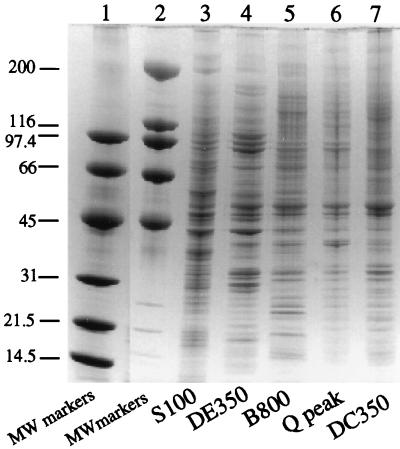
Polypeptide composition of peak fractions throughout the purification scheme. Equal amounts (on a mass basis) of S100, DEAE, Biorex, Mono Q, or DNA-cellulose peak fractions were subjected to SDS-PAGE on a 4.5 to 18% gradient gel (lanes 3 to 7, respectively). Following electrophoresis, the gel was stained with Coomassie blue. Two different-size classes of molecular mass (MW) markers (Bio-Rad) were run on the same gel (lanes 1 and 2); their sizes in kilodaltons are indicated to the left of the figure.
FIG. 7
FIG. 7
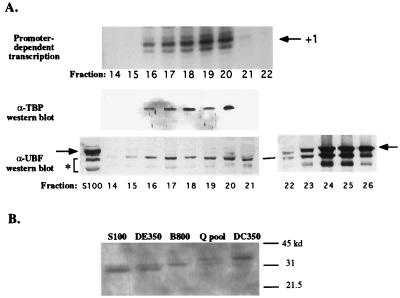
TBP copurifies with Pol I holoenzyme activity. (A) Mono Q fractions including the peak of Pol I holoenzyme activity (same column run as that shown in Fig. 4) were subjected to Western blotting with polyclonal antibodies directed against Xenopus TBP or UBF. The blots are aligned with an autoradiogram revealing the transcriptionally active fractions. Antibody-antigen complexes were detected by enhanced chemiluminescence. Full-length UBF is denoted by arrows; smaller proteins thought to be UBF degradation products are denoted by an asterisk. (B) Detection of TBP in peak fractions throughout the Pol I holoenzyme purification scheme reveals that an isoform with reduced gel mobility is enriched during purification.
FIG. 8
FIG. 8
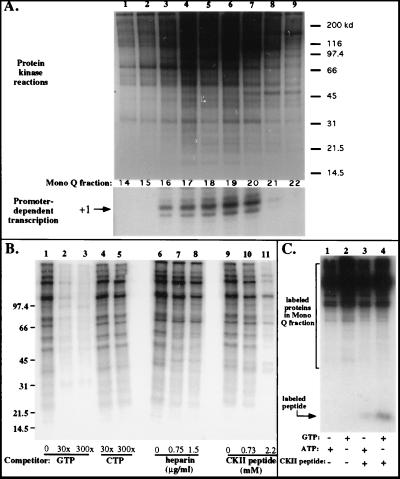
Protein kinase activity coelutes with Pol I holoenzyme activity. (A) Aliquots (4 μl) of Mono Q fractions 14 to 22 (same column run as that shown in Fig. 4) were incubated for 30 min in a buffer containing MgCl2 and [γ-32P]ATP and then subjected to SDS-PAGE (8% polyacrylamide, Tris-Tricine buffer) and autoradiography. Positions of molecular mass markers (in kilodaltons) are shown on the right. The lanes of the SDS-PAGE gel are aligned with the transcription reactions to highlight the correspondence between the kinase and transcriptionally active fractions. (B) Biochemical characterization of holoenzyme-associated kinase activity. Kinase activity of Mono Q fraction 20 was tested in the presence of various competitors or inhibitors, which were added to the reactions prior to the addition of [γ-32P]ATP. Reaction mixtures subjected to electrophoresis in lanes 1, 6, and 9 were controls to which no competitors were added. Nonradioactive GTP or CTP was added in a 30- or 300-fold excess to the reaction mixtures subjected to electrophoresis in lanes 2 to 5. Heparin was added in two concentrations to reaction mixtures in lanes 7 and 8. In lanes 10 and 11, a synthetic peptide containing a consensus CKII phosphorylation site was added in two concentrations. Numbers at left indicate molecular mass in kilodaltons. (C) Mono Q peak fraction 20 will direct phosphorylation of a synthetic peptide (1.5 mM) containing a consensus CKII phosphorylation site with either [γ-32P]ATP (lane 3) or [γ-32P]GTP (lane 4) as the phosphate donor. Lanes 1 and 2 are controls to which no peptide was added. Reaction mixtures were subjected to electrophoresis on a 16.5% SDS–Tris-Tricine gel.
FIG. 9
FIG. 9
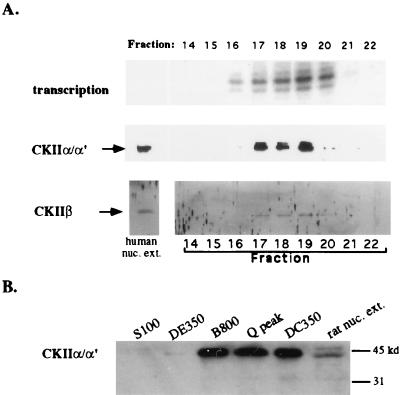
Detection of CKII in peak Pol I holoenzyme fractions by Western blotting. (A) Mono Q fractions (60 μl) were trichloroacetic acid precipitated and loaded on SDS–12% PAGE gels. Western blots were probed with an antiserum raised against Drosophila CKII which cross-reacts with the Xenopus β subunit or with an antibody raised against human CKII α and α′ subunits. In the far left lane of each gel, 2 μl of human nuclear extract was run as a control. Antigen-antibody complexes were detected by enhanced chemiluminescence on X-ray film (CKII α subunits) or by colorimetric reaction (β subunit). The Western blots are aligned with the gel showing the transcription reaction products to allow easy comparison. (B) Relative abundance of CKII in peak fractions throughout the purification scheme. A sample of rat nuclear extract was run as a positive control in the rightmost lane.
FIG. 10
FIG. 10
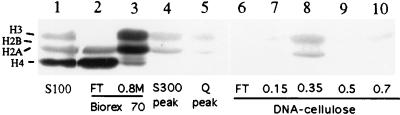
Detection of HAT activity in X. laevis S100 extract and purified holoenzyme fractions. Core histones (10 μg) were incubated in reaction mixtures containing [3H]acetyl-CoA and 5 μl of the following: S100 extract (lane 1), Biorex flowthrough (FT) (lane 2), the Biorex 0.8 M holoenzyme-containing fraction (lane 3), the Sephacryl S300 Pol I holoenzyme peak (lane 4), the Mono Q holoenzyme peak (lane 5), or all five fractions from the DNA-cellulose column (lanes 6 to 10), including the holoenzyme peak (lane 8). Proteins were then subjected to SDS–15% PAGE and fluorography to detect labeled proteins. Coomassie blue staining allowed the positions of the different core histones to be determined.

References

    1. Albert, A.-C. Unpublished data.
    1. Allende J E, Allende C C. Protein kinases. 4. Protein kinase CK2: an enzyme with multiple substrates and a puzzling regulation. FASEB J. 1995;9:313–323. - PubMed
    1. Bazett-Jones D, Leblanc B, Herfort M, Moss T. Short-range DNA looping by the Xenopus HMG-box transcription factor, xUBF. Science. 1994;264:1134–1137. - PubMed
    1. Bell S P, Jantzen H M, Tjian R. Assembly of alternative multiprotein complexes directs rRNA promoter selectivity. Genes Dev. 1990;4:943–954. - PubMed
    1. Bell S P, Learned R M, Jantzen H M, Tjian R. Functional cooperativity between transcription factors UBF1 and SL1 mediates human ribosomal RNA synthesis. Science. 1988;241:1192–1197. - PubMed

Publication types

MeSH terms

LinkOut - more resources