. 1998 Dec 22;95(26):15177-82.
doi: 10.1073/pnas.95.26.15177.

Structure of a biological oxygen sensor: a new mechanism for heme-driven signal transduction

Affiliations

Structure of a biological oxygen sensor: a new mechanism for heme-driven signal transduction

W Gong et al. Proc Natl Acad Sci U S A. .

Abstract

The FixL proteins are biological oxygen sensors that restrict the expression of specific genes to hypoxic conditions. FixL's oxygen-detecting domain is a heme binding region that controls the activity of an attached histidine kinase. The FixL switch is regulated by binding of oxygen and other strong-field ligands. In the absence of bound ligand, the heme domain permits kinase activity. In the presence of bound ligand, this domain turns off kinase activity. Comparison of the structures of two forms of the Bradyrhizobium japonicum FixL heme domain, one in the "on" state without bound ligand and one in the "off" state with bound cyanide, reveals a mechanism of regulation by a heme that is distinct from the classical hemoglobin models. The close structural resemblance of the FixL heme domain to the photoactive yellow protein confirms the existence of a PAS structural motif but reveals the presence of an alternative regulatory gateway.


Figures
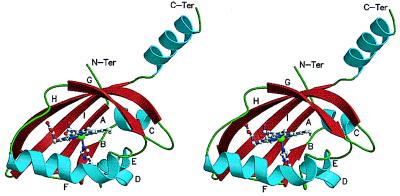
Figure 1
Figure 1
Ribbons diagram of BjFixLH. The secondary structure elements are color-coded with α-helices as blue, β-sheets as red, and random coils as green. The atoms of the heme cofactor and the proximal histidine are shown as ball-and-stick models and are colored by their elements, with carbon as gray, nitrogen as blue, oxygen as red, and iron as green.
Figure 2
Figure 2
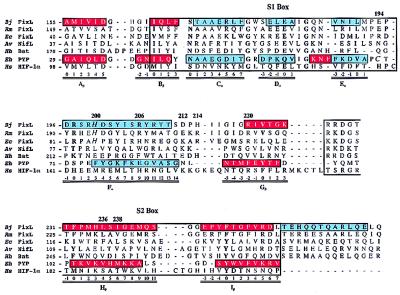
Sequence alignment of selected PAS-domain proteins from Bacteria, Archaea, and Eukarya. The sequences correspond to the FixLs from B. japonicum (Bj FixL), Rhizobium meliloti (Rm FixL), and E. coli (Ec FixL), the NifL flavoprotein from Azotobacter vinelandii (Av NifL), the bacterio-opsin activator protein from Halobacterium halobium (Hh Bat), the PYP from Ectothiorhodospira halophila (Eh PYP), and the hypoxia-inducible factor-1α from humans (Hs HIF-1α) (4, 8, 9, 16, 38, 39). The S1 and S2 boxes (large boxes), conserved PAS-domain residues (bold type), sites of cofactor attachment (italics), α-helices (blue), and β-sheets (red) are shown. The secondary-structure assignments for met- and cyanomet-BjFixLH were determined by procheck and dssp (23, 40). The proposed naming scheme for secondary-structure regions is indicated below the alignment. The FixL sequences illustrate the conservation of residues specific to the regulatory mechanism. The other proteins were chosen to illustrate the ubiquity of the PAS fold in Bacteria, Archaea, and Eukarya, and the diversity of its functions and cofactors.
Figure 3
Figure 3
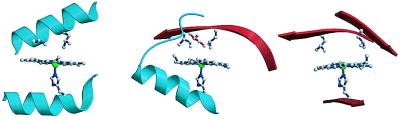
Ball-and-stick diagrams of three heme-binding pockets. Structures are shown for Glycera dibranchiata hemoglobin (PDB ID: 2HBG) (Left), BjFixLH (Center), and the NO transporter protein (PDB ID: 1NP1) (Right) (27, 28). The rightmost and leftmost side chains correspond to the E7 and E11 residues of hemoglobins, respectively. The additional side chain in BjFixLH (red) corresponds to Ile 215. The structures were aligned based on the orientation of the proximal histidine and the porphyrin ring. The atoms are colored as in Fig. 1.
Figure 4
Figure 4
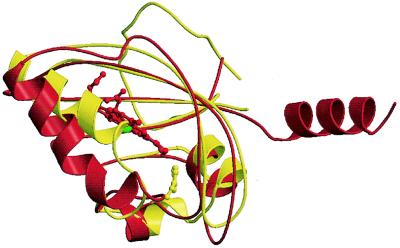
Comparison of the tertiary structures of the two PAS-domain prototypes. BjFixLH (red) and PYP (PDB ID: 2PHY) (yellow) together with their heme and hydroxycinnamate cofactors, respectively, are shown.
Figure 5
Figure 5
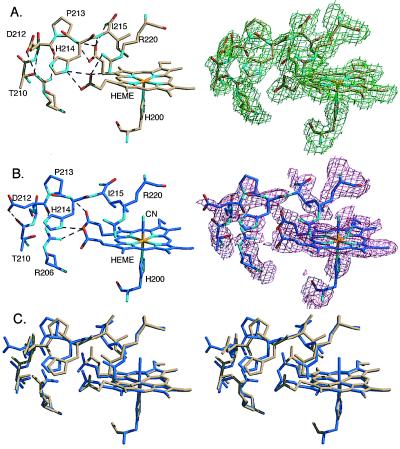
Comparison of the structures of the regulatory FG loop of BjFixLH in the unliganded “on” and cyanide bound “off” states. (A) The structure of the FG loop in the met-BjFixLH (brown) illustrating the hydrogen-bonding interactions (Left) and 2FO-FC electron density map (1σ) (Right). (B) Corresponding figure for cyanomet-BjFixLH (blue) showing hydrogen bonding (Left) and electron density (Right). (C) Stereoview of overlap of the refined models for both states.

References

    1. Gilles-Gonzalez M A, Ditta G, Helinski D R. Nature (London) 1991;350:170–172. - PubMed
    1. Garbers D L, Lowe D G. J Biol Chem. 1994;269:30741–30744. - PubMed
    1. Shelver D, Kerby R L, He Y, Roberts G P. Proc Natl Acad Sci USA. 1997;94:11216–11220. - PMC - PubMed
    1. David M, Daveran M-L, Batut J, Dedieu A, Domergue O, Ghai J, Hertig C, Boistard P, Kahn D. Cell. 1988;54:671–683. - PubMed
    1. Parkinson J S, Kofoid E C. Annu Rev Genet. 1992;26:71–112. - PubMed

Publication types

MeSH terms

LinkOut - more resources