. 1998 Dec 22;95(26):15613-7.
doi: 10.1073/pnas.95.26.15613.

Evidence that a prominent cavity in the coiled coil of HIV type 1 gp41 is an attractive drug target

Affiliations

Evidence that a prominent cavity in the coiled coil of HIV type 1 gp41 is an attractive drug target

D C Chan et al. Proc Natl Acad Sci U S A. .

Abstract

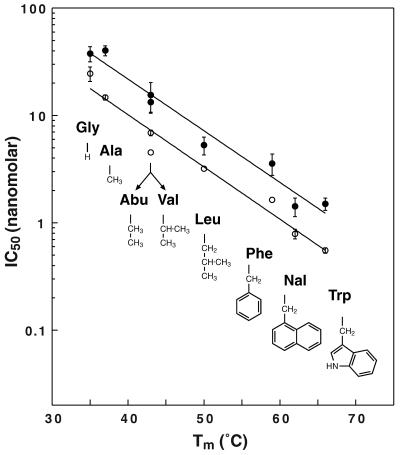
Synthetic C peptides, corresponding to the C helix of the HIV type 1 (HIV-1) gp41 envelope protein, are potent inhibitors of HIV-1 membrane fusion. One such peptide is in clinical trials. The crystal structure of the gp41 core, in its proposed fusion-active conformation, is a trimer of helical hairpins in which three C helices pack against a central coiled coil. Each C helix shows especially prominent contacts with one of three symmetry-related, hydrophobic cavities on the surface of the coiled coil. We show that the inhibitory activity of the C peptide C34 depends on its ability to bind to this coiled-coil cavity. Moreover, examining a series of C34 peptide variants with modified cavity-binding residues, we find a linear relationship between the logarithm of the inhibitory potency and the stability of the corresponding helical-hairpin complexes. Our results provide strong evidence that this coiled-coil cavity is a good drug target and clarify the mechanism of C peptide inhibition. They also suggest simple, quantitative assays for the identification and evaluation of analogous inhibitors of HIV-1 entry.


Figures
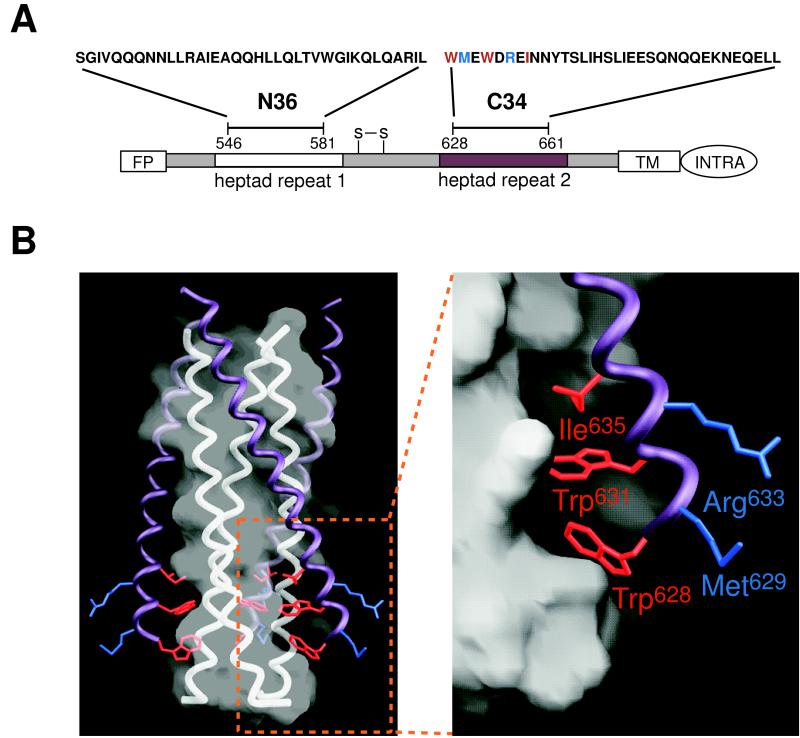
Figure 1
Figure 1
HIV-1 gp41 structure and mutant peptides. (A) Schematic of HIV-1 gp41 showing the N36 and C34 peptides, located within two regions containing 4,3 hydrophobic heptad repeats (white and purple boxes). The residues corresponding to the peptides discussed in this paper are as follows: C34, 628–661; DP178, 638–673; T649, 628–663. All of these peptides are acetylated at the amino terminus and amidated at the carboxy terminus. Colored residues in C34 were mutated in this study. Red residues project into the N36 cavity, whereas blue residues do not. FP, fusion peptide; S-S, disulfide bond; TM, transmembrane region; INTRA, intraviral region. (B) The N36/C34 crystal structure of the HIV-1 gp41 ectodomain core (2). (Left) The trimeric N36 coiled coil is represented by white three helices overlaid with a semitransparent white molecular surface. Three C34 helices (shown in purple with selected side chains) pack against this coiled coil surface. The bottom of the N36 surface contains three symmetry-related cavities (one is outlined by the box), each of which accommodates three hydrophobic residues (red) from a C34 helix. In contrast, the blue residues project outward and do not make contacts with the coiled coil. (Right) A close-up of the cavity region with the C34 residues labeled. Here, the surface of the central coiled coil is represented by an opaque molecular surface. This figure was made with the program grasp (42).
Figure 2
Figure 2
Correlation of C34 inhibitory potency with N36/C34 stability. C34 peptide variants containing substitutions at position Trp-631 were tested for inhibition of viral entry (•) and cell-cell fusion (○). IC50 values (Table 2) are plotted on a logarithmic scale against the Tm of the corresponding N36/C34 complex. The identities and chemical structures of the substitutions are indicated under the corresponding data points. Bars = SD from triplicate experiments.

References

    1. Kwong P D, Wyatt R, Robinson J, Sweet R W, Sodroski J, Hendrickson W A. Nature (London) 1998;393:648–659. - PMC - PubMed
    1. Chan D C, Fass D, Berger J M, Kim P S. Cell. 1997;89:263–273. - PubMed
    1. Weissenhorn W, Dessen A, Harrison S C, Skehel J J, Wiley D C. Nature (London) 1997;387:426–430. - PubMed
    1. Tan K, Liu J, Wang J, Shen S, Lu M. Proc Natl Acad Sci USA. 1997;94:12303–12308. - PMC - PubMed
    1. Bullough P A, Hughson F M, Skehel J J, Wiley D C. Nature (London) 1994;371:37–43. - PubMed

Publication types

MeSH terms