. 1999 Jan;67(1):173-81.
doi: 10.1128/IAI.67.1.173-181.1999.

The immunoglobulin (IgG) antibody response to OspA and OspB correlates with severe and prolonged Lyme arthritis and the IgG response to P35 correlates with mild and brief arthritis

Affiliations

The immunoglobulin (IgG) antibody response to OspA and OspB correlates with severe and prolonged Lyme arthritis and the IgG response to P35 correlates with mild and brief arthritis

E Akin et al. Infect Immun. 1999 Jan.

Abstract

In an effort to implicate immune responses to specific Borrelia burgdorferi proteins that may have a role in chronic Lyme arthritis, we studied the natural history of the antibody response to B. burgdorferi in serial serum samples from 25 patients monitored throughout the course of Lyme disease. In these patients, the immunoglobulin G (IgM) and IgG antibody responses to 10 recombinant B. burgdorferi proteins, determined during early infection, early arthritis, and maximal arthritis, were correlated with the severity and duration of maximal arthritis. The earliest responses were usually to outer surface protein C (OspC), P35, P37, and P41; reactivity with OspE, OspF, P39, and P93 often developed weeks later; and months to years later, 64% of patients had responses to OspA and OspB. During early infection and early arthritis, the levels of IgG antibody to P35 correlated inversely with the subsequent severity or duration of maximal arthritis. In contrast, during periods of maximal arthritis, the levels of IgG antibody to OspA and OspB, especially to a C-terminal epitope of OspA, correlated directly with the severity and duration of arthritis. Thus, the higher the IgG antibody response to P35 earlier in the infection, the milder and briefer the subsequent arthritis, whereas during maximal arthritis, the higher the IgG response to OspA and OspB, the more severe and prolonged the arthritis.


Figures
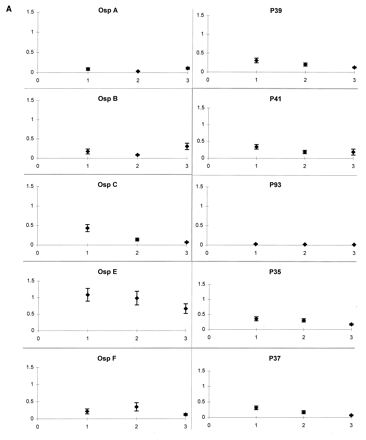
FIG. 1
FIG. 1
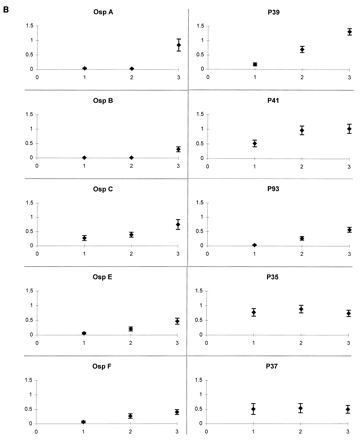
IgM (A) and IgG (B) responses to B. burgdorferi antigens over the course of Lyme disease. Data points representing the mean absorbance (optical density) ± the standard error of the mean of serum samples from all 25 patients are plotted at three time points: (i) when erythema migrans was present, 1 to 12 weeks from disease onset; (ii) during early, brief attacks of early arthritis or arthralgia, 2 to 12 months after disease onset; and (iii) during periods of maximal arthritis, 7 months to 4.5 years after disease onset. Except for OspA and OspB, the mean levels of IgM antibody were highest early in the infection and declined thereafter. The mean IgG antibody levels to OspC, OspE, OspF, P39, P41, and P93 were low initially and increased at each subsequent time point; the mean IgG antibody responses to P35 and P37 remained at a moderate level at each time point, and the mean levels of IgG antibody to OspA and OspB did not increase until the last time point, during periods of maximal arthritis.
FIG. 1
FIG. 1
IgM (A) and IgG (B) responses to B. burgdorferi antigens over the course of Lyme disease. Data points representing the mean absorbance (optical density) ± the standard error of the mean of serum samples from all 25 patients are plotted at three time points: (i) when erythema migrans was present, 1 to 12 weeks from disease onset; (ii) during early, brief attacks of early arthritis or arthralgia, 2 to 12 months after disease onset; and (iii) during periods of maximal arthritis, 7 months to 4.5 years after disease onset. Except for OspA and OspB, the mean levels of IgM antibody were highest early in the infection and declined thereafter. The mean IgG antibody levels to OspC, OspE, OspF, P39, P41, and P93 were low initially and increased at each subsequent time point; the mean IgG antibody responses to P35 and P37 remained at a moderate level at each time point, and the mean levels of IgG antibody to OspA and OspB did not increase until the last time point, during periods of maximal arthritis.
FIG. 2
FIG. 2
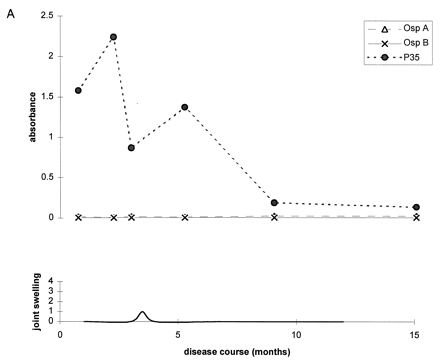
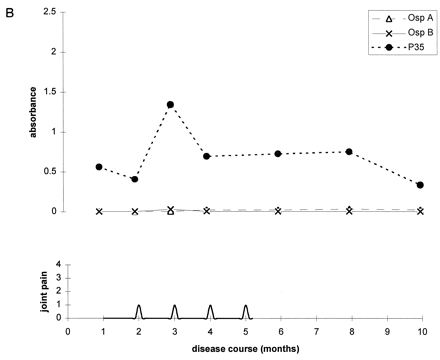
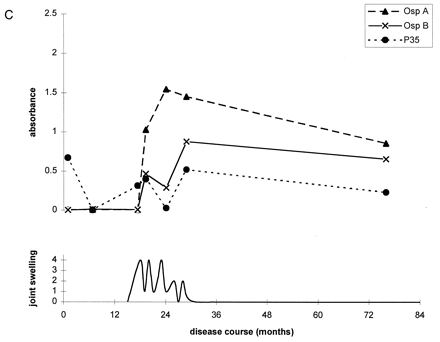
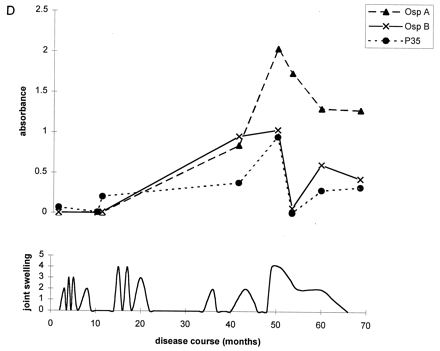
Antibody responses to OspA, OspB, and P35 in four representative patients at opposite ends of the spectrum of Lyme arthritis. (A) Patient with one short attack of arthritis; (B) patient with arthralgias of short duration; (C and D) patients with severe and prolonged chronic Lyme arthritis. Patients A and B had high levels of IgG antibody to P35 early in the infection or during early attacks of arthritis or arthralgia, and they had no responses to OspA or OspB at any time. In contrast, patients C and D had minimal or no IgG reactivity with P35 early in the infection, and they developed marked IgG responses to OspA and OspB during periods of maximal arthritis.
FIG. 2
FIG. 2
Antibody responses to OspA, OspB, and P35 in four representative patients at opposite ends of the spectrum of Lyme arthritis. (A) Patient with one short attack of arthritis; (B) patient with arthralgias of short duration; (C and D) patients with severe and prolonged chronic Lyme arthritis. Patients A and B had high levels of IgG antibody to P35 early in the infection or during early attacks of arthritis or arthralgia, and they had no responses to OspA or OspB at any time. In contrast, patients C and D had minimal or no IgG reactivity with P35 early in the infection, and they developed marked IgG responses to OspA and OspB during periods of maximal arthritis.
FIG. 2
FIG. 2
Antibody responses to OspA, OspB, and P35 in four representative patients at opposite ends of the spectrum of Lyme arthritis. (A) Patient with one short attack of arthritis; (B) patient with arthralgias of short duration; (C and D) patients with severe and prolonged chronic Lyme arthritis. Patients A and B had high levels of IgG antibody to P35 early in the infection or during early attacks of arthritis or arthralgia, and they had no responses to OspA or OspB at any time. In contrast, patients C and D had minimal or no IgG reactivity with P35 early in the infection, and they developed marked IgG responses to OspA and OspB during periods of maximal arthritis.
FIG. 2
FIG. 2
Antibody responses to OspA, OspB, and P35 in four representative patients at opposite ends of the spectrum of Lyme arthritis. (A) Patient with one short attack of arthritis; (B) patient with arthralgias of short duration; (C and D) patients with severe and prolonged chronic Lyme arthritis. Patients A and B had high levels of IgG antibody to P35 early in the infection or during early attacks of arthritis or arthralgia, and they had no responses to OspA or OspB at any time. In contrast, patients C and D had minimal or no IgG reactivity with P35 early in the infection, and they developed marked IgG responses to OspA and OspB during periods of maximal arthritis.

References

    1. Akin D R, Bourell K W, Caimaro M J, Norgard M V, Radolf J D. A new animal model for studying Lyme disease spirochetes in a mammalian host-adapted state. J Clin Investig. 1998;101:2240–2250. - PMC - PubMed
    1. Barbour A G, Burgdorfer W, Grunwaldt E, Steere A C. Antibodies of patients with Lyme disease to components of the Ixodes dammini spirochete. J Clin Investig. 1983;72:504–515. - PMC - PubMed
    1. Barbour A G, Tessier S L, Hayes S F. Variation in a major surface protein of Lyme disease spirochetes. Infect Immun. 1984;45:94–100. - PMC - PubMed
    1. Barbour A G, Tessier S L, Todd W J. Lyme disease spirochetes and ixodid spirochetes share a common surface antigenic determinant defined by a monoclonal antibody. Infect Immun. 1983;41:795–804. - PMC - PubMed
    1. Bergstrom S, Bundoc V G, Barbour A G. Molecular analysis of linear plasmid-encoded major surface proteins, OspA and OspB, of the Lyme disease spirochete Borrelia burgdorferi. Mol Microbiol. 1989;3:479–486. - PubMed

Publication types

MeSH terms