. 1999 Jan;67(1):201-5.
doi: 10.1128/IAI.67.1.201-205.1999.

Interaction of NK lysin, a peptide produced by cytolytic lymphocytes, with endotoxin

Affiliations

Interaction of NK lysin, a peptide produced by cytolytic lymphocytes, with endotoxin

M Andersson et al. Infect Immun. 1999 Jan.

Abstract

NK lysin is a 9-kDa polypeptide that was originally isolated from porcine intestinal tissue based on its antibacterial activity. It is produced by cytolytic lymphocytes and is cytolytic against a number of different types of tumor cells. Here we report the binding of NK lysin to lipopolysaccharide (LPS) and its anti-LPS activity. NK lysin binds to matrix-coated LPS from Escherichia coli, Pseudomonas aeruginosa, and different strains of Salmonella enterica. Lipid A and polymyxin B inhibited the binding, demonstrating a preferential interaction of NK lysin with the lipid part of LPS. Chromium-labeled lymphoma cells were lysed by NK lysin, and LPS dose-dependently inhibited the cytolysis at equimolar amounts. In the same manner, NK lysin inhibited certain LPS-stimulated effects on mouse bone marrow cells as well as LPS binding to mouse granulocytes. These results suggest that NK lysin may be a another natural LPS-binding protein from lymphocytes that may participate in the endogenous defense response associated with elevated concentrations of LPS.


Figures

FIG. 1
FIG. 1
NKL binding to LPS immobilized on microtiter plates. After coating and blocking nonspecific residual binding, plates were incubated with NKL plus additives overnight at 4°C. Plates were washed, and bound NKL was developed by incubating with a polyclonal anti-NKL IgG conjugated with biotin and visualized by streptavidin-peroxidase–o-phenylenediamine. (A) Plates were coated with anti-NKL IgG (•), E. coli LPS (■), S. enterica serovar Typhimurium LPS (□), or blocking solution only (○). (B) Plates were coated with E. coli LPS (□, •, ■) or E. coli LPS premixed with polymyxin B (▵). NKL was thereafter incubated either alone (□) or in the presence of 1 μg (•) or 10 μg (■) of E. coli LPS per ml. (C) Plates were coated with E. coli LPS, and NKL was incubated in the presence of lipid A (■) or polysaccharides from S. enterica serovar Abortus equi (▵), S. enterica serovar Riogrande (▴), or S. enterica serovar Paratyphi A (○). Data are means ± standard deviations of triplicate values. O.D., optical density.
FIG. 2
FIG. 2
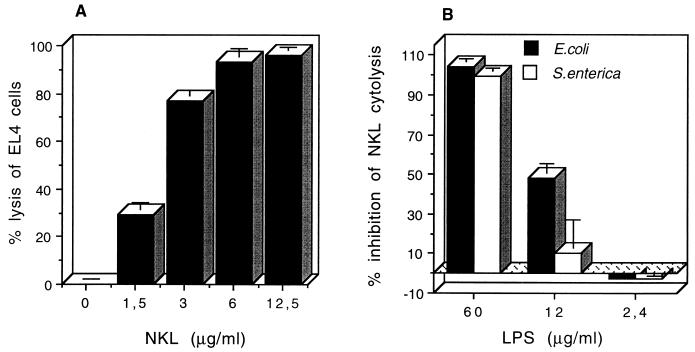
NKL cytolysis of EL4 cells and its inhibition by LPS. Chromium-labeled EL4 cells were seeded in microtiter plates at 20,000 cells/well. Cells were incubated with different concentrations of NKL (A) or with a fixed concentration of 12.5 μg of NKL/ml (B) in the presence of the indicated concentration of E. coli LPS or S. enterica serovar Typhimurium LPS. Data are means ± standard deviations of triplicate values.
FIG. 3
FIG. 3
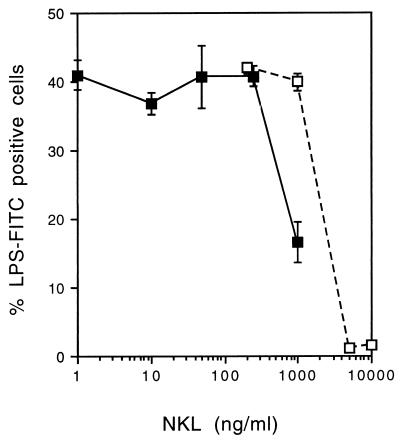
Neutralization of LPS binding. In a first experiment (filled squares), bone marrow cells were incubated with unlabeled LPS (10 ng/ml) in the presence of increasing concentrations of NKL. The expression of inducible LPS binding sites was analyzed by FACS after 18 h. In a second experiment (open squares), bone marrow cells already expressing LPS binding sites were incubated with LPS-FITC in the presence of 10% fetal calf serum and different concentrations of NKL. The binding of the labeled LPS was analyzed by FACS. Data are means ± standard deviations.

References

    1. Andersson M, Curstedt T, Jörnvall H, Johansson J. An amphipathic helical motif common to tumourolytic polypeptide NK-lysin and pulmonary surfactant polypeptide SP-B. FEBS Lett. 1995;362:328–332. - PubMed
    1. Andersson M, Gunne H, Agerberth B, Boman A, Bergman T, Sillard R, Jörnvall H, Mutt V, Olsson B, Wigzell H, Dagerlind Å, Boman G H, Gudmundsson H G. NK-lysin, a novel effector peptide of cytotoxic T and NK cells. Structure and cDNA cloning of the porcine form, induction by interleukin 2, antibacterial and antitumour activity. EMBO J. 1995;14:1615–1625. - PMC - PubMed
    1. Andersson, M., and B. Olsson. Unpublished data.
    1. Brade L, Brandenburg K, Kuhn H M, Kusumoto S, Macher I, Rietschel E, Brade H. The immunogenicity and antigenicity of lipid A are influenced by its physicochemical state and environment. Infect Immun. 1987;55:2636–2644. - PMC - PubMed
    1. Car B D, Eng V M, Schnyder B, Ozmen L, Huang S, Gallay P, Heumann D, Ague O, Ryffel B. Interferon gamma receptor deficient mice are resistant to endotoxic shock. J Exp Med. 1994;179:1437–1444. - PMC - PubMed

Publication types

MeSH terms

LinkOut - more resources