Current status of vivax malaria among civilians in Korea
- PMID: 9868889
- PMCID: PMC2732963
- DOI: 10.3347/kjp.1998.36.4.241
Current status of vivax malaria among civilians in Korea
Abstract
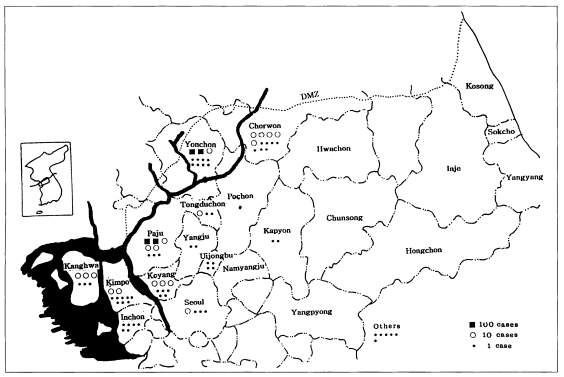
A result of national malaria surveillance in Korean civilians was described. Since a case of indigenous vivax malaria was detected in 1993, a total of 2,198 cases was confirmed by blood smear up to 1997. Of them, 1,548 cases were soldiers serving in the demilitarized zone (DMZ), while 650 cases were civilians. Number of civilian cases was 3 in 1994, 19 in 1995, 71 in 1996, and 557 in 1997. Of them, 239 were ex-soldiers who discharged after military service in the prevalent areas such as Paju, Yonchon, Kimpo, Kangwha, Tongduchon in Kyonggi-do and Chorwon in Kangwon-do while 308 patients were civilian residents in the prevalent areas. Seventy-two patients, living nationwide, had a history of visiting the prevalent areas during transmission season. Only 32 civilian patients denied any relation with the prevalent areas. As a whole, a half of the civilian cases was diagnosed when living in non-prevalent areas. Male patients in their twenties was the highest in number. Annual parasite index is steadily elevated in residents living in the prevalent areas. Monthly incidence showed an unimodal distribution, forming a peak in August. Ex-soldiers exhibited a delayed incubation ranging from 153 to 452 days (279 +/- 41 days). The time required for diagnosis was shortened from 23.6 days in 1995 to 13.7 days in 1997. Although the current epidemic of vivax malaria started as a border malaria, it seems highly probable that vivax malaria is established in the local areas and responsible for at least a part of transmission.
Figures
References
-
- Chai IH, Lim GI, Yoon SN, Oh WI, Kim SJ, Chai JY. Occurrence of tertian malaria in a male patient who has never been abroad. Korean J Parasitol. 1994;32(3):195–200. - PubMed
-
- Cho SY, Kong Y, Park SM, et al. Two vivax malaria cases detected in Korea. Korean J Parasitol. 1994;32(4):281–284. - PubMed
-
- Kim DC. Status of malaria infection in the Republic of Korea. Yonsei Rep Trop Med. 1982;13:59–62.
-
- Lee JM, Kim MY, Kim YR, et al. A small epidemiological survey for vivax malaria in Kimpo-gun, Kyonggi-do, Korea undertaken after detecting two consecutive cases. Korean J Parasitol. 1997;35(4):291–293. - PubMed
-
- Lee TU, Cho YJ, Paik YH. An epidemiohistorical study on malaria in Korea. Kyung Hee Univ Med J. 1994;19(2):205–220.
MeSH terms
LinkOut - more resources
Full Text Sources
Other Literature Sources
Research Materials