. 1999 Jan;65(1):241-50.
doi: 10.1128/AEM.65.1.241-250.1999.

Hybridization analysis of chesapeake bay virioplankton

Affiliations

Hybridization analysis of chesapeake bay virioplankton

KE Wommack et al. Appl Environ Microbiol. 1999 Jan.

Abstract

It has been hypothesized that, by specifically lysing numerically dominant host strains, the virioplankton may play a role in maintaining clonal diversity of heterotrophic bacteria and phytoplankton populations. If viruses selectively lyse only those host species that are numerically dominant, then the number of a specific virus within the virioplankton would be expected to change dramatically over time and space, in coordination with changes in abundance of the host. In this study, the abundances of specific viruses in Chesapeake Bay water samples were monitored, using nucleic acid probes and hybridization analysis. Total virioplankton in a water sample was separated by pulsed-field gel electrophoresis and hybridized with nucleic acid probes specific to either single viral strains or a group of viruses with similar genome sizes. The abundances of specific viruses were inferred from the intensity of the hybridization signal. By using this technique, a virus comprising 1/1,000 of the total virioplankton abundance (ca. 10(4) PFU/ml) could be detected. Titers of either a single virus species or a group of viruses changed over time, increasing to peak abundance and then declining to low or undetectable levels, and were geographically localized in the bay. Peak signal intensities, i.e., peak abundances of virus strains, were 10-fold greater than the low background level. Furthermore, virus species were found to be restricted to a particular depth, since probes specific to viruses from bottom water did not hybridize with virus genomes from surface water at the same geographical location. Overall, changes in abundances of specific viruses within the virioplankton were episodic, supporting the hypothesis that viral infection influences, if not controls, clonal diversity within heterotrophic bacteria and phytoplankton communities.


Figures
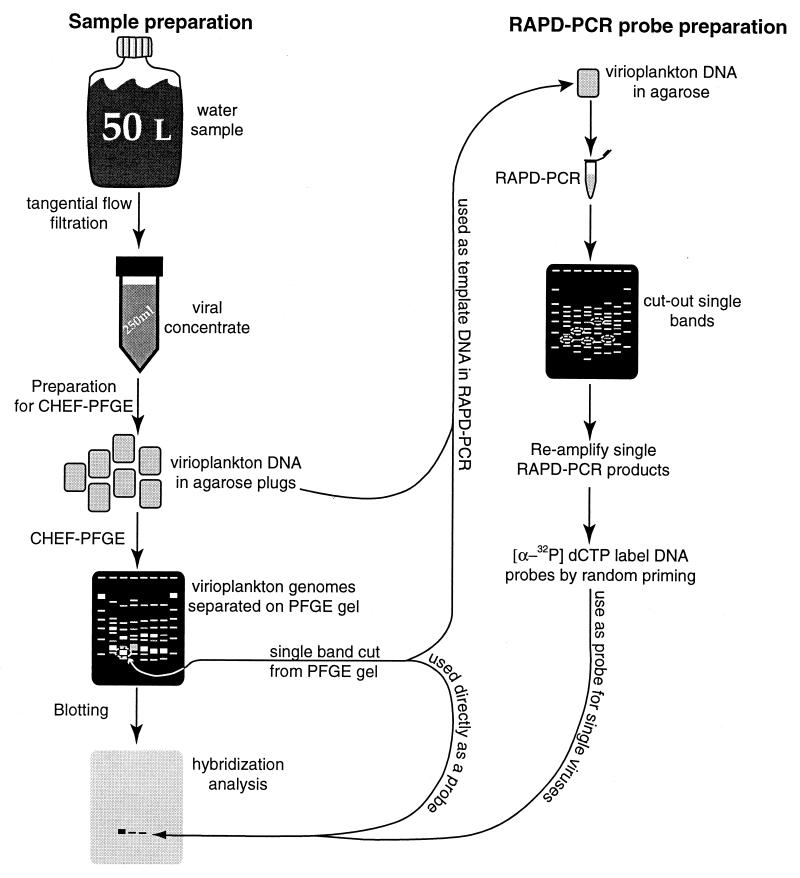
FIG. 1
FIG. 1
Flow chart of methods used in the hybridization analysis of Chesapeake Bay virioplankton.
FIG. 2
FIG. 2
Autoradiograms and hybridization intensity data. DNA from the rectangle in gel A was radiolabeled and hybridized against virioplankton PFGE fingerprints of Chesapeake Bay water samples. (A) Virioplankton PFGE of water samples from station 818. Lanes: 1, lambda marker; 2, August 1995; 3 to 5, May, June, and July 1996, respectively. (B to G) Autoradiograms of virioplankton PFGE fingerprints of water samples collected at stations 908, 858, 845, 818, 744, and 724, respectively. Lanes 1 to 3, May, June, and July 1996, respectively. The box in gel A outlines the subregion from which probe DNA was harvested. *, water sample from which the probe was generated.
FIG. 3
FIG. 3
Autoradiograms and hybridization data obtained by using RAPD-PCR-generated probe RAPD E. (A to F) Autoradiograms of virioplankton PFGE fingerprints of water samples collected at stations 908, 858, 845, 818, 744, and 724, respectively. Lanes 1 to 3, May, June, and July 1996, respectively. *, water sample from which the probe was generated.
FIG. 4
FIG. 4
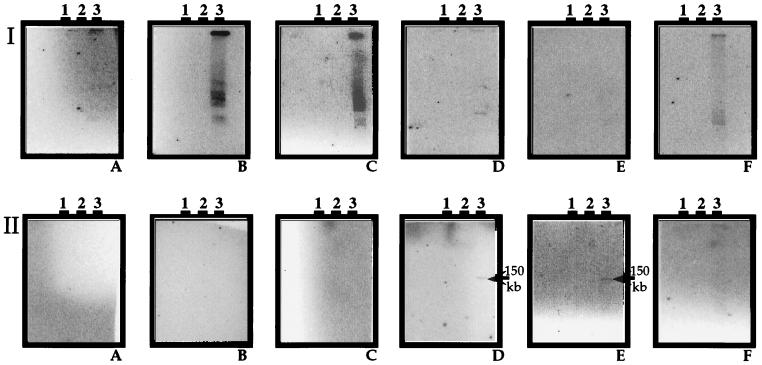
Autoradiograms of virioplankton PFGE fingerprints probed with RAPD 10 and RAPD 7. Probes were generated from virioplankton DNA of the water sample from station 724 in July 1996. (Series I) Southern blots probed with RAPD 10. (Series II) Southern blots probed with RAPD 7. (A to F) Water samples from stations 908, 858, 845, 818, 744, and 724, respectively. Lanes 1 to 3, May, June, and July 1996 samples, respectively.
FIG. 5
FIG. 5
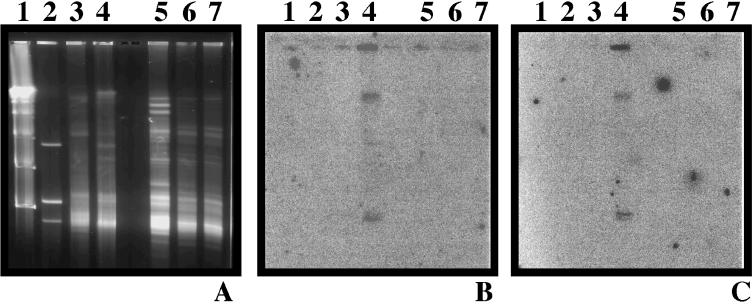
Autoradiograms and virioplankton PFGE fingerprints of virioplankton communities in surface and bottom waters. (A) Virioplankton PFGE fingerprint. (B) Autoradiogram of panel A probed with RAPD 1. (C) Autoradiogram of panel A probed with RAPD 2. Lanes: 1, molecular size markers of lambda phage concatamers; 2, 108 PFU each of genomic DNAs from three Chesapeake Bay bacteriophages; 3, virioplankton PFGE of water sample from station 834 in June 1996; 4, virioplankton PFGE of water sample from station 834B in June 1996; 5, 6, and 7, virioplankton PFGE of water samples at various depths from station 818 in July 1996.
FIG. 6
FIG. 6
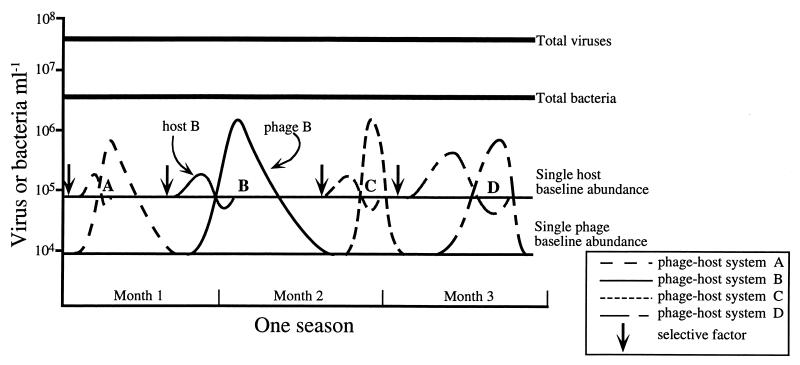
Conceptual model of virioplankton regulation of host community diversity. For each phage-host system, a selective factor stimulates growth of a specific host. An epidemic of phage infection begins at a critical threshold host cell density, and the abundance of a specific phage increases; thereafter, phage lysis causes the abundance of host cells to decline to background levels, preventing overdominance of a single host species. At the end of the epidemic, numbers of infective phage decline to a baseline level at a decay rate specific for each phage. It is also possible that the phage-host systems are temperate. Stimulation of host growth by a selective event causes curing of lysogeny and thus a release of phage. While abundances of specific hosts and phages change rapidly, the overall abundance of virio- and bacterioplankton is stable over longer, seasonal scales. A and D, moderate burst size of 10 to 50; B and C, large burst size of 100 to 500; A and B, low decay rate; C and D, high decay rate.

References

    1. Ackermann H W, DuBow M S. Viruses of prokaryotes: general properties of bacteriophages. Boca Raton, Fla: CRC Press, Inc.; 1987.
    1. Amann R I, Ludwig W, Schleifer K H. Phylogenetic identification and in situ detection of individual microbial cells without cultivation. Microbiol Rev. 1995;59:143–169. - PMC - PubMed
    1. Bergh O, Borsheim K Y, Bratbak G, Heldal M. High abundance of viruses found in aquatic environments. Nature. 1989;340:467–468. - PubMed
    1. Bratbak G, Egge J K, Heldal M. Viral mortality of the marine alga Emiliania huxleyi (Haptophyceae) and termination of algal blooms. Mar Ecol Prog Ser. 1993;93:39–48.
    1. Bratbak G, Heldal M, Thingstad T F, Tuomi P. Dynamics of virus abundance in coastal seawater. FEMS Microbiol Ecol. 1996;19:263–269.

LinkOut - more resources